An attack is considered a spoofing attack when an attacker injects traffic that appears to be sourced from a system other than the attacker's system itself. Spoofing is not specifically an attack, but spoofing can be incorporated into various types of attacks. Unlike other attack types, most spoofing can be easily prevented by well-known mitigation techniques.
當攻擊者注入的流量看起來像是來自攻擊者自身系統以外的其他系統時,這種攻擊就被視為偽造(spoofing)攻擊。偽造本身並不特別屬於一種攻擊,但它可以被納入各種類型的攻擊之中。與其他攻擊類型不同,大多數偽造攻擊都能透過廣為人知的緩解技術輕易防範。
There are several types of spoofing; here are some of them:
偽造有好幾種類型,以下列出其中一些:
- IP address spoofing: IP address spoofing is the most common type of spoofing. To perform IP address spoofing, attackers inject a source IP address in the IP header of packets different from their real IP addresses.IP 位址偽造:IP 位址偽造是最常見的偽造類型。攻擊者執行 IP 位址偽造時,會在封包的 IP 標頭中注入與自己真實 IP 位址不同的來源 IP 位址。
- MAC address spoofing: To perform MAC address spoofing, attackers use MAC addresses that are not their own. MAC address spoofing is generally used to exploit weaknesses at Layer 2 of the network.MAC 位址偽造:攻擊者執行 MAC 位址偽造時,會使用不屬於自己的 MAC 位址。MAC 位址偽造通常用於利用第 2 層網路的弱點。
- Application or service spoofing: An example is DHCP spoofing for IPv4, which can be done with either the DHCP server or the DHCP client. To perform DHCP server spoofing, the attacker enables a rogue DHCP server on a network. When a victim host requests a DHCP configuration, the rogue DHCP server responds before the authentic DHCP server. The victim is assigned an attacker-defined IPv4 configuration. An attacker can spoof many DHCP client requests from the client-side, specifying a unique MAC address per request. This process may exhaust the DHCP server's IPv4 address pool, leading to a DoS against valid DHCP client requests. Another simple example of spoofing at the application layer is an email from an attacker that appears to have been sourced from a trusted email account.應用程式或服務偽造:一個例子是針對 IPv4 的 DHCP 偽造,可以透過 DHCP 伺服器或 DHCP 用戶端來進行。若要執行 DHCP 伺服器偽造,攻擊者會在網路上啟用一台流氓 DHCP 伺服器。當受害主機請求 DHCP 設定時,流氓 DHCP 伺服器會搶在正牌 DHCP 伺服器之前回應,使受害端被指派攻擊者所定義的 IPv4 設定。攻擊者也可以從用戶端這一側偽造大量 DHCP 用戶端請求,每個請求指定不同的唯一 MAC 位址,這可能耗盡 DHCP 伺服器的 IPv4 位址池,導致正常 DHCP 用戶端請求遭到 DoS 攻擊。另一個應用層偽造的簡單範例,是一封看似來自可信電子郵件帳戶、實際上卻是攻擊者發送的電子郵件。
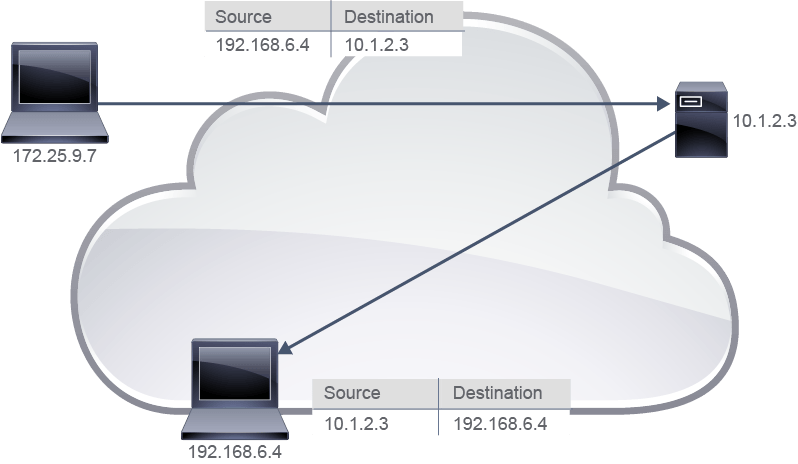
The following figure illustrates IPv4 address spoofing. Attacker 172.25.9.7 sends a packet to server 10.1.2.3 but specifies 192.168.6.4 as the source address of the packet. Server 10.1.2.3 sends its response packet to what it believes to be the originating system, host 192.168.6.4.
下圖說明 IPv4 位址偽造。攻擊者 172.25.9.7 向伺服器 10.1.2.3 傳送封包,但將封包的來源位址指定為 192.168.6.4。伺服器 10.1.2.3 會將回應封包傳送給它認為的發起系統,也就是主機 192.168.6.4。
Another example of spoofing is a land attack. The attack is named for the name of the file, land.c, used for the original source code that is compiled into an attack tool. In a land attack, the attacker sends a TCP SYN request using the same IP address and port as both the source and destination IP address and port. The IP address and port combination that is used is that of the target system. The target system replies to itself and, if the system is vulnerable, the response leads to a system crash.
另一個偽造的例子是 land 攻擊。這個攻擊之所以稱為 land,是因為原始攻擊工具的原始碼檔案名稱為 land.c。在 land 攻擊中,攻擊者傳送一個 TCP SYN 請求,其來源與目的 IP 位址及連接埠皆使用同一組(也就是目標系統的)IP 位址與連接埠組合。目標系統會回應給自己,若該系統存在弱點,這個回應就會導致系統當機。