Each network has both a physical and a logical topology. The physical topology of a network refers to the physical layout of the devices and cabling. The term node is commonly used when discussing topology diagrams. For networking topology diagrams, a node is a device.
每個網路都同時具有實體拓樸與邏輯拓樸。網路的實體拓樸指的是裝置與佈線的實體配置方式。討論拓樸圖時常使用節點(node)一詞。在網路拓樸圖中,一個節點就是一台裝置。
Two networks might have the same physical topology, but distances between nodes, physical interconnections, transmission rates, or signal types may differ. A physical topology must be implemented using the media that is appropriate for it. In wired networks, recognizing the type of cabling used is important in describing the physical topology. The figure represents some of the physical topologies that you may encounter.
兩個網路可能有相同的實體拓樸,但節點之間的距離、實體互連方式、傳輸速率或訊號類型可能不同。實體拓樸必須使用適合它的傳輸媒介來實作。在有線網路中,辨識所使用的佈線類型對描述實體拓樸很重要。下圖呈現你可能會遇到的幾種實體拓樸。
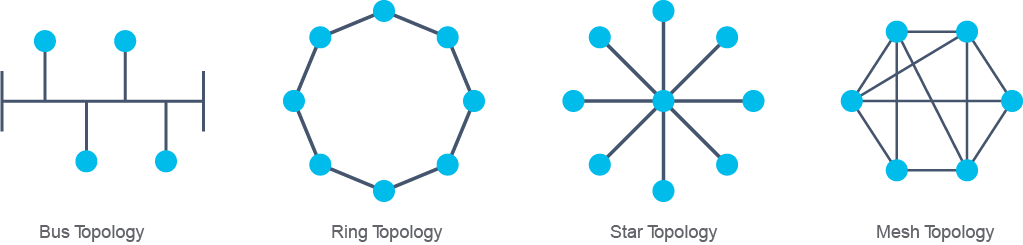
The following are the primary physical topology categories:
以下是主要的實體拓樸類別:
- Bus: In a bus topology, every workstation is connected to a common transmission medium, a single cable, which is called a backbone or bus. Therefore, each workstation is directly connected to every other workstation in the network. In previous bus topologies, computers and other network devices were connected to a central coaxial cable via connectors.匯流排(Bus):在匯流排拓樸中,每台工作站都連接到一條共用的傳輸媒介,也就是一條稱為骨幹(backbone)或匯流排的單一纜線。因此,每台工作站都直接與網路中的其他每一台工作站相連。在早期的匯流排拓樸中,電腦與其他網路裝置透過接頭連接到一條中央同軸電纜。
- Ring: In a ring topology, computers and other network devices are cabled in succession, and the last device is connected to the first one to form a circle or ring. Each device is connected to exactly two neighbors and has no direct connection to a third. When one node sends data to another, the data passes through each node that lies between them until it reaches the destination.環狀(Ring):在環狀拓樸中,電腦與其他網路裝置依序以纜線串接,最後一台裝置再連回第一台,形成一個圓圈或環。每台裝置正好與兩個鄰居相連,且與第三台裝置沒有直接連接。當一個節點傳送資料給另一個節點時,資料會經過兩者之間的每個節點,直到抵達目的地。
- Star: The most common physical topology is a star topology. In this topology, there is a central device to which all other network devices connect via point-to-point links. This topology is also called the hub and spoke topology. There are no direct physical connections among spoke devices. This topology includes star and extended star topologies. In an extended star topology, one or more spoke devices are replaced by a device with its own spokes. In other words, it is composed of multiple star topologies whose central devices are connected.星狀(Star):最常見的實體拓樸是星狀拓樸。在這種拓樸中,有一台中央裝置,所有其他網路裝置都透過點對點鏈路連接到它。這種拓樸也稱為軸輻式(hub and spoke)拓樸。輻端(spoke)裝置之間沒有直接的實體連接。這類拓樸包含星狀與延伸星狀(extended star)拓樸。在延伸星狀拓樸中,一或多台輻端裝置被替換為擁有自己輻端的裝置。換句話說,它由多個星狀拓樸組成,而這些星狀拓樸的中央裝置彼此相連。
- Mesh: In a mesh topology, a device can be connected to more than one other device. For one node to reach others, there are multiple paths available. Redundant links increase reliability and self-healing. In a full mesh topology, every node is connected to every other node. In partial mesh, certain nodes do not have connections to all other nodes.網狀(Mesh):在網狀拓樸中,一台裝置可以連接到多台其他裝置。一個節點要到達其他節點,有多條路徑可用。備援鏈路可提高可靠性與自我修復能力。在完全網狀(full mesh)拓樸中,每個節點都與其他每個節點相連。在部分網狀(partial mesh)中,某些節點並未與所有其他節點相連。
The logical topology is the path which data travels from one point in the network to another. The diagram depicts the logical topology between PC A and the Server. In this example, data does not follow the shortest physical path, which would go through two switches. The logical topology requires data to also travel through the router for the two devices to communicate. The same could be true for all other end devices. Logical topology would then be a star, where the router is a central device.
邏輯拓樸是資料從網路中的一點傳送到另一點所經過的路徑。下圖描繪 PC A 與伺服器(Server)之間的邏輯拓樸。在這個範例中,資料並未走最短的實體路徑(那會經過兩台交換器)。邏輯拓樸要求資料也必須經過路由器,這兩台裝置才能通訊。其他所有終端裝置也可能是同樣的情況。此時邏輯拓樸就會是星狀,而路由器是中央裝置。
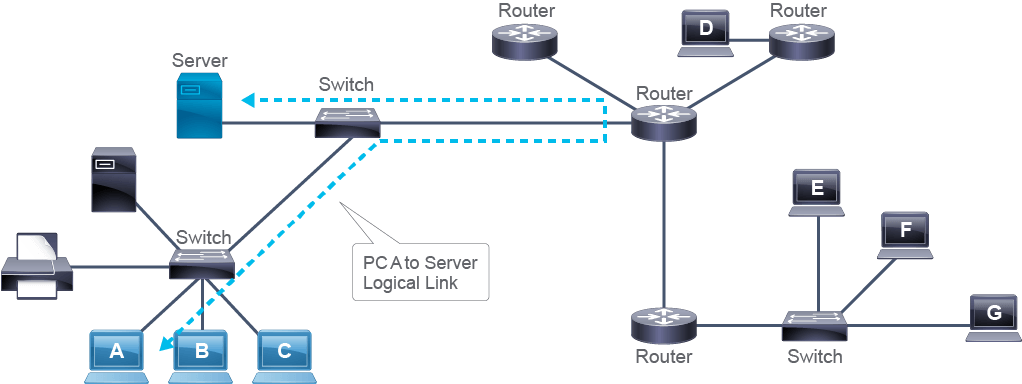
The logical and physical topology of a network can be of the same type. However, physical and logical topologies often differ. For example, an Ethernet hub is a legacy device that functions as a central device to which other devices connect in a physical star. The characteristic of a hub is that it "copies" every signal received on one port to all other ports. So, a signal sent from one node is received by all other nodes. This behavior is typical of a bus topology. Because data flow has the characteristics of a bus topology, it is a logical bus topology.
網路的邏輯拓樸與實體拓樸可以是同一種類型。然而,實體與邏輯拓樸經常不同。例如,Ethernet 集線器(hub)是一種舊式裝置,作為中央裝置讓其他裝置以實體星狀方式連接。集線器的特性是會把某一個連接埠收到的每個訊號「複製」到所有其他連接埠。因此,一個節點送出的訊號會被所有其他節點接收。這種行為是匯流排拓樸的典型特徵。由於資料流具有匯流排拓樸的特性,因此它是邏輯匯流排拓樸。
The logical topology is determined by the intermediary devices and the protocols chosen to implement the network. The intermediary devices and network protocols both determine how end devices access the media and how they exchange data.
邏輯拓樸由中介裝置以及實作網路時所選用的通訊協定決定。中介裝置與網路協定共同決定終端裝置如何存取媒介,以及如何交換資料。
A physical star topology in which a switch is the central device is by far the most common in implementations of LANs today. When using a switch to interconnect the devices, both the physical and the logical topologies are star topologies.
以交換器為中央裝置的實體星狀拓樸,是目前 LAN 實作中最為常見的方式。使用交換器來互連裝置時,實體拓樸與邏輯拓樸都是星狀拓樸。