All wireless radio signals are radio waves being sent from a source device to a destination device. Radio waves have their own properties in terms of physics. A radio wave traveling from point A to point B will be characterized by three properties. These are the Amplitude, Wavelength, and Frequency. Amplitude is referred to as the Power of the signal itself. Radio signals lose power when traveling over a distance. Therefore, there is a direct relation between increasing the power or amplitude of a signal and increasing the distance it travels. Wavelength is the distance from one peak in the wave to the next. Frequency is how often a wave will oscillate per second measured in Hertz [Hz]. Wavelength is inversely proportional to Frequency. Therefore, the higher the Frequency, the lower the Wavelength and vice versa.
所有無線訊號都是從來源裝置傳送到目的裝置的無線電波。無線電波在物理上有其自身的特性。一道從 A 點傳送到 B 點的無線電波,會由三種特性來描述,分別是振幅(Amplitude)、波長(Wavelength)與頻率(Frequency)。振幅指的是訊號本身的功率。無線訊號在傳輸一段距離後會損失功率,因此提高訊號的功率或振幅,與增加其傳輸距離之間存在直接關聯。波長是波形中一個波峰到下一個波峰之間的距離。頻率則是每秒波形振盪的次數,以赫茲(Hz)為單位。波長與頻率成反比,因此頻率越高,波長就越短,反之亦然。
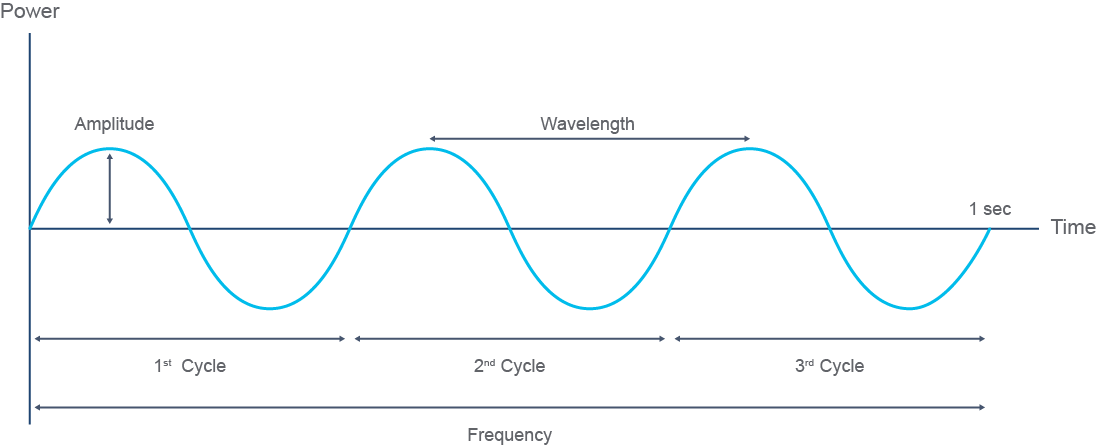
All wireless technology is based on the basics of wireless radio communication. These wireless communication basics are:
所有無線技術都是建立在無線電波通訊的基本原理之上。這些無線通訊的基本要點包括:
- All devices communicate at the same frequencies所有裝置都以相同的頻率進行通訊
- Overlapping and interfering communication needs to be regulated重疊與干擾的通訊需要受到規範
- Signal power from both source and destination affects the coverage area來源端與目的端的訊號功率都會影響涵蓋範圍
- Multiple different factors affect coverage area, such as the type of antenna and space around wireless devices多種不同因素會影響涵蓋範圍,例如天線類型與無線裝置周圍的空間
Shared Frequencies
共享頻率
All wireless technology sends radio waves on one of two main frequencies: 2.4GHz or 5GHz. Both of these frequencies are assigned by the IEEE as free use unlicensed frequencies, hence why most wireless devices use them. Wireless radio waves sent through the air all share the same space in which they travel. When multiple devices send wireless radio waves within the same time frame, this leads to overcrowded airspace that can lead to issues, such as signal collision. Let’s look at a simple analogy of vehicles on a road to clarify this. To travel across the land, we first create roads. These roads are where all vehicles will be located. For these vehicles to travel on the roads safely, the roads are divided into lanes. Each vehicle will travel in its lane to avoid a collision. In this example, the land is the wireless airspace and the roads are the 2.4GHz and 5GHz frequencies that we use. Similar to how roads are divided into lanes, so are the frequencies divided into channels. The vehicles are the wireless signals that contain data that is being sent from a source to a destination.
所有無線技術都會在兩個主要頻率之一傳送無線電波:2.4GHz 或 5GHz。這兩個頻率都由 IEEE 指定為免費使用的免授權頻率,這也是大多數無線裝置採用它們的原因。透過空中傳送的無線電波都共用相同的傳輸空間。當多個裝置在同一時間內傳送無線電波時,會導致空中資源過度擁擠,進而引發訊號碰撞等問題。讓我們用道路上車輛的簡單類比來說明。要在陸地上移動,我們首先會建造道路,所有車輛都會行駛在這些道路上。為了讓這些車輛能安全地在道路上行駛,道路會被劃分為車道,每輛車都在自己的車道上行駛以避免碰撞。在這個例子中,陸地就是無線空中資源,道路就是我們使用的 2.4GHz 與 5GHz 頻率。如同道路被劃分為車道一樣,頻率也被劃分為頻道(channel)。車輛則代表了承載著從來源端傳送到目的端資料的無線訊號。
Access points and clients are not the only devices that use radio signals. Bluetooth devices, gaming consoles, wireless headphones, wireless cameras, and more all use wireless signals. These devices all share the same frequencies, which need to be regulated.
無線基地台(AP)與用戶端並非唯一使用無線訊號的裝置。藍牙裝置、遊戲主機、無線耳機、無線攝影機等都使用無線訊號。這些裝置全都共用相同的頻率,因此需要受到規範。
Regulation
規範
When devices share the same frequencies and airspace, communication overlap occurs. This could lead to collisions and interference between the signals, which means traffic that is lost while en route to the destination. Because of this, wireless radio communication must be regulated. Regulatory bodies, such as the IEEE, FCC, and ETSI all play their part in regulating wireless radio communication. The IEEE, for example, has created the 802.11 wireless standard and its amendments, which are used by access points and WLAN clients. The FCC and ETSI regulate signal power, frequency usage, and antenna usage in the U.S. and EU respectively.
當裝置共用相同的頻率與空中資源時,通訊重疊便會發生,這可能導致訊號之間發生碰撞與干擾,意味著在傳輸過程中流量會遺失。正因如此,無線電波通訊必須受到規範。IEEE、FCC 與 ETSI 等監理機構都在無線電波通訊的規範上扮演各自的角色。舉例來說,IEEE 制定了 802.11 無線標準及其修正版本,供無線基地台與 WLAN 用戶端使用。FCC 與 ETSI 則分別在美國與歐盟規範訊號功率、頻率使用與天線使用。
Signal Power
訊號功率
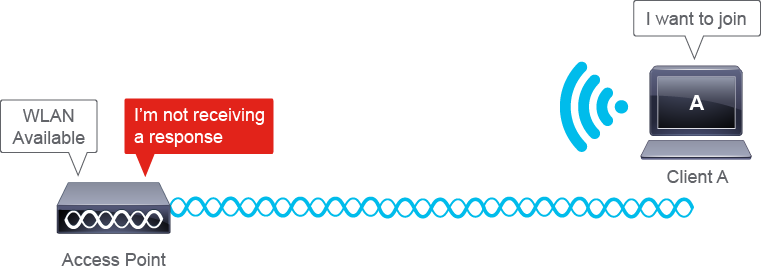
The power of the signal being transmitted affects the amplitude of the wave, which therefore affects the distance that the signal travels. This directly affects the overall wireless coverage of these devices. It is important to understand that this works both ways, meaning that the power of the signal from the transmitting device and receiving device both affect the coverage. For example, if an Access Point (AP) is transmitting at full power, the transmitted signal can reach client A. However, if client A is transmitting back at the lower signal strength, the AP will not receive anything back. This leads to a situation where client A is within the coverage area of the AP but it is still unable to communicate with it.
傳送訊號的功率會影響波形的振幅,進而影響訊號傳輸的距離,這也直接影響了這些裝置整體的無線涵蓋範圍。必須了解的是,這是雙向的,也就是說傳送裝置與接收裝置雙方的訊號功率都會影響涵蓋範圍。例如,若無線基地台(AP)以全功率傳送訊號,該訊號可以到達用戶端 A;但如果用戶端 A 以較低的訊號強度傳送回應,AP 將無法接收到任何回傳訊號。這會導致用戶端 A 雖然位於 AP 的涵蓋範圍內,卻仍然無法與其通訊的情況。
Other Factors
其他因素
Signal power is not the only factor affecting coverage for access points. The type of antennas used in devices directly affects the coverage area. There are many types of antennas that are used in wireless devices.
訊號功率並非影響無線基地台涵蓋範圍的唯一因素。裝置所使用的天線類型也會直接影響涵蓋範圍。無線裝置所使用的天線種類繁多。
Some of these antenna types are:
以下是部分天線類型:
- Omnidirectional Antennas全向性天線(Omnidirectional Antennas)
- Directional Antennas指向性天線(Directional Antennas)
- Patch Antennas平板天線(Patch Antennas)
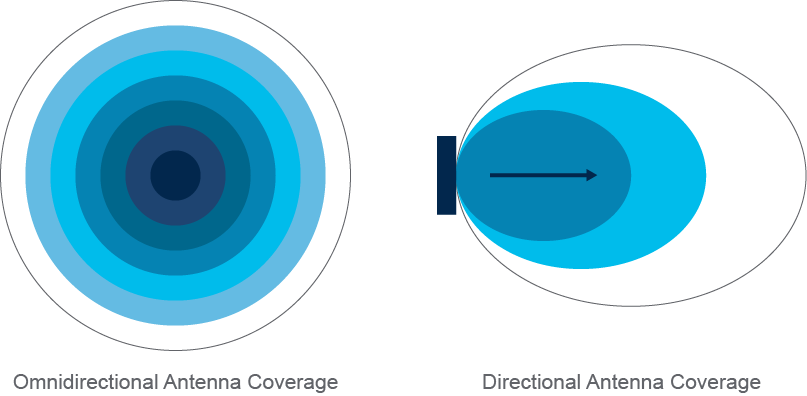
For example, omnidirectional antennas provide coverage in a spherical area around the antenna while a directional antenna provides coverage only in the specific direction that it faces.
舉例來說,全向性天線會在天線周圍提供球形的涵蓋範圍,而指向性天線則只會朝其所面對的特定方向提供涵蓋範圍。
Radio signals are also affected by the space in which they travel and objects within the area. Any waves traveling through a medium are affected by phenomena, such as:
無線訊號也會受到其傳輸空間及區域內物體的影響。任何在介質中傳輸的波都會受到以下現象的影響:
- Absorption: Signal power degrades when moving from a less dense to a higher dense medium (moving through air and then passing through a solid object in its path).吸收(Absorption):當訊號從密度較低的介質移動到密度較高的介質時(例如先穿過空氣、再穿過路徑上的固體物件),訊號功率會衰減。
- Reflection: Radio waves partially bounce off objects that they come in contact with.反射(Reflection):無線電波接觸到物體時會有部分反彈回來。
- Refraction: Some mediums, such as liquids, will alter the path that the wave is taking as it passes through.折射(Refraction):某些介質,例如液體,會在波形穿過時改變其行進路徑。
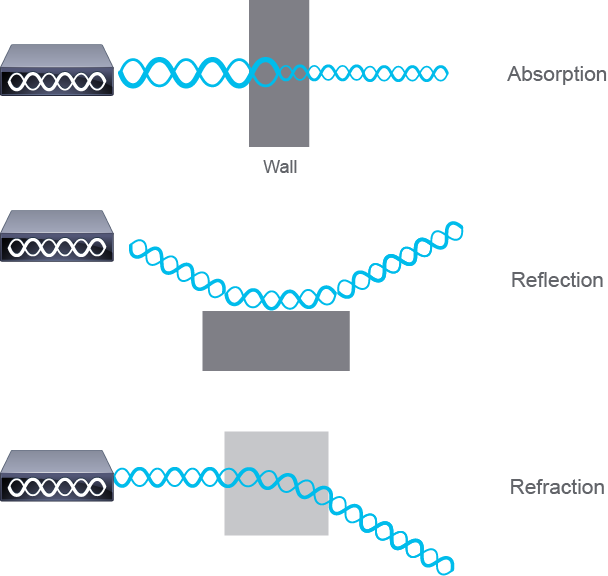
Radio waves hitting walls in their path will have their power absorbed by the wall. The amount of power absorbed by the wall differs based on the material that the wall is made of. For example, a dry concrete wall differs from a glass wall. Electrical equipment, such as generators, construction tools, and microwaves cause electromagnetic interference with the radio signals. Weather will also affect radio signals. For example, on a rainy day, the humidity in the air increases. This makes the radio signals more likely to refract. All these different situations combined have an effect to reduce the overall coverage area of APs.
無線電波在路徑中碰到牆壁時,其功率會被牆壁吸收。牆壁所吸收的功率多寡,取決於牆壁所使用的材質,例如乾燥的混凝土牆與玻璃牆的吸收程度就不同。發電機、施工工具與微波爐等電氣設備會對無線訊號造成電磁干擾。天氣也會影響無線訊號,例如在下雨天,空氣中的濕度會增加,這會讓無線訊號更容易發生折射。以上種種不同情況綜合起來,都會降低無線基地台整體的涵蓋範圍。