QoS offers intelligent network services that, when correctly applied, help to provide consistent, predictable performance.
服務品質(QoS)提供智慧型網路服務,若能正確套用,可協助提供一致且可預測的效能。
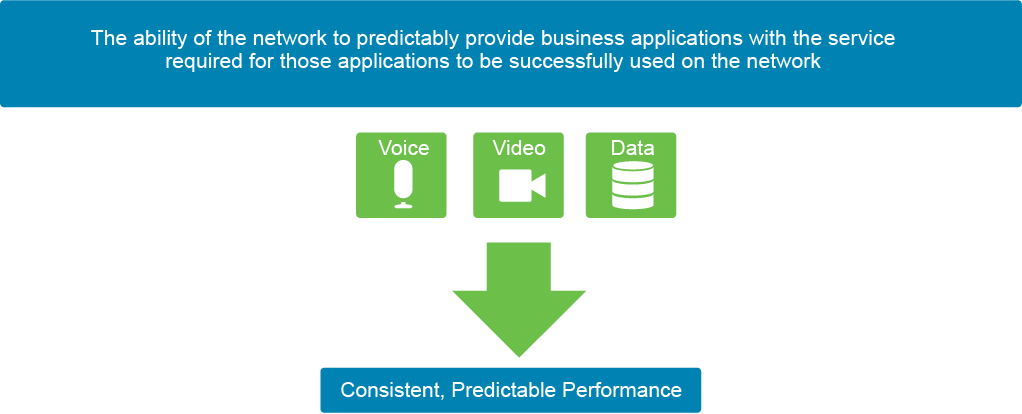
The goal of QoS is a better and more predictable network service with dedicated bandwidth, controlled jitter and latency, and improved loss characteristics as required by the business applications. QoS achieves these goals by providing tools for managing network congestion, shaping network traffic, using expensive wide-area links more efficiently, and setting traffic policies across the network.
QoS 的目標是依業務應用程式的需求,提供更佳且更可預測的網路服務,包括保留頻寬、控制抖動與延遲,以及改善遺失特性。QoS 藉由提供管理網路壅塞、整形網路流量、更有效地運用昂貴的廣域網路鏈路,以及在整個網路上設定流量政策等工具,來達成這些目標。
QoS gives priority to some sessions over other sessions. Packets of delay-sensitive sessions bypass queues of packets belonging to nondelay-sensitive sessions. When queue buffers overflow, packets are dropped on the session that can recover from the loss or those sessions that can be eliminated with minimal business impact.
QoS 會讓某些工作階段的優先權高於其他工作階段。對延遲敏感的工作階段之封包,會跳過屬於非延遲敏感工作階段的封包佇列。當佇列緩衝區溢位時,系統會捨棄那些能夠承受遺失,或可以在對業務影響最小的情況下被捨棄的工作階段封包。
To make space for applications that are important and cannot tolerate loss without affecting the end-user experience, QoS manages other sessions based on QoS policy decisions that you implement in the network. Managing refers to selectively delaying or dropping packets when contention arises.
為了替重要且無法容忍遺失(否則會影響終端使用者體驗)的應用程式騰出空間,QoS 會根據你在網路中實作的 QoS 政策決策,管理其他工作階段。所謂「管理」,是指在發生爭用時選擇性地延遲或捨棄封包。
QoS is not a substitute for bandwidth. If the network is congested, packets will be dropped. QoS allows the administrators control on how, when, and what traffic is dropped during congestion.
QoS 並非頻寬的替代品。若網路發生壅塞,封包仍會被捨棄。QoS 讓管理員能夠控制在壅塞發生時,哪些流量會以何種方式、在何時被捨棄。