Network architecture is the result of planning and design. Network design requires considerable technical knowledge and experience. Design decisions are based on network analysis, which is based on quality and capacity observations. Principal objectives of network design are providing scalability and resiliency, while meeting the needs of organizations.
網路架構是規劃與設計的成果。網路設計需要相當豐富的技術知識與經驗。設計決策取決於網路分析,而網路分析則以品質與容量觀察為基礎。網路設計的主要目標是在滿足組織需求的同時,提供可擴充性與韌性。
A scalable network can expand quickly to support new users and applications without impacting the performance of the service being delivered to existing users. In a well-designed network, it is relatively easy to add new elements. Scalability can be achieved through modular structuring. It is done by constructing smaller units, called modules, which are added or removed as required.
可擴充網路能夠迅速擴充,以支援新使用者與應用程式,而不影響現有使用者的服務效能。在設計良好的網路中,新增元素相對容易。可擴充性可透過模組化架構達成,做法是建構稱為模組的較小單元,並依需求新增或移除。
A resilient network is both highly available and highly reliable. Such a network allows for almost immediate data flow recovery in the event of a failure of any component. An area of the network that is impacted by a device or network service problem is called a failure domain. Small, limited failure domains are a characteristic of a good design. High reliability is achieved by choosing correctly sized devices with all the needed features in the correct location. It also involves appropriate dimensioning of interlinks in terms of required bandwidth. Resilient networks employ redundancy at multiple levels—device level, interlink level, software, and processes level.
韌性網路兼具高可用性與高可靠性。這類網路在任何元件故障時,都能幾乎立即恢復資料流。網路中因裝置或網路服務問題而受影響的區域稱為故障網域。良好設計的特徵之一就是故障網域範圍小且有限。透過在正確位置選用尺寸適當且具備所需功能的裝置,即可達成高可靠性;同時也涉及依所需頻寬適當配置各連結的容量。韌性網路會在裝置層級、連結層級、軟體及流程層級等多個層級採用備援。
Security and quality of service (QoS) are common requirements in network design. Designs that meet these requirements incorporate measures for physically securing the devices and measures to protect information. A network designed with QoS requirements in mind controls how and when network resources are used by applications both under normal operating conditions and when congestions occur.
安全性與服務品質(QoS)是網路設計中常見的需求。符合這些需求的設計會納入保護裝置實體安全的措施,以及保護資訊的措施。以 QoS 需求為考量所設計的網路,能在正常運作情況下以及發生壅塞時,控制應用程式使用網路資源的方式與時機。
The modular design approach addresses both scalability and resiliency. The term module can apply to hardware (a line card in modular switches), a network design building block (a switch block in a hierarchical architecture), or a functional segment of a network (data center, service block, internet edge). Modularity also facilitates implementation of services and helps in troubleshooting.
模組化設計方法同時解決了可擴充性與韌性的問題。「模組」一詞可指硬體(模組化交換器中的線卡)、網路設計的建構區塊(階層式架構中的交換器區塊),或網路的功能區段(資料中心、服務區塊、網際網路邊界)。模組化也有助於服務的實作,並協助疑難排解。
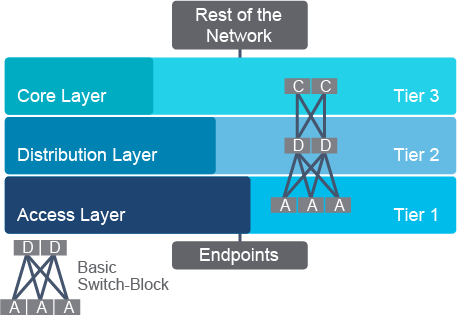
Cisco tiered models propose a hierarchical design. They divide the network into discrete layers or tiers. Each tier provides specific functions that help to select and optimize the right network hardware, software, and features. Hierarchical models apply to LAN and WAN design. Examples of tiered models are the three-tier hierarchicaland spine-and-leafmodels.
Cisco 的階層式模型提出了一種分層設計方式,將網路劃分為離散的層級。每一層都提供特定功能,有助於選擇並最佳化正確的網路硬體、軟體與功能。階層式模型適用於 LAN 與 WAN 設計。階層式模型的範例包括三層式階層模型與spine-and-leaf模型。
The following figure represents a three-tiered architectural model, which has three distinct functional layers, each playing a specific role.
下圖呈現三層式架構模型,具有三個不同的功能層,各自扮演特定角色。
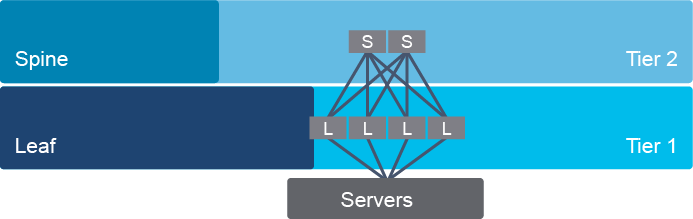
The spine-and-leaf model is a two-tiered architecture where servers connect to the leaf switches in the topology, while the spine layer is the backbone that interconnects all leaf switches.
spine-and-leaf 模型是一種二層式架構,伺服器連接到拓樸中的 leaf 交換器,而 spine 層則是互連所有 leaf 交換器的骨幹。
A model that helps in the design of a larger enterprise network, is the Cisco Enterprise Architecture model.
Cisco 企業架構模型是有助於設計較大型企業網路的模型。
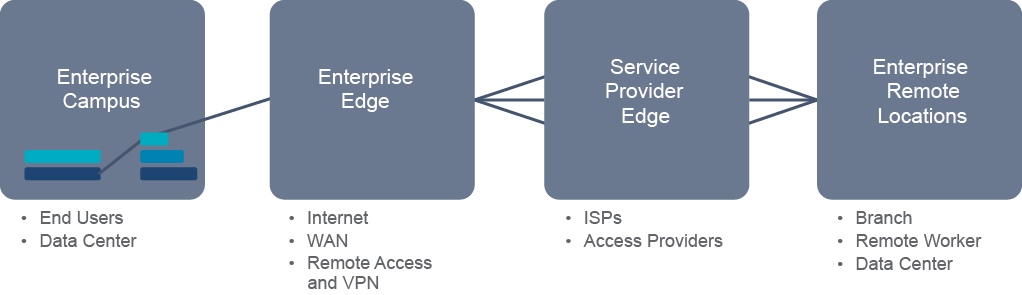
This design is based on modules that correspond to a specific place in the network or a specific function they have in a network. These modules represent areas that have different physical or logical connectivity. Basic modules in the Cisco Enterprise Architecture model are Enterprise Campus, Enterprise Edge, and Service Provider Edge. Larger network designs also include a module for Remote Locations, such as Enterprise Branch, Remote Data Center, and Remote Workers.
此設計以模組為基礎,各模組對應網路中的特定位置或特定功能。這些模組代表具有不同實體或邏輯連線方式的區域。Cisco 企業架構模型的基本模組包括企業園區(Enterprise Campus)、企業邊界(Enterprise Edge)與服務供應商邊界(Service Provider Edge)。較大型的網路設計還會包含遠端據點模組,例如企業分公司、遠端資料中心與遠端工作者。
Issues in a Poorly Designed Network
設計不良的網路所引發的問題
A poorly designed network has increased support costs, reduced service availability, and limited support for new applications and solutions. A suboptimal performance directly affects end users and their access to resources.
設計不良的網路會增加支援成本、降低服務可用性,並限制對新應用程式與解決方案的支援。次佳的效能會直接影響終端使用者及其對資源的存取。
One symptom of a poorly designed network is congestion. Congestion is a result of suboptimal traffic flow or the selection of inappropriate devices or links. The most probable cause of any problem is an inadequate or outdated design.
設計不良網路的其中一個徵兆是壅塞。壅塞是流量流動不佳,或選用不當裝置或連結所導致的結果。任何問題最有可能的成因都是設計不良或過時。
Even when a network is first implemented following a validated architecture, in time, its design can turn into an undesirable network. This situation might result from nonsystematic, uncontrolled expansion, or in other words, a liberal addition of devices without overall consideration of the design.
即使網路最初是依照經過驗證的架構建置,隨著時間推移,其設計仍可能演變為不理想的網路。這種情況可能源自非系統性、不受控制的擴充,換句話說,就是在未整體考量設計的情況下,隨意新增裝置。
The importance of careful design can be seen by examining an example of a flat network that does not follow a structured design. Devices in a flat design are connected to each other using Layer 2 switches without the use of VLANs. All devices on this network share the available bandwidth and all are members of the same broadcast domain. They are usually also in the same IP subnet. Layer 2 devices that build a flat network provide little opportunity to control broadcasts or to filter undesirable traffic. As more devices and applications are added to a flat network, network performance degrades until the network becomes unpredictable, slow, or even unusable.
從一個未遵循結構化設計的扁平網路範例,即可看出周全設計的重要性。扁平設計中的裝置僅透過第 2 層交換器互相連接,未使用 VLAN。此網路上的所有裝置共用可用頻寬,且都屬於同一個廣播網域,通常也位於同一個 IP 子網路中。組成扁平網路的第 2 層裝置幾乎無法控制廣播或篩選不需要的流量。隨著愈來愈多裝置與應用程式加入扁平網路,網路效能會逐漸下降,直到網路變得難以預測、緩慢,甚至無法使用。
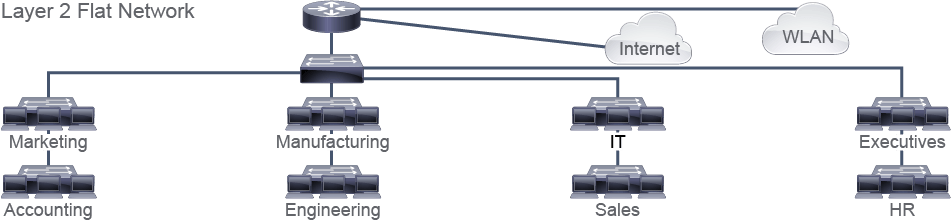
These issues are often found in poorly designed networks:
設計不良的網路經常出現下列問題:
- Large broadcast domains: Broadcasts exist in every network. Many applications and network operations use broadcasts to function properly. Therefore, you cannot eliminate them completely. In the same way that avoiding large failure domains involves clearly defining boundaries, broadcast domains should also have clear boundaries. They should also include a limited number of devices to minimize the negative effect of broadcasts.過大的廣播網域:廣播存在於每個網路中,許多應用程式與網路操作都需要利用廣播才能正常運作,因此無法完全消除廣播。正如避免過大故障網域須明確劃定界線一樣,廣播網域也應有明確的界線,並包含有限數量的裝置,以將廣播帶來的負面影響降到最低。
- Management and support difficulties:A poorly designed network may be disorganized, poorly documented, and lack easily identifiable traffic paths. These issues can make support, maintenance, and troubleshooting time-consuming and difficult.管理與支援困難:設計不良的網路可能雜亂無章、文件不全,且缺乏易於辨識的流量路徑。這些問題會使支援、維護與疑難排解變得耗時且困難。
- Possible security vulnerabilities:A switched network that has been designed with little attention to security requirements at network access points can compromise the integrity of the entire network.潛在的安全弱點:若交換式網路在設計時對網路存取點的安全需求關注不足,可能危害整個網路的完整性。
- Failure domains: One of the reasons to implement an effective network design is to reduce the extent of problems when they occur. When you do not clearly define Layer 2 and Layer 3 boundaries, a failure in one network area can have a far-reaching effect.故障網域:實施有效網路設計的原因之一,是在問題發生時縮小影響範圍。若未明確界定第 2 層與第 3 層的邊界,網路某一區域的故障可能造成深遠的影響。
A poor network design always has a negative effect that is exacerbated over time. A poorly designed network can quickly become a support and cost burden for its users.
設計不良的網路一律會產生負面影響,且會隨時間而加劇。設計不良的網路可能很快就會成為使用者的支援與成本負擔。