Cisco Catalyst Center is a Cisco SDN controller for enterprise networks—branch, campus, and WAN. Cisco Catalyst Center can program the network in an automated way, based on the application requirements, and it represents a basis for intent-based networking.
Cisco Catalyst Center 是專為企業網路(分支、園區與 WAN)設計的 Cisco SDN 控制器。Cisco Catalyst Center 能根據應用程式需求,以自動化方式對網路進行程式化設定,是意圖式網路的基礎。
Challenges with Traditional Networks
傳統網路面臨的挑戰
The following trends in traditional networks present significant challenges:
傳統網路存在以下趨勢,帶來重大挑戰:
- There are more users and endpoints, therefore, more VLANs and subnets. It becomes more difficult to keep track of all those groups and segment them.使用者與端點的數量增加,因此 VLAN 與子網路也隨之增加,要追蹤並區隔這些群組變得更加困難。
- There are so many different types of users coming into the network that it is becoming more complex to configure. Multiple steps are required to give users credentials and support connectivity choices.進入網路的使用者類型繁多,使設定變得更加複雜。要提供使用者憑證並支援連線方式,需要多個步驟。
- As users and devices move around the network, policy is not consistent. As a result, it is difficult to find users when they move around and troubleshoot issues.隨著使用者與裝置在網路中移動,政策無法保持一致,因此在使用者移動時難以找到他們並排除相關問題。
Cisco Catalyst Center is a Cisco SDN controller for enterprise networks—branch, campus, and WAN. Cisco Catalyst Center can program the network in an automated way, based on the application requirements, and it represents a basis for intent-based networking.
Cisco Catalyst Center 是專為企業網路(分支、園區與 WAN)設計的 Cisco SDN 控制器。Cisco Catalyst Center 能根據應用程式需求,以自動化方式對網路進行程式化設定,是意圖式網路的基礎。
What is Cisco Catalyst Center?
什麼是 Cisco Catalyst Center?
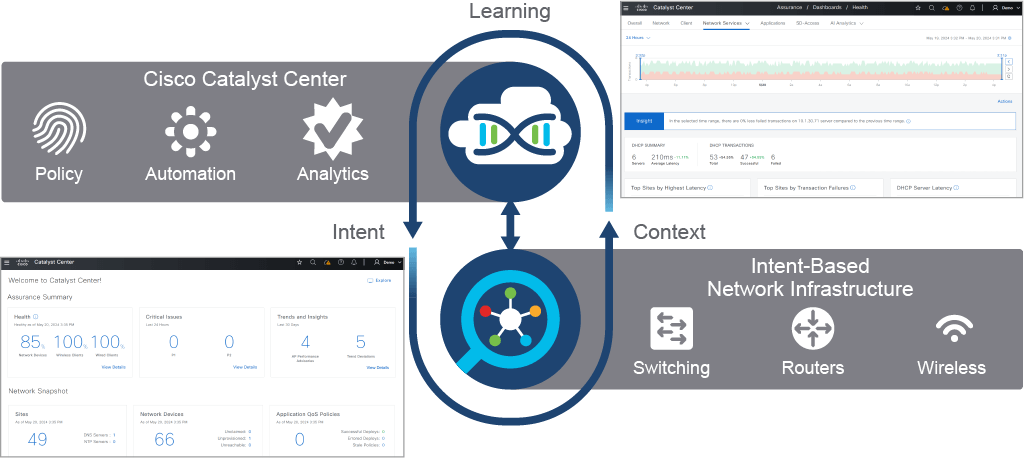
Cisco Catalyst Center provides open programmable APIs for policy-based management and security through a single controller. It provides an abstraction of the network, which leads to simplification of the management of network services. This approach automates what has typically been a tedious manual configuration.
Cisco Catalyst Center 透過單一控制器提供開放且可程式化的 API,用於以政策為基礎的管理與安全性。它提供網路的抽象化,進而簡化網路服務的管理,將原本繁瑣的手動設定自動化。
The controller consistently provisions network services and provides rich network information and analytics across all network resources: both LAN and WAN, wired and wireless, and physical and virtual infrastructures. This visibility allows you to optimize services and support new applications and business models. The controller bridges the gap between open, programmable network elements and the applications that communicate with them, automating the provisioning of the entire end-to-end infrastructure.
控制器能對網路服務提供一致的佈建,並在所有網路資源(不論 LAN 或 WAN、有線或無線、實體或虛擬基礎設施)中提供豐富的網路資訊與分析。這種可視性讓您能最佳化服務,並支援新的應用程式與商業模式。控制器彌合了開放、可程式化網路元件與跟這些元件溝通的應用程式之間的落差,讓整個端到端基礎設施的佈建自動化。
Intent-based Networking
意圖式網路
SDN is a foundational building block of intent-based networking. The good news for SDN practitioners is that intent-based networking addresses shortfalls of SDN. For example, the automated translation of business policies to IT (security and compliance) policies, automated deployment of these policies, and the assurance that if the network is not providing the requested policies, they will receive proactive notification. Intent-based networking adds context, learning, and assurance capabilities, by tightly coupling policy with intent. The "intent" enables the expression of both business purpose and network context through abstractions, which are then translated to achieve the desired outcome for network management. SDN is purposely focused on instantiating change in network functions.
SDN 是意圖式網路的基礎元件。對 SDN 從業人員而言,好消息是意圖式網路能彌補 SDN 的不足之處,例如自動將商業政策轉譯為 IT(安全性與合規性)政策、自動部署這些政策,並在網路未能提供所要求的政策時,主動發出通知。意圖式網路透過將政策與意圖緊密結合,加入了情境理解、學習與保證能力。「意圖」透過抽象化來表達商業目的與網路情境,再轉譯為網路管理所需達成的結果。SDN 則專注於落實網路功能的變更。
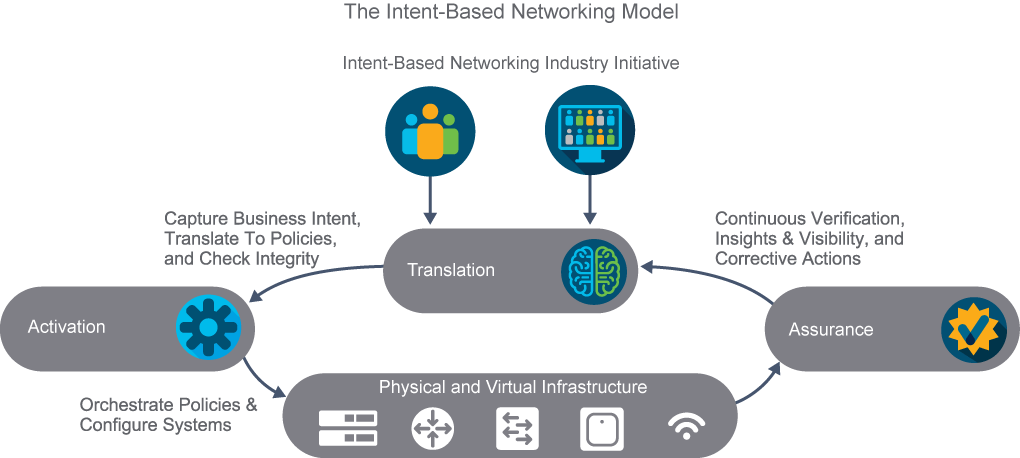
There are three foundational elements of intent-based networking:
意圖式網路有三項基本元素:
- The translation element enables the operator to focus on what they want to accomplish, and not how they want to accomplish it. The translation element takes the desired intent and translates it to associated network policies and security policies. Before applying these new policies, the system checks if these policies are consistent with the already deployed policies or if they will cause any inconsistencies.轉譯元素讓操作人員能專注於想要達成什麼,而不必費心於如何達成。轉譯元素會將所需的意圖轉譯為相關的網路政策與安全政策。在套用這些新政策之前,系統會檢查它們是否與已部署的政策一致,或是否會造成衝突。
- Once approved, the new policies are then activated (automatically deployed across the network).一經核准,新政策便會啟用(自動部署到整個網路)。
- With assurance, an intent-based network performs continuous verification that the network is operating as intended. Any discrepancies are identified; a root-cause analysis can recommend fixes to the network operator. The operator can then "accept" the recommended fixes to be automatically applied, before another cycle of verification. The assurance does not occur at discrete times in an intent-based network. Continuous verification is essential since the state of the network is constantly changing. Continuous verification assures network performance and reliability.透過保證,意圖式網路會持續驗證網路是否依照預期運作。系統會找出任何差異,並可由根本原因分析提出修復建議,操作人員可以「接受」建議的修復方式,讓系統自動套用,接著再進行下一輪驗證。在意圖式網路中,保證並非只在特定時間點發生。由於網路狀態不斷變化,持續驗證是不可或缺的,能確保網路的效能與可靠性。
Cisco Catalyst Center Features
Cisco Catalyst Center 功能
Cisco Catalyst Center provides a single dashboard for managing and controlling the enterprise network. It uses workflows to simplify provisioning of user access policies combined with advanced assurance capabilities. It also provides open platform APIs, adapters, and SDKs for integration with business applications and orchestrators.
Cisco Catalyst Center 提供單一儀表板,用於管理與控制企業網路,並透過工作流程簡化使用者存取政策的佈建,搭配進階的保證能力。它同時提供開放的平台 API、轉接器與 SDK,方便與商業應用程式及協調器整合。
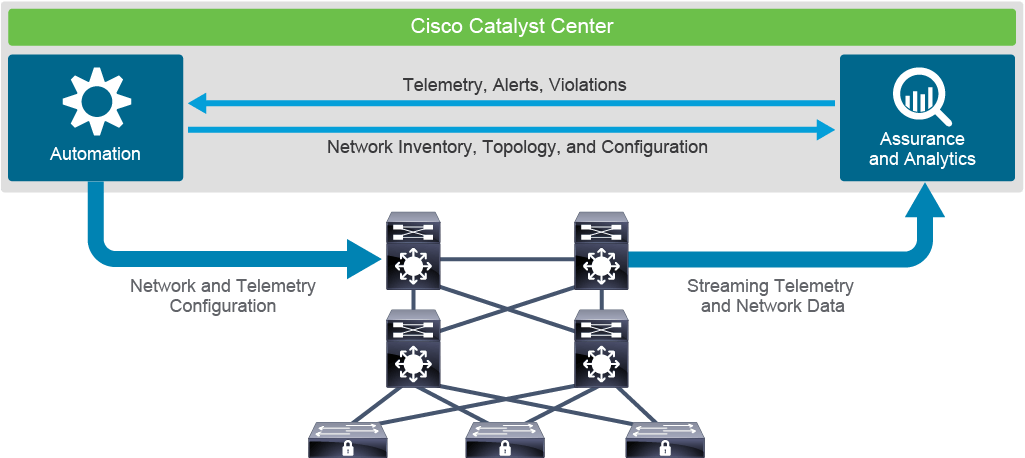
How does Cisco Catalyst Center work?
Cisco Catalyst Center 如何運作?
The enterprise programmable network infrastructure sends data to the Cisco Catalyst Center virtual appliance. The appliance activates features and capabilities on your network devices using the Cisco Catalyst software. Everything is managed from the Cisco Catalyst Center dashboard.
企業可程式化網路基礎設施會將資料傳送到 Cisco Catalyst Center 虛擬設備。該設備使用 Cisco Catalyst 軟體,在您的網路裝置上啟用各項功能與能力。所有管理作業皆透過 Cisco Catalyst Center 儀表板進行。
Cisco Catalyst Center is a robust software solution that is designed to simplify and enhance network management. It offers a variety of deployment options to meet the diverse operational requirements of different organizations:
Cisco Catalyst Center 是一套穩健的軟體解決方案,旨在簡化並強化網路管理,並提供多種部署選項以符合不同組織的多元營運需求:
- Cloud-based deployments: Cisco Catalyst Center Virtual Appliance can be deployed in major public cloud environments such as AWS (expected to be supported in Microsoft Azure and Google Cloud in the future) offering flexibility and scalability. This approach eliminates the need for on-premises hardware, reduces capital expenditure, and provides access to advanced cloud features.雲端式部署:Cisco Catalyst Center 虛擬設備可部署在主要的公有雲環境(例如 AWS,未來預計支援 Microsoft Azure 與 Google Cloud),提供彈性與可擴充性。這種方式不需要地端硬體,可降低資本支出,並能使用進階雲端功能。
- On-premises virtualization: For organizations preferring on-premises solutions, Cisco Catalyst Center supports deployment on virtual environments like VMware ESXi (expected to support Microsoft Hyper-V, and KVM in the future). This enables customers to leverage existing virtual infrastructure, enhancing resource utilization and reducing costs.地端虛擬化:對於偏好地端解決方案的組織,Cisco Catalyst Center 支援部署在 VMware ESXi 等虛擬環境(未來預計支援 Microsoft Hyper-V 與 KVM),讓客戶能運用既有的虛擬基礎設施,提升資源使用效率並降低成本。
- Physical appliance: Cisco offers the option to deploy Cisco Catalyst Center as a physical appliance for customers who need dedicated hardware. This option is ideal for environments with strict security or performance requirements, ensuring maximum control and reliability.實體設備:Cisco 也提供將 Cisco Catalyst Center 部署為實體設備的選項,適合需要專屬硬體的客戶。此選項最適合對安全性或效能有嚴格要求的環境,能確保最大程度的控制與可靠性。