Before physically connecting to a service provider network, an enterprise needs to choose the type of WAN service or connectivity that it requires.
在實體連接到服務供應商網路之前,企業需要先選擇所需的 WAN 服務或連線類型。
WAN networks have undergone many technological changes. When the internet was first developed, it was built on the existing telecom infrastructure, which was intended for telephony voice traffic. The telephony network, known under the term Public Switched Telephone Network (PSTN), was constructed over a period of 100 years. Its reach was global and reached very remote areas. Most of the subscriber telephone links—that is, local loops or last-mile—installed copper cabling. The international traffic and traffic within service providers networks was using the fiber optic cabling and satellite systems.
WAN 網路經歷了許多技術變革。網際網路最初開發時,是建構在既有、原本為電話語音流量設計的電信基礎設施之上。這個電信網路稱為公眾交換電話網路(Public Switched Telephone Network,PSTN),耗時 100 年建置而成,涵蓋範圍遍及全球,甚至延伸到非常偏遠的地區。大多數用戶端的電話線路(也就是本地迴路或最後一哩)採用銅纜安裝。服務供應商網路內部與國際流量則使用光纖與衛星系統傳輸。
The first WAN connectivity options and technologies leveraged the existing physical infrastructure, because installing cables for the new WAN infrastructure represents most of the cost in developing a new WAN network. The proliferation of the internet and internet-related business activities economically justified the investment into new WAN infrastructure. During the late 1990s, many telecommunications companies invested into building an optical fiber global network. Today, the optical fiber network has largely replaced the copper-based network, and it extends to many user homes—that is, it replaces the traditional copper cabling also on the local loop.
最早的 WAN 連線選項與技術是利用既有的實體基礎設施,因為為新 WAN 基礎設施鋪設線纜是建置新 WAN 網路的主要成本來源。網際網路及相關商業活動的蓬勃發展,在經濟上證明了投資新 WAN 基礎設施是值得的。1990 年代末期,許多電信公司投入建置光纖全球網路。如今,光纖網路已大致取代銅纜網路,並延伸到許多用戶家中,也就是在本地迴路上也取代了傳統的銅纜。
When discussing WANs, it can be useful to distinguish its geographical elements, as WAN technologies vary in these different geographical elements. A WAN network consist of:
討論 WAN 時,區分其地理元素會很有幫助,因為 WAN 技術在不同地理元素上有所差異。WAN 網路由以下部分組成:
- The local-loop/last-mile network represents end-user connections to the service providers. Local-loop connections terminate at service provider's access nodes, which are the first points that aggregate traffic from multiple end-users. A local loop can connect only one subscriber with a service provider access node—such as fiber point-to-point telephone lines, or it can connect a number of subscribers with a service provider access node " such as coaxial cable TV systems. The local loop is the smallest geographical WAN element. The local loop was traditionally built using copper cabling but is currently being replaced with optical fiber.本地迴路/最後一哩網路,代表終端使用者與服務供應商之間的連線。本地迴路連線終止於服務供應商的存取節點,這是彙集多個終端使用者流量的第一個節點。本地迴路可以只連接一個用戶與一個服務供應商存取節點,例如點對點光纖電話線路,也可以連接多個用戶到一個服務供應商存取節點,例如同軸纜線電視系統。本地迴路是 WAN 中地理範圍最小的元素,傳統上以銅纜建置,目前正逐漸被光纖取代。
- Backhaul networks, which connect multiple access nodes of the service provider’s network. Service provider backhaul networks can span over smaller areas, such as municipalities, or larger areas, such as countries and regions. Backhaul networks are also connected to Internet service providers and to the backbone network. Backhaul networks can be implemented using optical fiber, or using microwave links. Local loops together with backhaul networks are sometimes called access networks. Examples of access networks are the telephone network, cable TV network, and cellular network. These example access networks provide both access to the internet, and access to another communication service, such as telephony, or TV.回程網路(backhaul network),連接服務供應商網路中的多個存取節點。服務供應商的回程網路涵蓋範圍可大可小,小至市鎮,大至國家與地區。回程網路也連接到網際網路服務供應商及骨幹網路,可以使用光纖或微波鏈路實作。本地迴路與回程網路合稱為存取網路。存取網路的例子包括電話網路、有線電視網路及行動網路。這些存取網路範例同時提供網際網路存取及其他通訊服務的存取,例如電話或電視。
- The backbone network, or backbone, interconnects service provider’s networks. Backbone networks are large, high-capacity networks with a very large geographic span, owned and managed by governments, universities, and commercial entities. Backbone networks are connected among themselves to create a redundant network. Other service providers can connect to the backbone directly or through another service provider. Backbone network service providers are also called Tier-1 providers. Backbone networks are built mainly using optical fiber.骨幹網路(backbone),連接各服務供應商的網路。骨幹網路是大型、高容量、地理涵蓋範圍極廣的網路,由政府、大學及商業實體擁有並管理。骨幹網路彼此互連以建立備援網路。其他服務供應商可以直接或透過另一個服務供應商連接到骨幹網路。骨幹網路服務供應商也稱為第一層(Tier-1)供應商,主要以光纖建置。
Overview of WAN Connectivity Options
WAN 連線選項總覽
There are many options for implementing WAN solutions. These options differ in technology, bandwidth, and cost.
實作 WAN 解決方案有許多選項,這些選項在技術、頻寬及成本上各有差異。
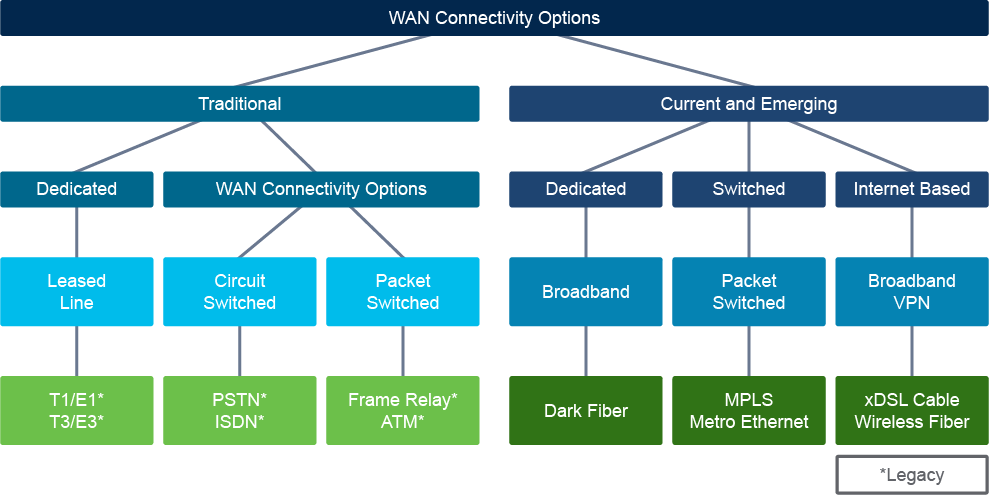
The diagram in the figure gives an overview of available WAN connectivity options, taking into consideration also the traditional, now mostly legacy connection options, that were built to leverage the telephone network.
圖中顯示了可用 WAN 連線選項的總覽,也考量了傳統上利用電話網路建置、現今多半已屬過時的連線選項。
Both the traditional, and current and emerging WAN connectivity options can be broadly classified into the following:
傳統與現行及新興的 WAN 連線選項可大致分類如下:
- Dedicated communication links, which provide permanent dedicated connections using point-to-point links with various capacities that are limited only by the underlying physical facilities and the willingness of enterprises to pay for these dedicated lines. A point-to-point link provides a pre-established WAN communications path from the customer premises through the provider network to a remote destination. They are simple to implement and provide high quality and permanent dedicated capacity. They are generally costly and have fixed capacity, which makes them inflexible.專用通訊鏈路,提供以點對點鏈路實現的永久專用連線,其容量僅受限於底層實體設施及企業願意為這類專線支付的費用。點對點鏈路提供從客戶端場所經由供應商網路到達遠端目的地的預先建立通訊路徑,實作簡單且提供高品質、永久的專用容量。缺點是通常成本高昂且容量固定,缺乏彈性。
- Switched communication links can be either circuit-switched or packet-switched. It is important to differentiate between the two switching models:交換式通訊鏈路可以是電路交換或封包交換,區分這兩種交換模式很重要:
- Circuit-switched communication: Circuit switching establishes a dedicated virtual connection, called a circuit, between a sender and a receiver. The connection through the network of the service provider is established dynamically, before communication can start, using signaling that varies for different technologies. During transmission, all communication takes the same path. The fixed capacity allocated to the circuit is available for the duration of the connection, regardless of whether there is information to transmit or not. Computer network traffic can be bursty in nature. Because the subscriber has sole use of the fixed capacity allocation, switched circuits are generally not suited for data communication. Examples of circuit-switched communication links are PSTN analog dialup and Integrated Services Digital Network (ISDN).電路交換通訊:電路交換在發送端與接收端之間建立一條稱為電路的專用虛擬連線。透過服務供應商網路的連線是在通訊開始前,使用因技術而異的信令動態建立的。傳輸期間,所有通訊都走同一條路徑。分配給該電路的固定容量在連線期間都可使用,無論是否有資料要傳輸。電腦網路流量本質上具有突發性;由於用戶獨佔使用固定容量分配,交換電路通常不適合資料通訊。電路交換通訊鏈路的例子包括 PSTN 類比撥接及整合服務數位網路(Integrated Services Digital Network,ISDN)。
- Packet-switched communication: Using circuit switching does not make efficient use of the allocated fixed bandwidth due to the data flow fluctuations. In contrast to circuit switching, packet switching segments data into packets that are routed over a shared network. Packet-switching networks do not require a dedicated circuit to be established, and they allow many pairs of nodes to communicate over the same channel. Packet-switched communication links include Ethernet WAN (Metro Ethernet), Multiprotocol Label Switching (MPLS), legacy Frame Relay, and legacy Asynchronous Transfer Mode (ATM).封包交換通訊:由於資料流量波動,使用電路交換無法有效利用分配到的固定頻寬。相對於電路交換,封包交換將資料切割成封包,經由共享網路路由傳送。封包交換網路不需要建立專用電路,也允許多對節點透過同一通道通訊。封包交換通訊鏈路包括乙太網路 WAN(Metro Ethernet)、多協定標籤交換(Multiprotocol Label Switching,MPLS)、已過時的訊框中繼(Frame Relay)及非同步傳輸模式(Asynchronous Transfer Mode,ATM)。
- Internet-based communication links: Instead of using a separate WAN infrastructure, enterprises today commonly take advantage of the global internet infrastructure for WAN connectivity. Previously, the internet was not a viable option for a WAN connection due to many security risks and lack of SLA, that is, the lack of adequate performance guarantees. Nowadays, with the development of VPN technologies, the internet has become one of the most common connection types that is cheap and secure. Internet WAN connection links include various broadband access technologies, such as fiber, DSL, cable, and broadband wireless. They are usually combined with VPN technologies to provide security. Other access options are cellular (or mobile) networks and satellite systems.以網際網路為基礎的通訊鏈路:現今企業普遍不再使用獨立的 WAN 基礎設施,而是利用全球網際網路基礎設施來實現 WAN 連線。過去因為存在許多安全風險,且缺乏服務等級協議(SLA),也就是缺乏適當的效能保證,網際網路並非可行的 WAN 連線選項。如今隨著 VPN 技術的發展,網際網路已成為最常見、便宜又安全的連線類型之一。網際網路 WAN 連線鏈路包括各種寬頻存取技術,例如光纖、DSL、纜線及寬頻無線,通常會搭配 VPN 技術以提供安全性。其他存取選項包括行動(蜂巢式)網路及衛星系統。
Each of the WAN technologies provides advantages and disadvantages for the customer. When choosing an appropriate WAN connection, consider whether to use the internet based public connections or connections implemented within nonpublic service providers networks. Internet-based connections are readily available, flexible, and a cheaper option that can be made secure using technologies, such as VPNs. Connections within a service provider’s network guarantee security and performance.
每種 WAN 技術對客戶而言各有優缺點。選擇合適的 WAN 連線時,需考量是要使用以網際網路為基礎的公用連線,還是在非公用的服務供應商網路內實作的連線。以網際網路為基礎的連線容易取得、有彈性且較便宜,可以使用 VPN 等技術來確保安全。而服務供應商網路內的連線則能保證安全性與效能。
Another element to consider when deciding about WAN connections, is the number of nodes you need to interconnect. Also, consider the traffic requirements and QoS for each of the required connections. If traffic is sensitive to delays, such as is voice or video, private dedicated or switched connections might be better. One of the factors that will limit your choices is what connection options are locally available. In remote areas, you might have only satellite access at your disposal. Since WAN costs can be significant, your operating budget will also influence your choice.
決定 WAN 連線時另一個要考量的元素,是需要互連的節點數量。此外,也要考量每個連線所需的流量需求與 QoS。若流量對延遲敏感,例如語音或視訊,私有的專用或交換式連線可能較為合適。限制你選擇的因素之一,是當地可用的連線選項。在偏遠地區,你可能只有衛星存取可用。由於 WAN 成本可能相當可觀,你的營運預算也會影響選擇。
| SwitchedSwitched | GG |
| DedicatedDedicated | AA |
| Internet BasedInternet Based | CC |
| Leased LineLeased Line | BB |
| Circuit SwitchedCircuit Switched | FF |
| Frame Relay/ATMFrame Relay/ATM | DD |
| MPLS/Metro EthernetMPLS/Metro Ethernet | EE |
Traditional WAN Connectivity Options
傳統 WAN 連線選項
WAN technologies that emerged at the beginning of the data communications era were developed so they could leverage the existing global telephone network. Nowadays, most of them are considered legacy. However, even today, you might still encounter situations in which these legacy connectivity options might be the only ones available.
資料通訊時代早期出現的 WAN 技術,是為了利用既有的全球電話網路而開發的。如今其中大多數已被視為過時技術,但即使在今天,你仍可能遇到只有這些傳統連線選項可用的情況。
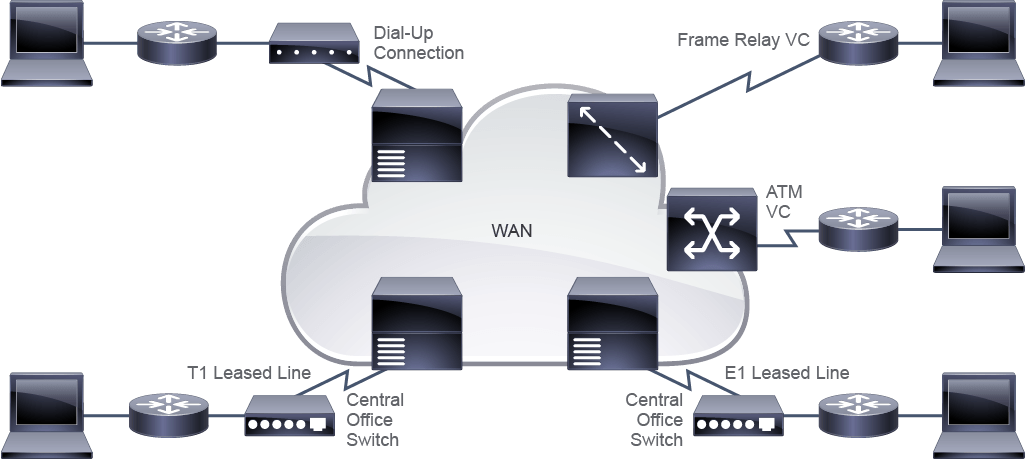
The figure illustrates legacy WAN connectivity options.
此圖說明傳統 WAN 連線選項。
Leased lines are an example of legacy dedicated communication links, which have existed since the early 1950s, and for this reason, are referred to by different names such as leased circuits, serial link, serial line, or point-to-point link. The term leased line refers to the fact that the organization pays a monthly lease fee to a service provider to use the line. Leased lines are available in different capacities and are generally priced based on the bandwidth required and the distance between the two connected points.
專線(leased line)是傳統專用通訊鏈路的一個例子,自 1950 年代初期便已存在,因此也有租用電路、序列鏈路、序列線路,或點對點鏈路等不同名稱。專線一詞源自於組織須向服務供應商支付月租費以使用該線路。專線有不同容量可供選擇,通常依所需頻寬及兩連接點之間的距離計費。
In North America, service providers use the T-carrier system to define the digital transmission capability of a serial copper media link, while Europe uses the E-carrier system. For instance, a T1 link supports 1.544 Mbps, an E1 link supports 2.048 Mbps, a T3 link supports 43.7 Mbps, and an E3 link supports 34.368 Mbps. The copper cable physical infrastructure has largely been replaced by an optical fiber network. Transmission rates in optical fiber networks are given in terms of Optical Carrier (OC) transmission rates, which define the digital transmitting capacity of a fiber optic network.
在北美,服務供應商使用 T 載波系統來定義序列銅纜媒介鏈路的數位傳輸能力,而歐洲則使用 E 載波系統。舉例來說,T1 鏈路支援 1.544 Mbps,E1 鏈路支援 2.048 Mbps,T3 鏈路支援 43.7 Mbps,E3 鏈路支援 34.368 Mbps。銅纜實體基礎設施已大致被光纖網路取代。光纖網路的傳輸速率以光載波(Optical Carrier,OC)傳輸速率表示,用以定義光纖網路的數位傳輸容量。
The two types of legacy circuit-switched WAN technologies are the PSTN analog dialup connection and ISDN connections. Both connections utilize the copper cabling at the local loop, to connect the equipment in the subscriber premises to the Central Office, which acts as the access node of the service provider network.
兩種傳統的電路交換 WAN 技術是 PSTN 類比撥接連線及 ISDN 連線。兩者皆利用本地迴路的銅纜,將用戶端場所的設備連接到中央局(Central Office),中央局在服務供應商網路中扮演存取節點的角色。
- In the dialup connections, binary computer data is transported through the voice telephone network using a device called modem. The physical characteristics of the cabling and its connection to the PSTN limit the rate of the signal to less than 56 kbps. The legacy dialup WAN connection is a solution for remote areas with limited WAN access options.在撥接(dialup)連線中,二進位電腦資料透過一種稱為數據機(modem)的裝置,經由語音電話網路傳輸。線纜的實體特性及其與 PSTN 的連接,將訊號速率限制在低於 56 kbps。傳統撥接 WAN 連線是 WAN 存取選項有限的偏遠地區的一種解決方案。
- ISDN technology enables the local loop of a PSTN to carry digital signals, resulting in higher capacity switched connections. The capacity ranges from 64 kbps to 2.048 Mbps.ISDN 技術使 PSTN 的本地迴路能夠傳輸數位訊號,從而實現容量更高的交換式連線,容量範圍從 64 kbps 到 2.048 Mbps。
The examples of legacy packet switched networks are Frame Relay and ATM.
傳統封包交換網路的例子有訊框中繼與 ATM。
- Frame Relay is a Layer 2 technology that defines virtual circuits (VCs). Each VC represents a logical end-to-end link mapped over the physical service provider’s Frame Relay WAN. An enterprise can use a single router interface to connect to multiple sites using different VCs. VCs are used to carry both voice and data traffic between a source and a destination. Each frame carries the identification of the VC that it should be transferred over. This identification is called a Data-Link Connection Identifier (DLCI). VCs are configurable, offering flexibility in defining WAN connections.訊框中繼(Frame Relay)是一種第 2 層技術,定義了虛擬電路(VC)。每個 VC 代表映射於服務供應商實體訊框中繼 WAN 之上的邏輯端對端鏈路。企業可以使用單一路由器介面,透過不同的 VC 連接到多個站點。VC 用於在來源與目的地之間承載語音與資料流量。每個訊框都攜帶其應傳送所經 VC 的識別碼,稱為資料鏈結連線識別碼(Data-Link Connection Identifier,DLCI)。VC 可設定,為定義 WAN 連線提供了彈性。
- ATM technology is built on a cell-based architecture rather than on a frame-based architecture. ATM cells are always a fixed length of 53 bytes. Small, fixed-length cells are well suited for carrying voice and video traffic because this traffic is intolerant of delay. Video and voice traffic do not have to wait for larger data packets to be transmitted. The 53-byte ATM cell is less efficient than the bigger frames and packets. A typical ATM line needs almost 20 percent greater bandwidth than Frame Relay to carry the same volume of network layer data. ATM was designed to be extremely scalable and to support link speeds of T1/E1 to optical fiber network speeds of 622 Mbps and faster. ATM also defines VCs and also allows multiple VCs on a single interface to the WAN network.ATM 技術建立在以信元(cell)為基礎的架構上,而非以訊框為基礎。ATM 信元固定長度為 53 位元組。體積小、長度固定的信元非常適合承載語音與視訊流量,因為這類流量無法容忍延遲,語音及視訊流量不需要等待較大的資料封包傳輸完畢。不過,53 位元組的 ATM 信元效率不如較大的訊框及封包,一般 ATM 線路要承載與訊框中繼相同資料量,需要多出約 20% 的頻寬。ATM 設計上具有高度可擴充性,可支援從 T1/E1 到 622 Mbps 以上光纖網路速率的鏈路速度。ATM 也定義了 VC,並允許在單一 WAN 介面上使用多個 VC。
Current and Emerging WAN Connectivity Options
現行與新興 WAN 連線選項
WAN technologies and approaches are constantly evolving. Some technologies that were once commonplace, like dialup, ISDN and Frame Relay, are rarely seen today. The following figure depicts WAN technologies that you are likely to encounter today.
WAN 技術與作法持續不斷演進,一些曾經普遍的技術,如撥接、ISDN 及訊框中繼,如今已不常見。下圖描繪了你今日可能會遇到的 WAN 技術。
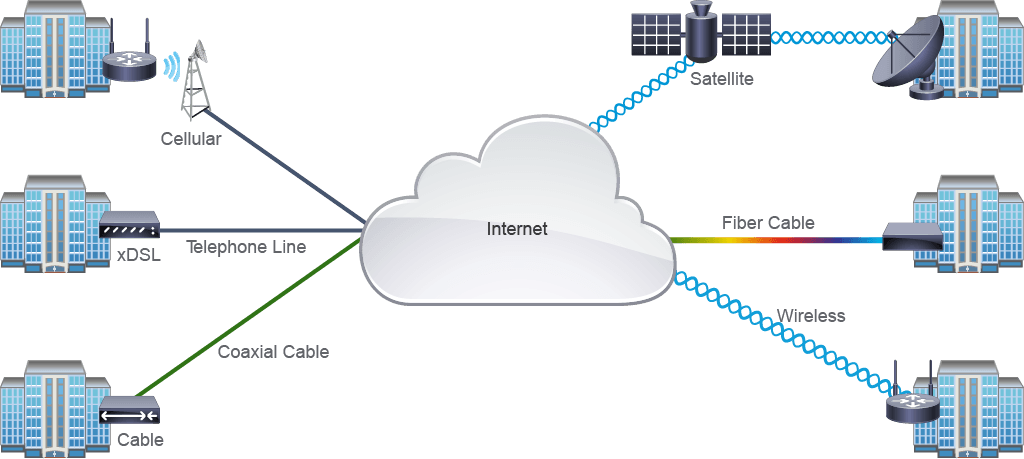
Multiprotocol Label Switching
多協定標籤交換
Service providers build networks by using different underlying technologies, the most popular being MPLS. MPLS is an IETF standard that defines a packet label-based switching technique, which was originally devised to perform fast switching in the core of IP networks. This technique helped carriers and large enterprises scale their networks as increasingly large routing tables become more complex to manage. Service providers began implementing MPLS in 2001 as a way to allow enterprises to create end-to-end circuits across any type of transport medium using any available WAN technology.
服務供應商使用不同的底層技術建置網路,其中最普及的是 MPLS。MPLS 是一項 IETF 標準,定義了以封包標籤為基礎的交換技術,原本設計用於在 IP 網路核心中執行快速交換。這項技術有助於電信業者及大型企業擴充其網路規模,因為日益龐大的路由表越來越難以管理。服務供應商自 2001 年開始導入 MPLS,讓企業能夠使用任何可用的 WAN 技術,跨任何類型的傳輸媒介建立端對端電路。
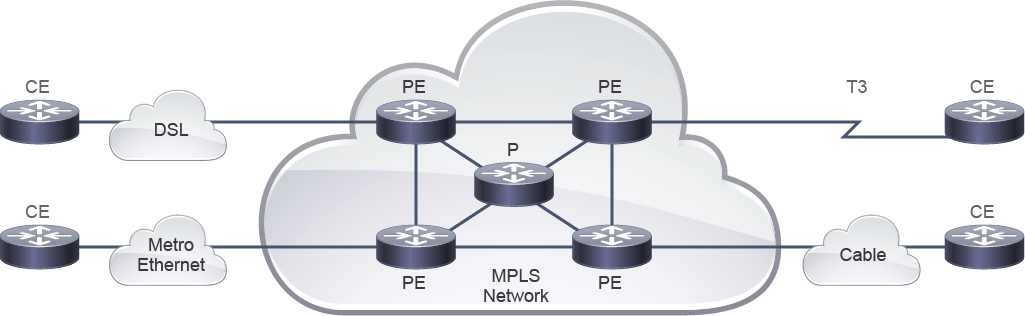
MPLS is an architecture that combines the advantages of Layer 3 routing with the benefits of Layer 2 switching.
MPLS 是一種結合第 3 層路由優勢與第 2 層交換優點的架構。
The multiprotocol in the name means that the technology is able to carry any protocol as payload data. Payloads may be IPv4 and IPv6 packets, Ethernet, or DSL, and so on. This means that different sites can connect to the provider’s network using different access technologies.
名稱中的「多協定」表示這項技術能夠攜帶任何協定作為承載資料,承載資料可能是 IPv4 及 IPv6 封包、乙太網路,或 DSL 等等,這代表不同站點可以使用不同的存取技術連接到供應商網路。
When a packet enters an MPLS network, the first MPLS router adds a short fixed-length label to each packet, placed between a packet's data link layer header and its IP header. The label is removed by the egress router, when the packet leaves the MPLS network. The label is added by a provider edge (PE) router when the packet enters the MPLS network and is removed by a PE router when leaving the MPLS network. This process is transparent to the customer.
當封包進入 MPLS 網路時,第一台 MPLS 路由器會在每個封包上加上一個固定長度的短標籤,放置於封包的資料鏈結層標頭與 IP 標頭之間。當封包離開 MPLS 網路時,該標籤會由出口路由器移除。此標籤是由封包進入 MPLS 網路時的供應商邊緣(PE)路由器加上,並在離開 MPLS 網路時由 PE 路由器移除,整個過程對客戶而言是透明的。
MPLS routers are also called label switched routers (LSRs). Based on its location in the network, a router can be a customer edge router (CE router), a provider edge router (PE router), or an internal provider router (P router). To forward a packet, routers use the label to determine the packet's next hop.
MPLS 路由器也稱為標籤交換路由器(label switched routers,LSR)。根據路由器在網路中的位置,可分為客戶邊緣路由器(CE 路由器)、供應商邊緣路由器(PE 路由器),或供應商內部路由器(P 路由器)。為了轉送封包,路由器會使用標籤來判斷封包的下一跳。
MPLS is a connection-oriented protocol. For a packet to be forwarded, a path must be defined beforehand. A label-switched path (LSP) is constructed by defining a sequence of labels that must be processed from the network entry to the network exit point. Using dedicated protocols, routers exchange information about what labels to use for each flow.
MPLS 是一種連線導向的協定,封包在轉送前必須先預先定義路徑。標籤交換路徑(label-switched path,LSP)是透過定義一系列必須從網路進入點到離開點依序處理的標籤而建立的。路由器使用專屬協定,交換每個流量應使用哪些標籤的資訊。
Since packets sent between the same endpoints might belong to different MPLS flows, they might flow through different paths in the network.
由於同一對端點之間傳送的封包可能屬於不同的 MPLS 流量,它們可能會在網路中經過不同的路徑。
MPLS labels can be added one on top of another. This feature of MPLS is called label stacking. Therefore, a protocol data unit (PDU) may carry multiple labels. The top label is always processed first, making it possible to combine labels in many different ways. Label stacking allows the possibility to create many paths, which can have different processing characteristics, which in turn means that MPLS can accommodate a great variety of customer requirements.
MPLS 標籤可以一層疊一層地加上,這項功能稱為標籤堆疊。因此,一個協定資料單元(PDU)可能攜帶多個標籤,最上層的標籤永遠最先被處理,這使得標籤可以以許多不同方式組合。標籤堆疊使建立多種路徑成為可能,這些路徑可以有不同的處理特性,也就代表 MPLS 能夠因應各式各樣的客戶需求。
MPLS provides several services. The most common ones are QoS support, traffic engineering, quick recovery from failures, and VPNs.
MPLS 提供多項服務,最常見的包括 QoS 支援、流量工程、快速故障復原及 VPN。
Ethernet over WAN
乙太網路 WAN
Ethernet was originally developed to be a LAN access technology. At that time, it was not suitable as a WAN access technology because the maximum cable length supported was only up to a kilometer. Over the years the Ethernet physical layer media and coding schemes constantly changed, while the Ethernet frame has remained the same, enabling a consistent link layer and upper layer interface. Ethernet has therefore become a reasonable WAN access option.
乙太網路最初是作為一種 LAN 存取技術開發的。當時它並不適合作為 WAN 存取技術,因為所支援的最大線纜長度僅約一公里。多年來,乙太網路的實體層媒介與編碼方案不斷改變,而乙太網路訊框則維持不變,使得鏈結層與上層介面得以保持一致。因此,乙太網路已成為一個合理的 WAN 存取選項。
Service providers now offer Ethernet WAN services using fiber optic cabling. The Ethernet WAN service can go by many names, including Metropolitan Ethernet (Metro Ethernet), Ethernet over MPLS (EoMPLS), and Virtual Private LAN Service (VPLS).
服務供應商現在使用光纖提供乙太網路 WAN 服務。乙太網路 WAN 服務有許多不同名稱,包括都會乙太網路(Metropolitan Ethernet,Metro Ethernet)、乙太網路 over MPLS(EoMPLS),以及虛擬私有 LAN 服務(Virtual Private LAN Service,VPLS)。
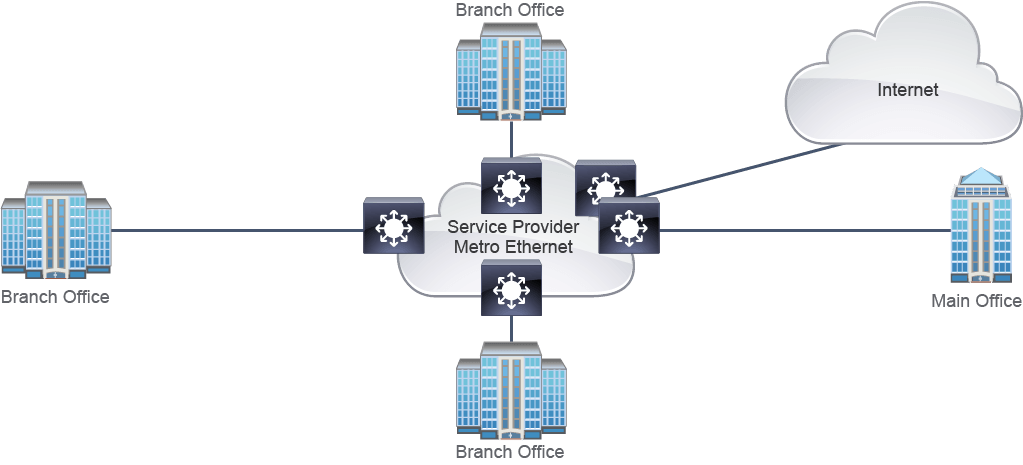
With Ethernet WAN, all sites look as if they are connected to the same Ethernet switch inside the service provider network. Therefore, all sites are on a single multiaccess network and each site can communicate directly with all others on the WAN. As Ethernet operates at layer 2 of the OSI model, you can use your own IP addressing space for routing purposes. You can also extend your internal LAN QoS policies across the service provider network.
使用乙太網路 WAN 時,所有站點看起來就像連接到服務供應商網路內部的同一台乙太網路交換器。因此,所有站點都在同一個多重存取網路上,各站點可以直接與 WAN 上的其他站點通訊。由於乙太網路運作於 OSI 模型的第 2 層,你可以使用自己的 IP 定址空間進行路由。你也可以將內部 LAN 的 QoS 政策延伸到服務供應商網路。
Ethernet as the WAN connectivity protocol can be deployed in several ways:
乙太網路作為 WAN 連線協定,可以有多種部署方式:
- Pure Ethernet connectivity, that is, end-to-end Ethernet connectivity without transformations to other WAN technologies, has a geographic span determined by the physical layer limitations. Therefore, the service is limited to specific geographic regions and is more adequate for Metropolitan Area Network (MAN) implementations, hence the name Metro Ethernet. Pure Ethernet-based deployments are cheaper but less reliable and scalable. They can handle hundreds of remote sites.純乙太網路連線,也就是不轉換為其他 WAN 技術的端對端乙太網路連線,其地理涵蓋範圍受實體層限制而受限,因此該服務僅限於特定地理區域,更適合都會區域網路(Metropolitan Area Network,MAN)的實作,這也是 Metro Ethernet 名稱的由來。純乙太網路部署成本較低,但可靠性與可擴充性較差,可以處理數百個遠端站點。
- Ethernet over SDH/ SONET deployments is useful when there is an existing SDH/SONET infrastructure already in place. SDH/SONET are two versions of the protocol designed for, and used within, the service provider network infrastructure. Ethernet frames must undergo reframing in order to be transferred over a SDH/SONET network. Also, the bit-rate hierarchy of the SDH/SONET network must be followed, which limits bandwidth flexibility.當已有既有的 SDH/SONET 基礎設施時,乙太網路 over SDH/SONET 的部署方式很有用。SDH/SONET 是專為服務供應商網路基礎設施設計並使用的兩種協定版本。乙太網路訊框必須經過重新訊框化才能透過 SDH/SONET 網路傳輸,同時也必須遵循 SDH/SONET 網路的位元速率階層,這限制了頻寬的彈性。
- MPLS-based deployments are a service provider solution that uses an MPLS network to provide virtual private Layer 2 WAN connectivity for customers. MPLS based Ethernet WANs can connect a very large number (thousands) of locations, and are reliable and scalable.以 MPLS 為基礎的部署,是服務供應商使用 MPLS 網路為客戶提供虛擬私有第 2 層 WAN 連線的一種解決方案。以 MPLS 為基礎的乙太網路 WAN 可以連接非常大量(數千個)的據點,具備可靠性與可擴充性。
Benefits of Ethernet WAN include:
乙太網路 WAN 的優點包括:
- Reduced expenses and administration " Ethernet WAN provides a switched, high-bandwidth Layer 2 network capable of managing data, voice, and video all on the same infrastructure. These characteristics increase bandwidth and eliminate expensive conversions to other WAN technologies. The technology enables businesses to inexpensively connect numerous sites, in a metropolitan area, to each other and to the internet. An all-Ethernet infrastructure simplifies the network management process because every device uses the same protocol to communicate.降低支出與管理成本,乙太網路 WAN 提供交換式高頻寬第 2 層網路,能夠在同一基礎設施上管理資料、語音及視訊。這些特性提升了頻寬,也省去昂貴的其他 WAN 技術轉換。這項技術使企業能夠以低成本連接都會區內的眾多站點,並連接到網際網路。全乙太網路基礎設施因每台裝置皆使用相同協定通訊而簡化了網路管理流程。
- Easy integration with existing networks " Ethernet WAN connects easily to existing Ethernet LANs, reducing installation costs and time.與既有網路輕鬆整合,乙太網路 WAN 能輕鬆連接到既有的乙太網路 LAN,降低安裝成本與時間。
- Enhanced business productivity—Ethernet WAN enables businesses to continue to use IP-based business applications already developed, and to use the accumulated knowledge, that is, to reuse the investment made in software and training.提升企業生產力,乙太網路 WAN 使企業能持續使用既有的以 IP 為基礎的商業應用程式,並運用累積的知識,也就是重複利用在軟體與訓練上所做的投資。
Broadband Internet Access
寬頻網際網路存取
Broadband connectivity options could be classified into wired and wireless. Wired connections use some sort of cabling, such as fiber or copper wires. These wired connections tend to be permanent, that is, permanently enabled, dedicated, and mostly offer consistent bandwidth. On the other hand, given the nature of wireless communications, wireless connectivity solutions do not offer the same consistency of bandwidth, error rate and latency as wired connections. This is due to factors such as location (distance from radio towers, multipath propagation, radio interference from other sources, etc.), weather, and bandwidth usage (local loop is usually shared among multiple users). In addition, these factors can vary over time. In order to deliver highly reliable and consistent performance, an understanding of the radio propagation and conditions at each installation is needed. Examples of wired broadband connectivity are DSL, cable TV connections, and optical fiber networks. Examples of wireless broadband are cellular 3G/4G/5G or satellite internet services.
寬頻連線選項可分為有線及無線。有線連線使用某種線纜,例如光纖或銅線,這類有線連線通常是永久啟用、專用的,且大多能提供穩定一致的頻寬。另一方面,由於無線通訊本身的特性,無線連線解決方案無法提供與有線連線相同穩定的頻寬、錯誤率及延遲,這是因為位置(與無線電塔的距離、多重路徑傳播、來自其他來源的無線電干擾等)、天氣,以及頻寬使用(本地迴路通常由多個使用者共享)等因素所致。此外,這些因素也可能隨時間變化。為了提供高度可靠且穩定的效能,需要了解每個安裝地點的無線電傳播與環境條件。有線寬頻連線的例子包括 DSL、有線電視連線及光纖網路。無線寬頻的例子則有行動 3G/4G/5G 或衛星網際網路服務。
Broadband solutions are inexpensive when compared to other WAN connectivity options. However, they do not allow customer to control latency or QoS. In terms of broadband throughput, there are usually several options from which to choose.
與其他 WAN 連線選項相比,寬頻解決方案成本低廉,但無法讓客戶控制延遲或 QoS。在寬頻吞吐量方面,通常有多種選項可供選擇。
Wired Broadband Internet Access
有線寬頻網際網路存取
DSL technology is an always-on connection technology that uses existing twisted-pair telephone lines to transport high-bandwidth data, and provides IP services to subscribers. Service providers deploy DSL connections in the local loop/last mile. The connection is set up between a pair of modems on either end of a copper wire that extends between the customer premises equipment (CPE) and the DSL access multiplexer (DSLAM). A DSLAM is the device located at the Central Office (CO) of the provider, which concentrates connections from multiple DSL subscribers. The DSLAM combines individual DSL connections from users into one high-capacity link to an ISP, and, therefore, to the internet. DSL is a broadband technology of choice for many remote workers.
DSL 技術是一種常時連線(always-on)技術,利用既有的雙絞線電話線傳輸高頻寬資料,並為用戶提供 IP 服務。服務供應商在本地迴路/最後一哩部署 DSL 連線,連線建立於位於客戶端場所的設備(Customer Premises Equipment,CPE)與 DSL 存取多工器(DSL access multiplexer,DSLAM)之間,兩端各有一台數據機,並以銅線相連。DSLAM 是位於供應商中央局(Central Office,CO)的裝置,用以彙集多個 DSL 用戶的連線。DSLAM 將多個 DSL 使用者的個別連線合併為一條連向 ISP、進而連向網際網路的高容量鏈路。DSL 是許多遠端工作者偏好的寬頻技術。

There are many DSL varieties, differing in available bit rates, and underlying data link and physical layer characteristics. Different DSL flavors are: asymmetric DSL (ADSL), with different upload and download bit rates; ADSL2+, with higher data rates, longer reach, and improvements for packet transmission; high-data-rate DSL (HDSL); ISDN-based DSL, with the longest DSL reach of all DSL technologies; and symmetric DSL (SDSL), which allows symmetric bandwidth on the upstream and downstream and offers multiple rates, very-high-data-rate DSL (VDSL), and so on. All these variations are encompassed under the term xDSL, which denotes any of the DSL technologies.
DSL 有許多種類,在可用位元速率及底層資料鏈結與實體層特性上各有不同。不同的 DSL 類型包括:非對稱 DSL(ADSL),上傳與下載位元速率不同;ADSL2+,具有更高的資料速率、更長的傳輸距離,並改善了封包傳輸;高資料速率 DSL(HDSL);以 ISDN 為基礎的 DSL,是所有 DSL 技術中傳輸距離最長的;以及對稱 DSL(SDSL),提供上下行對稱的頻寬並支援多種速率;還有極高資料速率 DSL(VDSL)等。所有這些變化統稱為 xDSL,泛指任何一種 DSL 技術。
Generally, a subscriber cannot choose to connect to an enterprise network directly, but must first connect to an ISP, and then an IP connection is made through the internet to the enterprise. Security risks are incurred in this process, but can be mitigated with security measures.
一般而言,用戶無法選擇直接連接到企業網路,而必須先連接到 ISP,再透過網際網路建立到企業的 IP 連線。此過程中會產生安全風險,但可以透過安全措施加以緩解。
Another wired broadband access option is cable access. Accessing the internet through cable utilizes the cable network, which was primarily developed for TV signal distribution, and is known as the cable TV system. At the physical layer, the coaxial cable was the primary medium used to build cable TV systems. It carries radio frequency (RF) signals. Most cable operators are deploying hybrid fiber-coaxial networks. Internet service is provided by the ISP associated with the cable service provider.
另一種有線寬頻存取選項是纜線存取。透過纜線存取網際網路,利用的是最初為電視訊號傳輸而開發的纜線網路,也就是有線電視系統。在實體層,同軸纜線是建置有線電視系統所使用的主要媒介,用於承載射頻(RF)訊號。大多數纜線業者正在部署混合光纖同軸(hybrid fiber-coaxial)網路,網際網路服務則由與該纜線服務供應商合作的 ISP 提供。
To enable the transmission of data over the cable system and to add high-speed data transfer to an existing cable TV system, the Data over Cable Service Interface Specification (DOCSIS) international standard defines the communications requirements and operation support interface requirements.
為了讓資料能透過纜線系統傳輸,並為既有的有線電視系統增加高速資料傳輸功能,纜線資料服務介面規範(Data over Cable Service Interface Specification,DOCSIS)這項國際標準定義了通訊需求與操作支援介面需求。
Two types of equipment are required to send signals upstream and downstream on a cable system:
在纜線系統上傳送上行與下行訊號需要兩種設備:
- Cable Modem (CM) on the subscriber end.用戶端的纜線數據機(Cable Modem,CM)。
- Cable Modem Termination System (CMTS) at the headend of the cable operator.位於纜線業者機房(headend)的纜線數據機終端系統(Cable Modem Termination System,CMTS)。
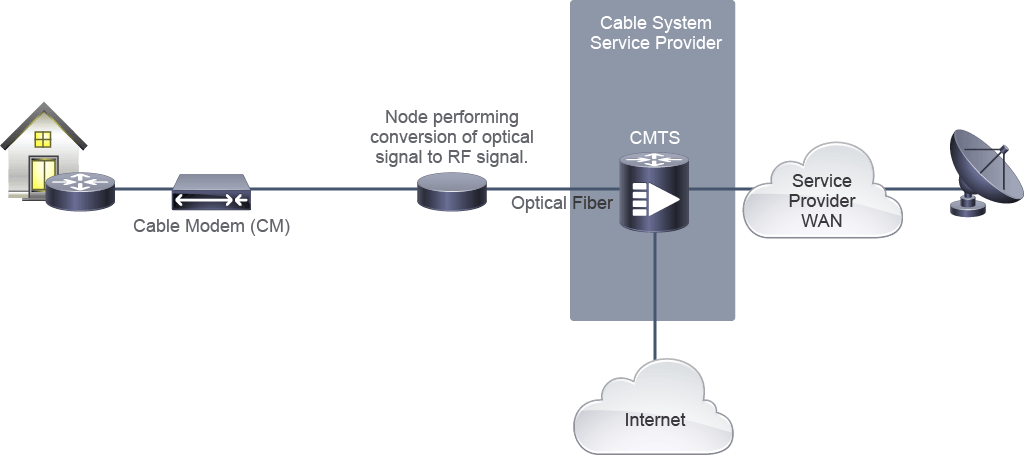
The topology in the figure displays a sample cable WAN connection. A headend CMTS communicates with CMs located in subscriber homes. The headend is actually a router with databases for providing internet services to cable subscribers. When deploying hybrid fiber-coaxial (HFC) networks, service providers enable high-speed transmission of data to cable modems located in residential areas. Using optical fiber, the headend is connected to a node that also connects to coaxial cables, called feeder cables, which connect multiple subscribers. The node performs optical-to-RF signal conversion.
圖中的拓樸展示了一個纜線 WAN 連線範例。機房的 CMTS 與位於用戶家中的 CM 通訊。機房實際上是一台配有資料庫的路由器,用於為纜線用戶提供網際網路服務。部署混合光纖同軸(HFC)網路時,服務供應商能夠將資料以高速傳輸到位於住宅區的纜線數據機。機房透過光纖連接到一個節點,該節點也連接到稱為饋線纜(feeder cable)的同軸纜線,這些饋線纜連接多個用戶。該節點負責執行光訊號轉射頻訊號的轉換。
Wireless Broadband Internet Access
無線寬頻網際網路存取
Wireless technology uses RF spectrum to send and receive data. One limitation of wireless access was the need to be within the local transmission range (typically less than 150 feet/46 m) of a wireless router or a wireless modem that has a wired connection to the internet. However, developments in broadband wireless technology are increasing the reach of wireless connections and now include WANs.
無線技術使用射頻頻譜來傳送及接收資料。無線存取的限制之一,是必須位於具有網際網路有線連線的無線路由器或無線數據機的本地傳輸範圍內(通常不到 150 英尺/46 公尺)。然而,寬頻無線技術的發展正在擴大無線連線的涵蓋範圍,如今也涵蓋了 WAN。
The following technologies enable wireless broadband access:
以下技術可實現無線寬頻存取:
- Municipal Wi-Fi: Many municipal governments, often working with service providers, are deploying wireless networks. Some of these networks provide high-speed internet access at no cost or for substantially less than the price of other broadband services. Other cities reserve their Wi-Fi networks for official use, providing police, fire fighters, and city workers remote access to the internet and municipal networks. To connect to a municipal Wi-Fi, a subscriber typically needs a wireless modem, which provides a stronger radio and directional antenna than conventional wireless adapters. Most service providers provide the necessary equipment for free or for a fee, much like they do with DSL or cable modems.市政 Wi-Fi:許多市政府經常與服務供應商合作部署無線網路,其中一些網路提供免費或遠低於其他寬頻服務價格的高速網際網路存取。有些城市則將其 Wi-Fi 網路保留供官方使用,讓警察、消防員及市政人員能夠遠端存取網際網路及市政網路。要連接市政 Wi-Fi,用戶通常需要一台無線數據機,其提供比一般無線介面卡更強的無線電及方向性天線。大多數服務供應商會免費或收費提供所需設備,做法與 DSL 或纜線數據機類似。
- Cellular/Mobile broadband refers to wireless internet access delivered through mobile phone towers to computers, mobile phones, and other digital devices. Devices use a small radio antenna to communicate with a larger antenna at the phone tower, via radio waves. Organizations leverage cellular networks for a variety of use cases, such as for metering devices (sensors, vehicle diagnostics), temporary sites (sports/fair/conference access), and to connect smaller and remote business sites. Three common terms that are used when discussing cellular/mobile networks include:行動/蜂巢式寬頻是指透過行動電話基地台,將無線網際網路存取提供給電腦、行動電話及其他數位裝置的技術。裝置使用小型無線電天線,透過無線電波與電話基地台的大型天線通訊。各組織將蜂巢式網路運用於多種情境,例如計量裝置(感測器、車輛診斷)、臨時場所(體育賽事/展覽/會議現場的存取),以及連接較小型或偏遠的營業據點。討論蜂巢式/行動網路時常見的三個術語包括:
- Mobile Internet or Mobile Data is a general term for the internet services from a mobile phone or from any device that uses the same technology. A mobile phone subscription does not necessarily include a mobile data subscription.行動網際網路或行動數據是指透過行動電話或任何使用相同技術的裝置所提供的網際網路服務的通用術語。行動電話的門號方案不一定包含行動數據方案。
- Long-Term Evolution (LTE) A mobile technology that increased the capacity and speed of the wireless link compared to 2G and 3G technologies. It introduced novelties, such as using a different radio interface, and core network improvements. It is considered to be the part of 4G technology, although it was its predecessor.長期演進技術(Long-Term Evolution,LTE)是一種相較於 2G 及 3G 技術,提升了無線鏈路容量與速度的行動技術,引入了諸如使用不同無線電介面及核心網路改進等創新。LTE 雖然是 4G 技術的前身,但仍被視為 4G 技術的一部分。
- 2G/3G/4G/5G acronyms refer to the mobile wireless technologies and standards, and stand for second, third, fourth, and fifth generations of mobile wireless technologies. Each new generation is an evolution of the previous one. Each generation defines its own standards and with each new generation the access bit rates continue to increase. 4G standards provided bit rates up to 450 Mbps download and 100 Mbps upload. The 5G standard should provide cellular data transfer speeds from 100 Mbps to 10 Gbps and beyond. Also, 5G should significantly decrease latency and improve reliability of cellular broadband. 5G uses new and so far, rarely used radio frequency bands. 5G will also work in a directional way, meaning the effects of interferences from other wireless signals will be minimized. Low latency is one of 5G's most important attributes, making the technology highly suitable for critical applications that require rapid responsiveness.2G/3G/4G/5G這些縮寫代表行動無線技術與標準,分別代表行動無線技術的第二代、第三代、第四代及第五代。每一代都是在前一代基礎上演進而來,各代皆定義了自己的標準,且每一代的存取位元速率都持續提升。4G 標準提供最高 450 Mbps 的下載速率及 100 Mbps 的上傳速率。5G 標準應能提供 100 Mbps 到 10 Gbps 以上的蜂巢式資料傳輸速度,且 5G 也應能顯著降低延遲並提升蜂巢式寬頻的可靠性。5G 使用了新的、目前仍鮮少使用的無線電頻段,並將以定向方式運作,意味著來自其他無線訊號的干擾影響會被降到最低。低延遲是 5G 最重要的特性之一,使該技術非常適合需要快速回應的關鍵應用程式。
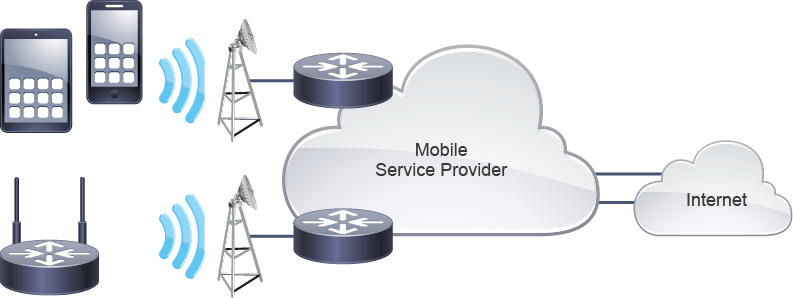
- Satellite Internet is a high-speed bidirectional internet connection made through geostationary communications satellites. Internet-by-satellite speed and cost nowadays compare with DSL broadband offerings. Satellite Internet is typically used in locations where land-based internet access is not available or for temporary installations that are mobile. Internet access using satellites is available worldwide, including for providing internet access to vessels at sea, airplanes in flight, and vehicles moving on land. To access satellite internet services, subscribers need a satellite dish, two modems (uplink and downlink), and coaxial cables between the dish and the modem. The only prerequisite is that the dish can see the sky; that it has clear line-of-sight to a geostationary satellite. A company can create a private WAN using satellite communications and Very Small Aperture Terminals (VSAT). A VSAT is a type of satellite dish similar to the ones used for satellite TV from the home and is usually about 1 meter in width. The VSAT dish sits outside, pointed at a specific satellite, and is cabled to a special router interface, with the router inside the building.衛星網際網路是透過同步通訊衛星建立的高速雙向網際網路連線。如今,衛星網際網路的速度與成本已可與 DSL 寬頻服務相比。衛星網際網路通常用於無法取得地面網際網路存取的地點,或用於行動式的臨時安裝。使用衛星的網際網路存取可在全球取得,包括為海上船隻、飛行中的飛機及地面移動中的車輛提供網際網路存取。要使用衛星網際網路服務,用戶需要一個衛星碟形天線、兩台數據機(上行與下行),以及連接天線與數據機之間的同軸纜線。唯一的前提條件是該碟形天線能看見天空,也就是與同步衛星之間有清晰的視線。公司可以使用衛星通訊及極小型天線終端(Very Small Aperture Terminal,VSAT)來建立私有 WAN。VSAT 是一種類似家用衛星電視所使用的衛星碟形天線,寬度通常約 1 公尺。VSAT 天線放置於室外,對準特定衛星,並以纜線連接到室內建築物中路由器的特殊介面。
- Worldwide Interoperability for Microwave Access (WiMAX) provides high-speed broadband service with wireless access and provides broad coverage similar to a cell phone network rather than through small Wi-Fi hotspots. WiMAX is a wireless technology for both fixed and mobile implementations. WiMAX operates in a similar way to Wi-Fi, but at higher speeds, over greater distances, and for a greater number of users. It uses a network of WiMAX towers that are similar to cell phone towers. To access a WiMAX network, subscribers must subscribe to an ISP with a WiMAX tower within 30 miles of their location. They also need some type of WiMAX receiver and a special encryption code to get access to the base station. WiMAX may still be relevant for some areas of the world. However, in most of the world, WiMAX has largely been replaced by LTE for mobile access and cable or DSL for wired access.全球互通微波存取(WiMAX)提供高速寬頻服務,透過無線存取提供類似行動電話網路的廣泛覆蓋範圍,而非透過小型 Wi-Fi 熱點。WiMAX 是一種同時適用於固定式與行動式部署的無線技術。WiMAX 的運作方式與 Wi-Fi 類似,但速度更高、傳輸距離更遠,且可服務更多使用者。它使用類似行動電話基地台的 WiMAX 塔台網路。要存取 WiMAX 網路,訂閱者必須向其所在位置 30 英里內設有 WiMAX 塔台的 ISP 訂閱服務。他們也需要某種 WiMAX 接收器和特殊加密碼,才能存取基地台。WiMAX 在世界某些地區可能仍具有其重要性,但在大多數地區,WiMAX 已大致被行動存取用的 LTE 及有線存取用的纜線或 DSL 所取代。
Optical Fiber in WAN connections
WAN 連線中的光纖
Due to much lower attenuation and interference, optical fiber has large advantages over existing copper wire, especially in long-distance, high-demand applications. Until recently, optical fiber infrastructures were complex and expensive to install and operate and they have been installed mainly within the service provider backhaul and backbone networks, where they could be utilized to their full capacity. In the late 1990s, the price for installing fiber dropped and many telecommunication companies invested in building optical fiber networks with sufficient capacity to take existing traffic and future traffic, which was forecast to grow exponentially, and to expand the optical network to include the local loop. At the same time, the technologies used for transmission of optical signals also evolved. With the development of wavelength division multiplexing (WDM), the capacity of the single strand of optical fiber increased significantly, and as a consequence, many fiber optic cable runs were left "unlit""that is, were not in use. Today, this optic fiber is offered under the term "dark fiber."
由於衰減與干擾程度低得多,光纖相較於既有的銅線有很大的優勢,尤其在長距離、高需求的應用中。直到最近,光纖基礎架構的建置與維運仍相當複雜且昂貴,因此主要安裝於服務供應商的骨幹迴傳網路中,以充分利用其容量。1990 年代末期,光纖建置成本下降,許多電信公司投資建置具備足夠容量的光纖網路,以因應現有及預估將呈指數成長的未來流量,並將光纖網路擴展至最後一哩。與此同時,光訊號傳輸所使用的技術也持續演進。隨著分波多工(WDM)技術的發展,單一光纖線芯的容量大幅提升,因此許多光纖線路被閒置未用,也就是「未點亮」。如今,這類光纖被稱為「暗光纖」。
Fiber to the x
光纖到x(Fiber to the x)
Optical fiber network architectures, in which optical fiber reaches the subscriber home, premises, or building, are referred to as Fiber to the x (FTTx), which includes Fiber to the Home (FTTH), Fiber to the Premises (FTTP), or Fiber to the Building (FTTB). When optical cabling reaches a device that serves several customers, with copper wires (twisted pair or coaxial) completing the connection, the architecture is referred to as Fiber to the Node/Neighborhood (FTTN), or Fiber to the Curb/Cabinet (FTTC). In FTTN, the final subscriber gains broadband internet access using cable or some form of DSL.
光纖網路架構中,若光纖延伸至用戶住家、場所或建築物,稱為光纖到x(FTTx),包含光纖到府(FTTH)、光纖到場所(FTTP)或光纖到大樓(FTTB)。當光纖電纜連接到服務多位用戶的裝置,再以銅線(雙絞線或同軸電纜)完成最後連接時,此架構稱為光纖到節點/社區(FTTN)或光纖到路邊/機櫃(FTTC)。在 FTTN 架構中,最終用戶透過纜線或某種形式的 DSL 取得寬頻網際網路存取。
SONET and SDH
SONET 與 SDH
The standards used in service provider optical fiber networks are SONET or SDH. SONET/SDH were designed specifically as WAN physical layer standards. SONET is used in the United States and Canada, while SDH is used in the rest of the world. Both standards are essentially the same and, therefore, are often listed as SONET/SDH. Both define how to transfer multiple data, voice, and video communications over optical fiber using lasers or light-emitting diodes (LEDs) over great distances.
服務供應商光纖網路所採用的標準為 SONET 或 SDH。SONET/SDH 是專為 WAN 實體層所設計的標準。SONET 用於美國與加拿大,SDH 則用於世界其他地區。兩種標準本質上相同,因此常合稱為 SONET/SDH。兩者皆定義如何使用雷射或發光二極體(LED),在光纖上長距離傳輸多種資料、語音及視訊通訊。
SONET/SDH standards are used on the ring network topology. The ring contains redundant fiber paths and allows traffic to flow in both directions.
SONET/SDH 標準採用於環狀網路拓樸。此環狀結構包含備援光纖路徑,並允許流量雙向傳輸。
SONET and SDH have a hierarchical signal structure. This means that a basic unit of transmission is defined, which can be multiplexed, or combined, to achieve greater data rates.
SONET 與 SDH 皆採階層式訊號結構,也就是說,定義了一個基本傳輸單位,可透過多工或組合達到更高的資料速率。
The figure shows the SONET and SDH signal hierarchy. SONET and SDH both have their own terminology for the basic unit of transmission. In SONET the basic unit of transmission is called Synchronous Transport Signal 1 (STS-1) or Optical Carrier 1 (OC-1) and operates at 51.84 Mbps. The higher-level signals are multiples of STS-1 signals and operate at multiples of base transmission rate. For example, STS-3 operates at a bit rate of 155.52 Mbps interleaving frames coming from three STS-1 signals. Four STS-3 streams can be multiplexed into an STS-12 stream and so on.
此圖顯示 SONET 與 SDH 的訊號階層。SONET 與 SDH 對基本傳輸單位各有其專屬術語。在 SONET 中,基本傳輸單位稱為同步傳輸訊號 1(STS-1)或光載波 1(OC-1),運作速率為 51.84 Mbps。較高階的訊號是 STS-1 訊號的倍數,並以基本傳輸速率的倍數運作。舉例來說,STS-3 以 155.52 Mbps 的位元速率運作,交錯來自三個 STS-1 訊號的訊框。四個 STS-3 串流可多工組成一個 STS-12 串流,依此類推。
The STS-1 and OC-1 designations are often used interchangeably, though the OC refers to the physical signal, that is, the signal in its optical form, while STS-1 specifies the transmission format.
STS-1 與 OC-1 兩種名稱經常互換使用,不過 OC 指的是實體訊號,也就是光學形式的訊號,而 STS-1 則指定傳輸格式。
In SDH the basic unit of transmission is the Synchronous Transport Module, level 1 (STM-1). which operates at 155.520 Mbps. The STM-1 bit rate is the same as the SONET STS-3 bit rate.
在 SDH 中,基本傳輸單位為第 1 級同步傳輸模組(STM-1),運作速率為 155.520 Mbps。STM-1 的位元速率與 SONET 的 STS-3 位元速率相同。
Each rate is an exact multiple of the lower rate, ensuring that the hierarchy is synchronous.
每一速率都是較低速率的精確倍數,確保此階層維持同步。
Dense Wavelength-Division Multiplexing
密集分波多工(Dense Wavelength-Division Multiplexing)
Along with installing extensive optical fiber networks, the technologies for transmission of optical signals also advanced. DWDM is a form of wavelength division multiplexing that combines multiple high-bit-rate optical signals into one optical signal transmitted over one fiber strand. Each of the input optical signals is assigned a specific light wavelength, or "color", and is transmitted using that wavelength. Different signals can be extracted from the multiplexed signal at the reception in a way that there is no mixing of traffic. As demands change, more capacity can be added, either by simple equipment upgrades or by increasing the number of wavelengths on the fiber, without expensive upgrades. The figure below illustrates this multiplexing concept.
在建置大規模光纖網路的同時,光訊號傳輸技術也持續進步。DWDM 是一種分波多工形式,可將多個高位元速率的光訊號合併為一個光訊號,透過單一光纖線芯傳輸。每個輸入光訊號會分配到特定的光波長,也就是「顏色」,並以該波長傳輸。接收端可從多工訊號中提取不同訊號,且不會混合流量。隨著需求變化,可透過簡單的設備升級或增加光纖上的波長數量來增加容量,而無需昂貴的升級。下圖說明此多工概念。
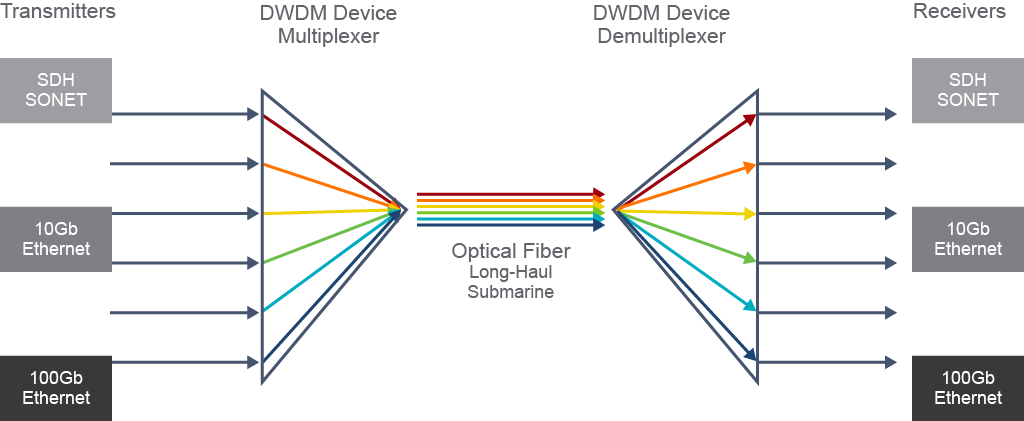
Specifically, DWDM:
具體而言,DWDM:
- Assigns incoming optical signals to specific wavelengths of light (that is, frequencies).將傳入的光訊號分配至特定光波長(即頻率)。
- Can multiplex more than 96 different channels of data (that is, wavelengths) onto a single fiber.可在單一光纖上多工超過 96 個不同資料通道(即波長)。
- Each channel is capable of carrying a 200 Gbps multiplexed signal.每個通道可承載 200 Gbps 的多工訊號。
- Can amplify these wavelengths to boost the signal strength.可放大這些波長以增強訊號強度。
- Is protocol agnostic, it supports various protocols with different bit rates, including Ethernet, Fiber Channel, SONET and SDH standards與通訊協定無關,支援多種不同位元速率的協定,包括乙太網路、光纖通道、SONET 與 SDH 標準
DWDM circuits are used in all modern submarine communications cable systems and other long-haul circuits.
DWDM 電路廣泛應用於現今所有海底通訊電纜系統及其他長途電路。
Dark Fiber
暗光纖(Dark Fiber)
The availability of WDM reduced the demand for fiber by increasing the capacity that could be placed on a single fiber strand. As a result, many fiber optic cable runs were left "unlit""that is, were not in use.
WDM 的出現提升了單一光纖線芯可承載的容量,因而降低對光纖數量的需求。結果是,許多光纖線路被閒置未用,也就是「未點亮」。
Enterprises can use dark fiber to interconnect their remote locations directly. The enterprises can create a privately operated optical fiber network over dark fiber leased or purchased from another supplier. Both ends of the link are controlled by the same entity. Dark fiber networks can operate using WDM to add capacity where needed. The cost to lease fiber is usually more expensive than any other WAN option available today. On the other hand, connecting remote sites using dark fiber offers the greatest flexibility and control. Therefore, dark fiber is leased when speed and security are of utmost importance.
企業可利用暗光纖直接互連其遠端據點。企業可租用或購買其他供應商的暗光纖,建置私有營運的光纖網路。連線兩端皆由同一實體控制。暗光纖網路可搭配 WDM 運作,依需求增加容量。租用光纖的成本通常比現今任何其他 WAN 選項都要高。另一方面,使用暗光纖連接遠端據點提供了最大的彈性與控制權。因此,當速度與安全性至關重要時,企業會選擇租用暗光纖。
WAN-Related Protocols
WAN 相關通訊協定
In addition to understanding the various technologies available for broadband internet access, it is also important to understand the underlying data link layer protocol used by the ISP.
除了了解各種可用的寬頻網際網路存取技術外,了解 ISP 所使用的底層資料鏈結層通訊協定也同樣重要。
A data-link protocol that is commonly used by ISP on links to the customers is PPP. PPP originally emerged as an encapsulation protocol for transporting IP traffic over point-to-point links, such as links in analog dialup and ISDN access networks. PPP specifies standards for the assignment and management of IP addresses, encapsulation, network protocol multiplexing, link configuration, link quality testing, error detection, and option negotiation for such capabilities as network layer address negotiation and data compression negotiation. PPP provides router-to-router and host-to-network connections over both synchronous and asynchronous circuits. An example of an asynchronous connection is a dialup connection. An example of a synchronous connection is a leased line.
ISP 在連接客戶的鏈路上常用的資料鏈結層通訊協定是 PPP。PPP 最初是作為在點對點鏈路(例如類比撥接與 ISDN 存取網路中的鏈路)上傳輸 IP 流量的封裝通訊協定而出現。PPP 規範了 IP 位址的指派與管理、封裝、網路層通訊協定多工、鏈路組態設定、鏈路品質測試、錯誤偵測,以及網路層位址協商、資料壓縮協商等功能選項的協商標準。PPP 可在同步與非同步電路上提供路由器對路由器及主機對網路的連線。撥接連線就是非同步連線的一例;專線則是同步連線的一例。
Additionally, ISPs often use PPP as the data link protocol over broadband DSL connections. There are several reasons for this. First, PPP supports the ability to automate assigning of the IP addresses to remote ends of a PPP link. With PPP enabled, ISPs can use PPP to assign each customer one public IPv4 address. PPP also includes the link-quality management feature. If too many errors are detected, PPP takes down the link. More importantly, PPP supports authentication. ISPs often want to use this feature to authenticate customers because during authentication, ISPs can check accounting records to determine whether the customer’s bill is paid, before letting the customer connect to the internet. Also, ISPs can use the same authentication model as the ones already in place for analog and ISDN connections.
此外,ISP 也常在寬頻 DSL 連線上使用 PPP 作為資料鏈結通訊協定,原因有幾個。首先,PPP 支援自動指派 IP 位址給 PPP 鏈路遠端的功能。啟用 PPP 後,ISP 可用 PPP 為每位客戶指派一個公用 IPv4 位址。PPP 也包含鏈路品質管理功能,若偵測到過多錯誤,PPP 會中斷該鏈路。更重要的是,PPP 支援驗證功能。ISP 通常希望利用此功能來驗證客戶身分,因為在驗證過程中,ISP 可查核帳務記錄以確認客戶帳單是否已繳清,才允許客戶連上網際網路。此外,ISP 也能沿用原本用於類比與 ISDN 連線的相同驗證模式。
Analog dialup and ISDN WAN technologies supported PPP, but are largely deprecated today. On the other hand, the DSL subscriber base is still significant. When deploying a DSL network, ISPs often provide their customers with a DSL modem. A DSL modem has one Ethernet interface to connect to the customer Ethernet segment, and another interface for DSL line connectivity. While ISPs value PPP because of the authentication, accounting, and link management features, customers appreciate the ease and availability of the Ethernet connection. However, Ethernet links do not natively support PPP. PPP over Ethernet (PPPoE) provides a solution to this situation. As shown in the figure, PPPoE allows the sending of PPP frames encapsulated inside Ethernet frames.
類比撥接與 ISDN 這類 WAN 技術過去支援 PPP,但如今已大致淘汰。相對地,DSL 用戶群仍相當可觀。在部署 DSL 網路時,ISP 通常會提供客戶一台 DSL 數據機。DSL 數據機具備一個連接客戶乙太網路區段的乙太網路介面,以及另一個用於 DSL 線路連線的介面。ISP 重視 PPP 的驗證、帳務與鏈路管理功能,客戶則欣賞乙太網路連線的便利性與普及性。然而,乙太網路鏈路原生並不支援 PPP。乙太網路上的 PPP(PPPoE)正是為解決此問題而生。如圖所示,PPPoE 允許將 PPP 訊框封裝在乙太網路訊框內傳送。
PPPoE provides an emulated point-to-point link across a shared medium, typically a broadband aggregation network such as the ones that you can find in DSL service providers. A very common scenario is to run a PPPoE client on the customer side, which connects to and obtains its configuration from the PPPoE server at the ISP side.
PPPoE 在共享媒介(通常是 DSL 服務供應商網路中常見的寬頻聚合網路)上提供模擬的點對點鏈路。常見情境是在客戶端執行 PPPoE 用戶端,連線至 ISP 端的 PPPoE 伺服器並取得其組態設定。
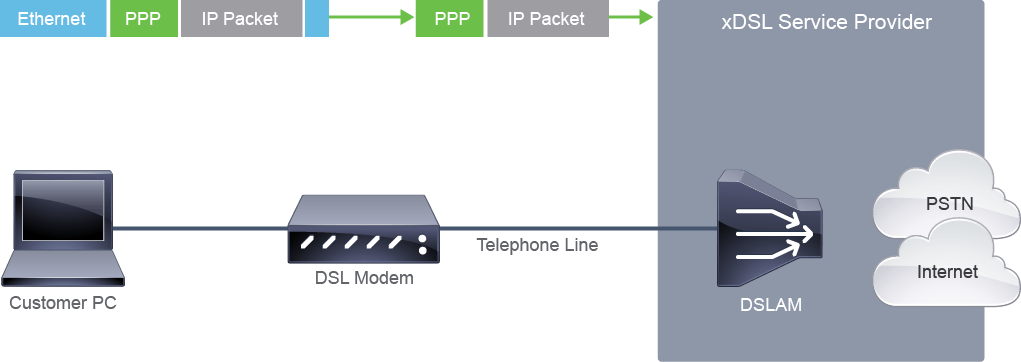
The figure illustrates a DSL deployment, in which the DSL modem is the only intermediary device on the customer side, between the PC and the Internet. In such case, there can be only one PPPoE client device on the LAN side of the connection, which is the PC. The modem converts the Ethernet frames to PPP frames by stripping the Ethernet headers. The modem then transmits these PPP frames on the ISP’s DSL network.
此圖說明一個 DSL 部署情境,其中 DSL 數據機是客戶端唯一位於 PC 與網際網路之間的中介裝置。在此情況下,LAN 端只能有一台 PPPoE 用戶端裝置,也就是該台 PC。數據機會剝除乙太網路標頭,將乙太網路訊框轉換為 PPP 訊框,接著在 ISP 的 DSL 網路上傳送這些 PPP 訊框。
The following figure shows a typical network topology, in which a Cisco IOS router is added on the customer site. The Cisco IOS router connects to the Ethernet LAN on one side and to the DSL modem on the other. The customer’s router is connected to a DSL modem using an Ethernet cable. You can run the PPPoE client IOS feature on the Cisco router. This way, you can connect multiple PCs on the Ethernet segment that is connected to the Cisco IOS router.
下圖顯示一個典型的網路拓樸,其中客戶端加入了一台 Cisco IOS 路由器。此 Cisco IOS 路由器一側連接乙太網路 LAN,另一側連接 DSL 數據機。客戶的路由器透過乙太網路線纜連接至 DSL 數據機。您可以在 Cisco 路由器上執行 PPPoE 用戶端 IOS 功能,如此一來,即可讓多台 PC 透過連接至 Cisco IOS 路由器的乙太網路區段連上網路。
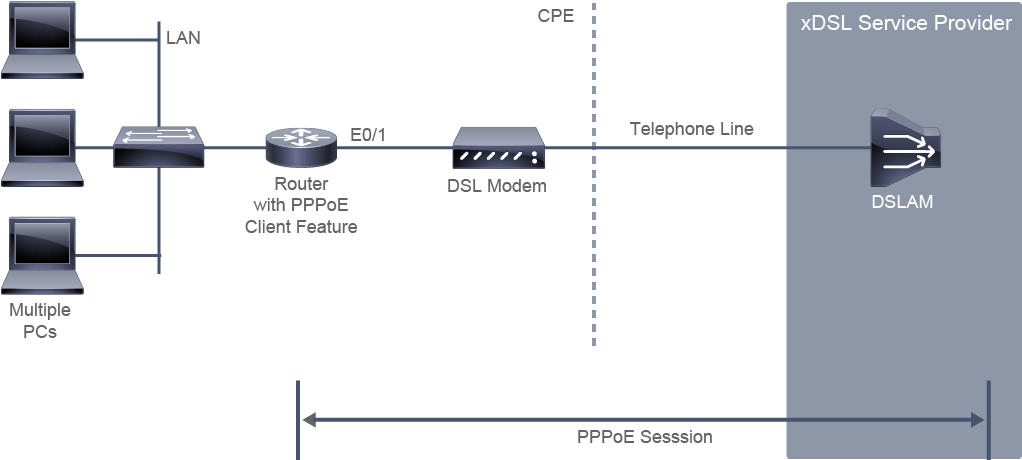
PPPoE creates a PPP tunnel over an Ethernet connection. This allows PPP frames to be sent across the Ethernet cable to the service provider from the customer’s router. The modem converts the Ethernet frames to PPP frames by stripping the Ethernet headers. The modem then transmits these PPP frames on the service provider’s DSL network. The PPPoE client initiates a PPPoE session. If the session has a timeout or is disconnected, the PPPoE client will immediately attempt to reestablish the session.
PPPoE 會在乙太網路連線上建立 PPP 通道,讓 PPP 訊框能從客戶端路由器透過乙太網路線纜傳送至服務供應商。數據機會剝除乙太網路標頭,將乙太網路訊框轉換為 PPP 訊框,接著在服務供應商的 DSL 網路上傳送這些 PPP 訊框。PPPoE 用戶端會發起 PPPoE 工作階段。若工作階段逾時或連線中斷,PPPoE 用戶端會立即嘗試重新建立該工作階段。
Enterprise Internet Connectivity Options
企業網際網路連線選項
When connecting an enterprise network to an ISP, redundancy is a serious concern. There are different aspects that can be addressed to achieve redundant connectivity.
當企業網路連接至 ISP 時,備援是一項重要考量。可從多個層面著手,以達成備援連線。
Using redundant links protects your network against link failure between your router and the ISP router. Deployment of redundant equipment protects your network against device failure. If one router fails, internet connectivity is still established through the redundant router. You also need redundant links to connect all devices.
使用備援鏈路可保護您的網路,避免路由器與 ISP 路由器之間的鏈路故障造成影響。部署備援設備則可保護您的網路,避免裝置故障造成影響。若其中一台路由器故障,仍可透過備援路由器維持網際網路連線。您也需要備援鏈路來連接所有裝置。
If you are hosting important servers in your network, it is best to have two redundant internet providers. If there is a failure in one ISP network, all traffic is automatically rerouted through the second ISP.
若您的網路中託管重要伺服器,最好搭配兩家備援的網際網路供應商。若其中一家 ISP 的網路發生故障,所有流量會自動改道經由第二家 ISP 傳送。
There are multiple strategies for connecting your network to an ISP. The topology depends on the needs of the company.
連接網路至 ISP 有多種策略,拓樸選擇取決於公司的需求。
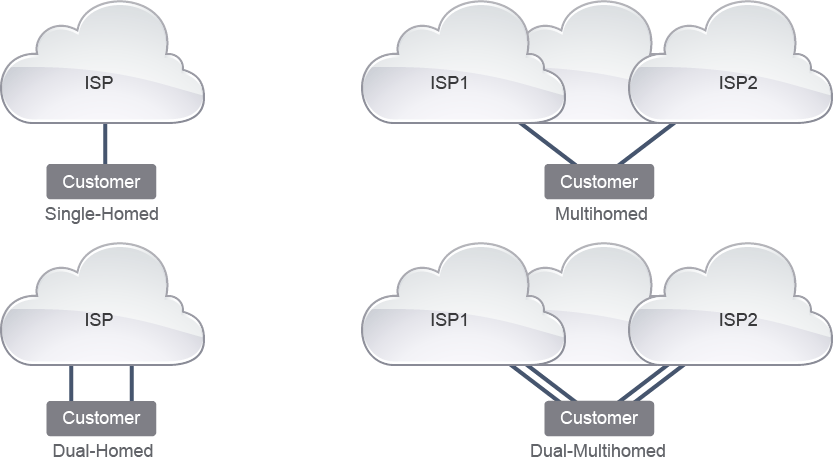
There are four basic ISP connectivity types:
ISP 連線基本上有四種類型:
- Single-homed: Single-homed ISP connectivity is used in cases when a loss in internet connectivity is not as problematic to a customer (although the internet is typically a vital resource). Single-homed customers use only one service provider for the internet uplink, and use only one physical uplink to connect to the ISP so there is no redundancy.單歸屬(Single-homed):當網際網路連線中斷對客戶造成的影響較小(儘管網際網路通常仍是重要資源)時,會採用單歸屬式 ISP 連線。單歸屬客戶僅使用一家服務供應商作為網際網路上行連線,且僅使用一條實體上行鏈路連接至 ISP,因此沒有備援。
- Dual-homed: With a single ISP, customers can still achieve redundancy if two links toward the same ISP are used, effectively making a customer dual-homed. The dual-homed design could also be configured to load balance traffic over both of the links, but the dual-homed redundancy option cannot protect the customer if the ISP has an outage.雙歸屬(Dual-homed):即使只使用單一 ISP,客戶仍可透過對同一 ISP 使用兩條鏈路來達成備援,實際上即為雙歸屬。雙歸屬設計也可以組態為在兩條鏈路間進行負載平衡,但雙歸屬備援方案無法在 ISP 發生服務中斷時保護客戶。
- Multihomed: If a customer network is connected to multiple ISPs, the solution is said to be multihomed. The customer is responsible for announcing their own IP address space to upstream ISPs. The customer should avoid forwarding any routing information between ISPs, or they become a transit provider between the two ISPs. This design provides more than redundancy—it also enables load-balancing of customer traffic between both ISPs.多歸屬(Multihomed):若客戶網路連接至多家 ISP,此方案稱為多歸屬。客戶負責向上游 ISP 宣告自己的 IP 位址空間,並應避免在 ISP 之間轉發任何路由資訊,否則會成為兩家 ISP 之間的傳輸提供者。此設計不僅提供備援,也能實現客戶流量在兩家 ISP 之間的負載平衡。
- Dual-multihomed: To enhance resiliency, a customer can have two links to each ISP, making the solution dual-multihomed. This dual-multihomed solution gives an organization the most redundancy possible. This would be an option for a data center or a large enterprise with plenty of resources, as it would be the most costly option.雙重多歸屬(Dual-multihomed):為提升復原能力,客戶可對每家 ISP 各建立兩條鏈路,形成雙重多歸屬方案。此方案可為組織提供最大程度的備援,適合資源充裕的資料中心或大型企業採用,因為這是成本最高的選項。