Introduction
簡介
Last week, your boss, Jerry, returned from an IT conference buzzing with excitement about a revelation that shook the foundation of networking practices: the impending exhaustion of IPv4 addresses. Although this revelation is only partially true, it highlighted a critical step forward for your network—transitioning to IPv6.
上週,你的主管 Jerry 從一場 IT 研討會回來,對一項震撼網路產業根基的消息興奮不已:IPv4 位址即將耗盡。雖然這項消息只有部分屬實,但它凸顯出你的網路必須邁出的關鍵一步:轉換至 IPv6。
You are tasked with a vital project—implementing IPv6 in parallel with your network’s existing IPv4 infrastructure. This dual-stack approach will not only enhance your network's capabilities but also prepare you for a seamless transition to an IPv6-dominant environment in the future.
你被指派了一項重要專案:在現有 IPv4 基礎架構的同時導入 IPv6。這種雙堆疊(dual-stack)做法不僅能提升網路能力,也能讓你為未來以 IPv6 為主的環境做好無縫轉換的準備。
You might not yet be fully familiar with IPv6, but you know that:
你可能對 IPv6 還不完全熟悉,但你知道:
- IPv6 addresses aren't just longer than IPv4 addresses, they are also written differently.IPv6 位址不僅比 IPv4 位址長,寫法也不同。
- Knowledge of IPv4 address allocation is helpful, but IPv6 introduces some unique differences.具備 IPv4 位址配置的知識會有幫助,但 IPv6 引入了一些獨特的差異。
- Familiarity with new features such as neighbor discovery, router advertisements, and stateless autoconfiguration is essential.熟悉鄰居探索(neighbor discovery)、路由器通告(router advertisement)與無狀態自動設定(stateless autoconfiguration)等新功能是不可或缺的。
- Tools similar to those used in IPv4, such as show ipv6 route instead of show ip route, will be necessary for managing and troubleshooting IPv6 networks.管理與疑難排解 IPv6 網路時,將需要類似 IPv4 所用的工具,例如以 show ipv6 route 取代 show ip route。
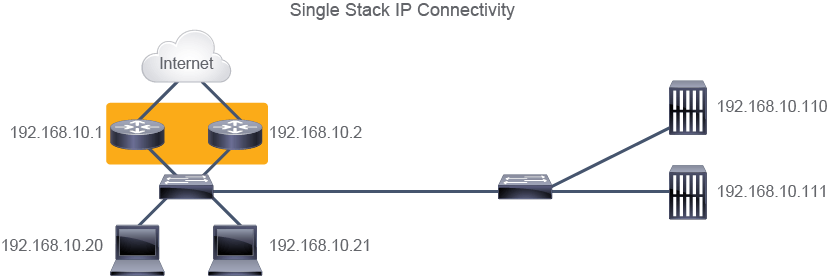
This topology represents single stack IP connectivity using IPv4 addresses. It includes routers connecting to the internet, switches, and end devices such as computers and servers, all using IPv4 addresses for communication.
此拓樸代表使用 IPv4 位址的單一堆疊 IP 連線。其中包括連接至網際網路的路由器、交換器,以及電腦與伺服器等終端裝置,全部都使用 IPv4 位址進行通訊。
Why is using both IPv4 and IPv6 important for organizations and how do you ensure uninterrupted connectivity? Companies run IPv4 and IPv6 in parallel, using a dual-stack approach, to ensure compatibility and smooth transition as the internet shifts from IPv4 to IPv6. This approach deals with the exhaustion of IPv4 addresses while maintaining network reliability and flexibility. It allows organizations to benefit from IPv6 enhancements in routing efficiency and security without disrupting connectivity for systems that still depend on IPv4. Thus, running both protocols simultaneously ensures seamless operation during the transition.
為什麼企業同時使用 IPv4 與 IPv6 很重要,又該如何確保連線不中斷?企業採用雙堆疊做法,同時執行 IPv4 與 IPv6,以確保相容性並在網際網路從 IPv4 轉向 IPv6 的過程中順利過渡。這種做法能因應 IPv4 位址耗盡的問題,同時維持網路的可靠性與彈性。它讓企業能在不影響仍依賴 IPv4 系統連線的情況下,享有 IPv6 在路由效率與安全性上的優勢。因此,同時執行這兩種協定可確保轉換期間的無縫運作。
In this course, you will learn about the following:
在本課程中,你將學習以下內容:
- Differences between IPv6 and IPv4, including the larger address space.IPv6 與 IPv4 之間的差異,包括更大的位址空間。
- Basic IPv6 configuration for network devices.網路裝置的基本 IPv6 設定。
- Types and uses of IPv6 addresses: unicast, multicast, and anycast.IPv6 位址的類型與用途:單播、群播與任播。
- IPv6 autoconfiguration and its differences from IPv4 DHCP.IPv6 自動設定,以及它與 IPv4 DHCP 的差異。
- Implementation of dual-stack IPv4/IPv6 configurations for network transition.為網路轉換實作雙堆疊 IPv4/IPv6 設定。
- Management and troubleshooting of IPv6 routing protocols.IPv6 路由協定的管理與疑難排解。
- Use of IPv6 diagnostic commands such as show ipv6 route.使用 show ipv6 route 等 IPv6 診斷指令。
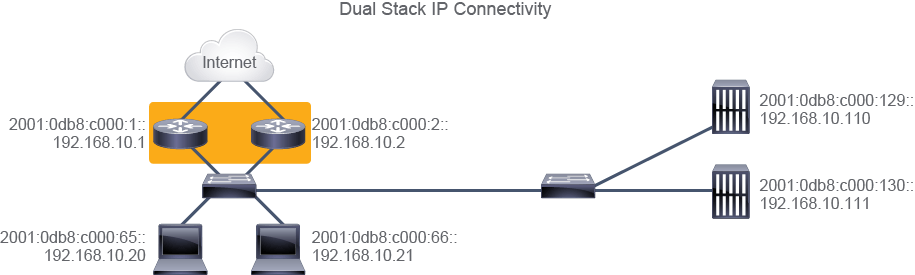
Dual-stack IP connectivity solves the problems of IPv4 address exhaustion by allowing the use of IPv6 addresses alongside existing IPv4 addresses. This approach allows a smooth transition to IPv6 addresses without causing any network disruptions.
雙堆疊 IP 連線讓 IPv6 位址能與現有 IPv4 位址並存使用,藉此解決 IPv4 位址耗盡的問題。這種做法可讓網路在不造成任何中斷的情況下,順利轉換至 IPv6 位址。