Introduction
簡介
Imagine that you are trapped in a maze that keeps changing its layout. Following predefined directions wouldn’t be very helpful, right? But having a dynamic guide that constantly updates the best path as the maze shifts would solve your problem. This scenario is very similar to how dynamic routing protocols work in networking.
想像你被困在一座不斷改變格局的迷宮裡。依循預先設定好的方向並沒有太大幫助,對吧?但如果有一份動態指南,能隨著迷宮改變即時更新最佳路徑,就能解決你的問題。這個情境和動態路由協定在網路中的運作方式非常相似。
Static routing, something that you are already familiar with, is like having fixed directions to navigate the maze: "Turn left, turn right, then go straight, and again turn right." However, if the maze changes its layout, these static routes don’t help much.
靜態路由(你已經熟悉的概念)就像是走迷宮時使用固定方向:「左轉、右轉、直走、再右轉。」然而,如果迷宮改變了格局,這些靜態路由就幫不上什麼忙了。
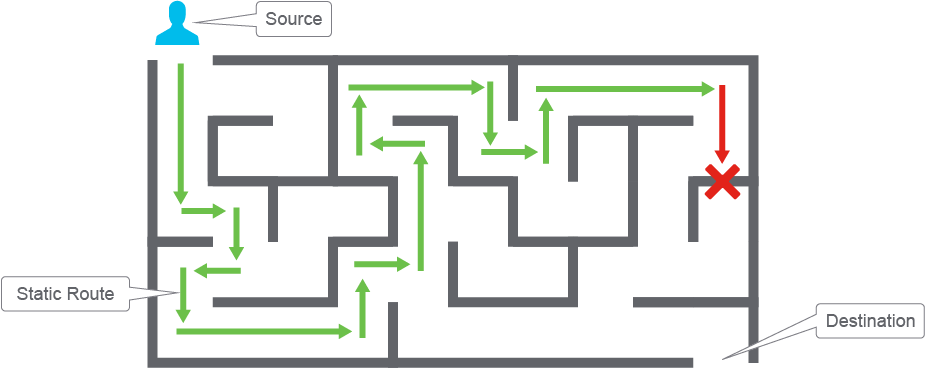
The approach described may have worked in the past, but because the maze keeps changing its layout, constant manual intervention would be required. If the network evolves and grows, does it make sense to use static routing to route traffic through it?
上述方法在過去或許還行得通,但由於迷宮的格局不斷改變,就需要持續進行人工介入。如果網路不斷演進、成長,用靜態路由來轉送流量還合理嗎?
Think about a dynamic guide for your networks:
想想你的網路需要一份動態指南:
- Each router using a dynamic routing protocol sends updates to all other routers, sharing information about its local connections.每台使用動態路由協定的路由器都會向其他所有路由器發送更新,分享自己本地連線的資訊。
- Each router runs an algorithm against its own database to calculate the best path to each destination.每台路由器都會對自己的資料庫執行演算法,計算到每個目的地的最佳路徑。
- Whenever the network topology changes, such as when a link or device goes down, routers immediately send out new updates to refresh their maps.每當網路拓樸發生變化,例如鏈路或裝置故障時,路由器會立即發出新的更新,以重新整理它們的地圖。
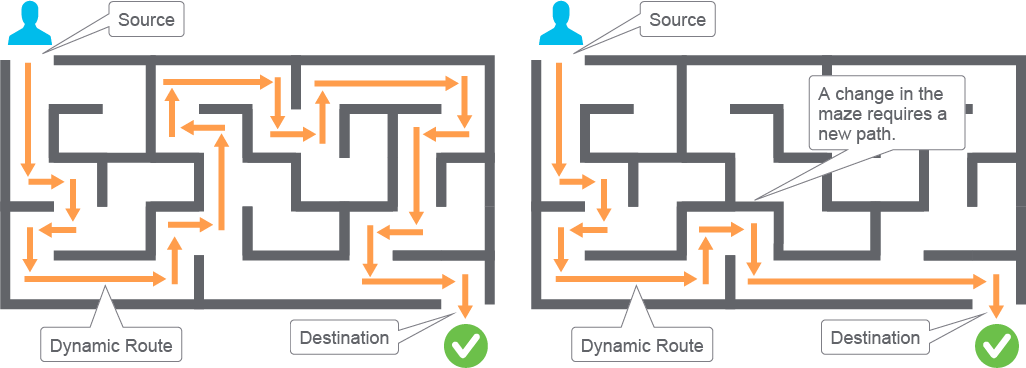
Dynamic routing calculates all paths and presents the best one. If the network topology changes, all paths are recalculated, ensuring you are not stuck without an administrator making manual changes.
動態路由會計算所有路徑並提供最佳路徑。如果網路拓樸發生變化,所有路徑都會重新計算,確保你不會因為沒有系統管理員手動修改而卡住。
Open Shortest Path First (OSPF) is a very popular dynamic routing protocol because it is efficient and scalable. It is supported on many different network devices and is great for managing large and complex networks.
開放最短路徑優先(OSPF)是一種非常流行的動態路由協定,因為它高效且具可擴充性。許多不同的網路裝置都支援它,非常適合管理大型且複雜的網路。
In this course, you will learn how to:
在本課程中,你將學到如何:
- Explain OSPF and dynamic routing protocols in enterprise networks.說明 OSPF 及動態路由協定在企業網路中的應用。
- Differentiate between interior gateway protocols (IGPs) and exterior gateway protocols (EGPs) and explore path selection using metrics and administrative distances.區分內部閘道協定(IGP)與外部閘道協定(EGP),並探討如何使用度量值與管理距離進行路徑選擇。
- Establish and manage OSPF neighbor adjacencies and states and build link-state databases (LSDBs) using the Shortest Path First (SPF) algorithm.建立並管理 OSPF 鄰居鄰接關係與狀態,並使用最短路徑優先(SPF)演算法建立鏈路狀態資料庫(LSDB)。
- Configure and verify single-area OSPF on Cisco IOS routers.在 Cisco IOS 路由器上設定並驗證單區域 OSPF。