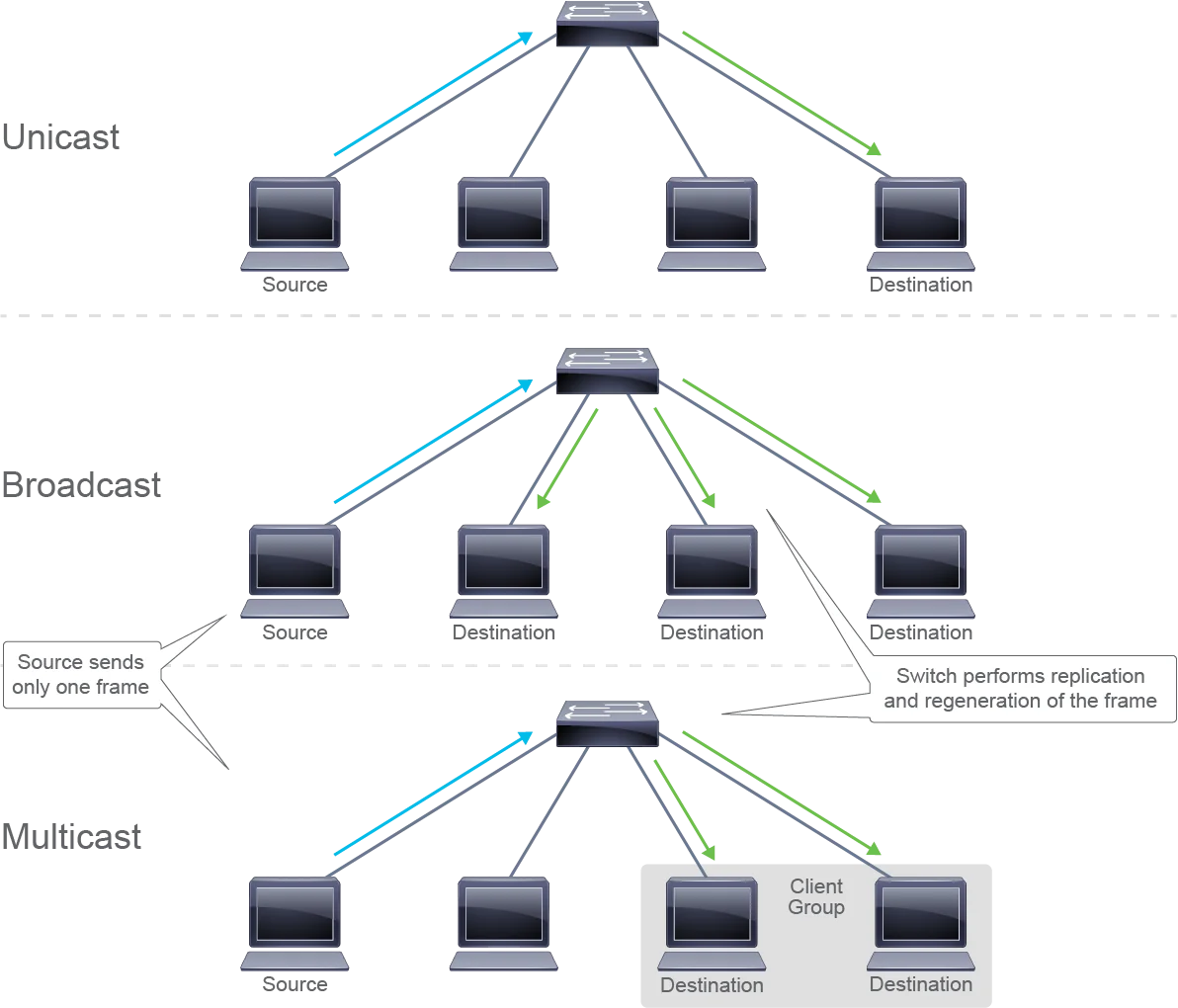
The three major types of network communications are:
網路通訊的三種主要類型為:
- Unicast:Communication in which a frame is sent from one host and is addressed to one specific destination. In a unicast transmission, there is only one sender and one receiver. Unicast transmission is the predominant form of transmission on LANs and within the internet.單播:由一台主機發送框架,並指定給一個特定目的地的通訊方式。在單播傳輸中,只有一個傳送端與一個接收端。單播傳輸是 LAN 及網際網路上最主要的傳輸形式。
- Broadcast: Communication in which a frame is sent from one address to all other addresses. In this case, there is only one sender, but the information is sent to all the connected receivers. Broadcast transmission is used for sending the same message to all devices on the LAN.廣播:由一個位址發送框架給所有其他位址的通訊方式。在此情況下,只有一個傳送端,但資訊會傳送給所有已連線的接收端。廣播傳輸用於將相同訊息傳送給 LAN 上的所有裝置。
- Multicast:Communication in which information is sent to a specific group of devices or clients. Unlike broadcast transmission, in multicast transmission, clients must be members of a multicast group to receive the information.群播:將資訊傳送給特定一群裝置或用戶端的通訊方式。與廣播傳輸不同,在群播傳輸中,用戶端必須是某個群播群組的成員才能接收資訊。
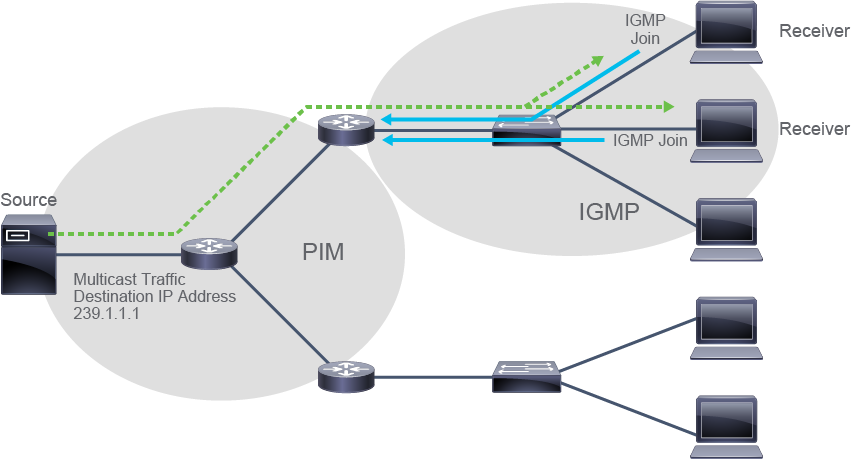
A multicast source can send a multicast stream to a group of devices thanks to the use of specific multicast IP and MAC addresses. The receivers send Join messages to declare that they want to receive the multicast traffic destined to a specific multicast IP address. The source starts to send packets and only the receivers will accept the packets because they are listening that specific multicast IP address, which represents a multicast group. Two main protocols assist in the delivery of multicast packets: Internet Group Management Protocol (IGMP) and Protocol-Independent Multicast (PIM). These protocols work together to build the path that allows the multicast source to send packets to the multicast receivers. IGMP works within the local LAN and it is responsible for handling the Join messages sent by the receivers, and also ensure that multicast traffic is only sent to the multicast group destinations. PIM is a multicast routing protocol that sets up multicast distribution trees for data packets to reach all the receivers that have joined the multicast group.
群播來源可透過使用特定的群播 IP 與 MAC 位址,將群播串流傳送給一群裝置。接收端會發送加入(Join)訊息,表示它們想要接收傳送至特定群播 IP 位址的群播流量。來源開始傳送封包後,只有正在監聽該特定群播 IP 位址(代表一個群播群組)的接收端才會接受這些封包。有兩個主要通訊協定協助群播封包的傳遞:網際網路群組管理協定(IGMP)與獨立於通訊協定的群播(PIM)。這兩個通訊協定共同運作,建立起讓群播來源能將封包傳送給群播接收端的路徑。IGMP 在本地 LAN 內運作,負責處理接收端發送的加入訊息,並確保群播流量只會傳送給群播群組的目的地。PIM 是一種群播路由通訊協定,用來建立群播散佈樹(distribution tree),使資料封包能到達所有已加入該群播群組的接收端。