When routers have different paths to specific destinations (through redundant next-hop routers) and the primary path becomes unavailable, the routing protocol between the routers will dynamically converge, providing a connection through the secondary path.
當路由器之間對特定目的地存在不同路徑(透過備援的下一跳路由器)時,一旦主要路徑無法使用,路由器之間的路由協定會動態收斂,透過次要路徑提供連線。
Hosts that run routing protocols can react in the same manner when the primary path towards different subnets fails, since they do not depend on a default gateway configuration. For example, you can have a Microsoft Windows server with the LAN routing feature that can communicate with two different routers to establish connectivity to remote subnets. If the primary router fails, the server will use the information from the routing protocol to switch to the secondary path.
執行路由協定的主機在通往不同子網路的主要路徑失效時,可以有相同的反應,因為它們不依賴預設閘道設定。舉例來說,你可以有一台具備 LAN 路由功能的 Microsoft Windows 伺服器,能與兩台不同的路由器通訊,以建立到遠端子網路的連線。若主要路由器故障,該伺服器會利用路由協定所提供的資訊切換到次要路徑。
However, most client computers, servers, printers, and so on, do not support dynamic routing protocols and whenever they need to communicate with a host that is located in a different subnet, they must relay packets through the default gateway. Therefore, the availability of this gateway is extremely important.
然而,大多數用戶端電腦、伺服器、印表機等裝置並不支援動態路由協定,因此每當它們需要與位於不同子網路的主機通訊時,都必須透過預設閘道轉送封包。因此,這個閘道的可用性極為重要。
For example, a company that has dual redundant routers that connect users to the internet may experience a problem when the primary router goes down. Without an extra protocol, none of the devices on the company's network can access the internet because of the primary router failure. Even though the secondary router is operational, the devices may not be configured to access a secondary router when the primary router goes down. Hence, an extra feature is needed that can provide default gateway redundancy to the clients.
舉例來說,某家公司擁有雙重備援路由器,將使用者連接到網際網路,若主要路由器故障,就可能發生問題。在沒有額外協定的情況下,由於主要路由器故障,公司網路上的裝置都無法存取網際網路。即使次要路由器仍在正常運作,這些裝置也可能未被設定為在主要路由器故障時改用次要路由器。因此,需要一項額外的功能,為用戶端提供預設閘道備援。
The following figure illustrates a topology with redundant routers that provide routing functions in the specific segment. When the host determines that a destination IPv4 network is not on its local subnet, it forwards the packet to the default gateway. Most IPv4 hosts do not run a dynamic routing protocol to build a list of reachable networks. Instead, they rely on a manually configured or dynamically learned default gateway to route all packets. Typically, IPv4 hosts are configured to request addressing information, including the default gateway, from a DHCP server.
下圖說明了一個具有備援路由器的拓樸,這些路由器在特定網段中提供路由功能。當主機判定目的地 IPv4 網路不在其本地子網路上時,會將封包轉送給預設閘道。大多數 IPv4 主機並不會執行動態路由協定來建立可到達網路的清單,而是依賴手動設定或動態學習到的預設閘道來路由所有封包。一般而言,IPv4 主機會被設定為向 DHCP 伺服器請求定址資訊,其中包括預設閘道。
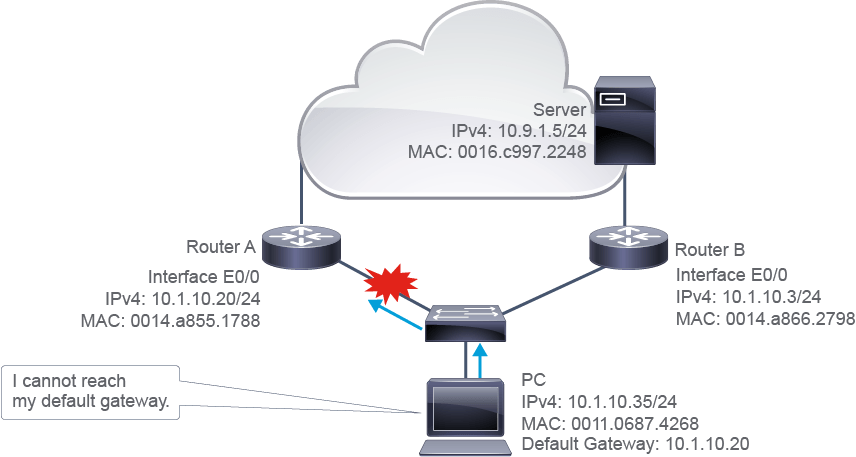
Redundant equipment alone does not guarantee failover. In this example, both Router A and Router B are responsible for routing packets for the 10.1.10.0/24 subnet. Because the routers are deployed as a redundant pair, if Router A becomes unavailable, the interior gateway protocol (IGP) can quickly and dynamically converge and determine that Router B will now transfer the packets that would otherwise have gone through Router A. Because the end device does not run a routing protocol, it will not receive the dynamic routing information.
僅有備援設備並不能保證容錯移轉。在此範例中,Router A 與 Router B 都負責為 10.1.10.0/24 子網路轉送封包。由於這兩台路由器是以備援對的方式部署,若 Router A 無法使用,內部閘道協定(IGP)可以快速動態收斂,並判定改由 Router B 轉送原本經由 Router A 傳送的封包。但由於終端裝置並未執行路由協定,因此不會收到這項動態路由資訊。
The end device is configured with a single default gateway IPv4 address, which does not dynamically update when the network topology changes. If the default gateway fails, the local device is unable to send packets out of the local network segment. As a result, the host is isolated from the rest of the network. Even if a redundant router that could serve as a default gateway for that segment exists, there is no dynamic method by which these devices can determine the address of a new default gateway.
終端裝置設定了單一的預設閘道 IPv4 位址,當網路拓樸改變時,這個位址不會動態更新。若預設閘道故障,本地裝置就無法將封包送出本地網段,結果該主機會與網路其餘部分隔離。即使存在一台可作為該網段預設閘道的備援路由器,這些裝置也沒有動態方法可以判定新預設閘道的位址。