In its Special Publication 800-145, the National Institute of Standards and Technology (NIST) defines cloud computing as "a model for enabling ubiquitous, convenient, on-demand network access to a shared pool of configurable computing resources (for example, networks, servers, storage, applications, and services) that can be rapidly provisioned and released with minimal management effort or service provider interaction." This definition along with the description of cloud computing characteristics, service models, and deployment mode was given in 2011. Although it might not be comprehensive enough to accommodate all cloud computing developments of today, NIST terminology is still accurate and in use by most cloud computing providers.
美國國家標準與技術研究院(NIST)在其特別出版物 800-145 中,將雲端運算定義為「一種模型,可讓使用者隨時隨地、方便地依需求存取可組態運算資源的共用資源池(例如網路、伺服器、儲存、應用程式與服務),並可在最少的管理成本或服務供應商互動下快速布建與釋出。」此定義連同雲端運算特性、服務模型與部署模式的說明於 2011 年提出。雖然這套定義可能不足以涵蓋今日所有雲端運算的發展,但 NIST 的術語至今仍然準確,且被多數雲端運算供應商採用。
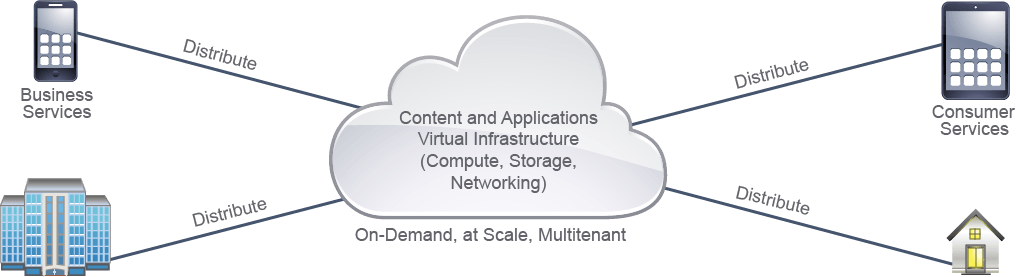
Clouds have become common in modern internet-driven technologies. Many popular internet services function as a cloud. Some are intended for individuals—for instance, Gmail and Yahoo mail—providing an email service, or Microsoft OneDrive, Google Drive, Adobe Creative Cloud, or Dropbox providing document sharing, storage, or media editing services. Other cloud products address business and organizational needs, such as Amazon Web Services, Google Cloud, Salesforce, Oracle Cloud, and Alibaba.
雲端已成為現代網際網路驅動技術中常見的元素。許多熱門的網際網路服務都是以雲端方式運作。有些服務針對個人用戶,例如 Gmail 與 Yahoo Mail 提供電子郵件服務,或 Microsoft OneDrive、Google Drive、Adobe Creative Cloud、Dropbox 提供文件共享、儲存或媒體編輯服務。其他雲端產品則針對企業與組織需求,例如 Amazon Web Services、Google Cloud、Salesforce、Oracle Cloud 與 Alibaba。
Enterprise networks often include data centers. Data centers are part of IT infrastructure, where computing resources are centralized and virtualized to support applications and access to those applications, while ensuring high availability and resiliency. Data centers also provide support for a mobile workforce, varying access device types, and a high-volume, data-driven business. When a data center is located at the enterprise premises, it is called an on-premises data center.
企業網路通常包含資料中心。資料中心是 IT 基礎架構的一部分,運算資源在此集中並虛擬化,以支援應用程式及對這些應用程式的存取,同時確保高可用性與韌性。資料中心也支援行動化工作團隊、各種存取裝置類型,以及高資料量、資料驅動的業務。當資料中心位於企業自有場地時,稱為地端(on-premises)資料中心。
Clouds are in essence large-scale data centers, or an interconnection of data centers, which have all or some of the following characteristics, as described by NIST:
雲端本質上是大型資料中心,或資料中心的互聯集合,依 NIST 的描述,具備下列全部或部分特性:
- On-demand self-service: Cloud computing capabilities, such as server computing time and network storage, are activated as needed without requiring human interaction with each cloud provider.隨需自助服務:雲端運算能力,例如伺服器運算時間與網路儲存空間,可依需要啟用,不需要人員與各雲端供應商互動。
- Broad network access: Clouds are accessible to the users (businesses and individuals) remotely via some type of network connectivity, through the internet or cloud-dedicated WAN networks. The cloud can be accessed by using a variety of client platforms, such as mobile phones, tablets, laptops, and workstations.廣泛的網路存取:使用者(企業與個人)可透過某種網路連線方式,例如網際網路或雲端專用 WAN 網路,以遠端方式存取雲端。使用者可透過各種用戶端平台存取雲端,例如行動電話、平板電腦、筆記型電腦與工作站。
- Resource pooling: Clouds serve multiple customers with different requirements. Users of different customers are isolated. Users generally have no control or knowledge over the exact location of the provided resources. The cloud resources appear centralized to the user. Users can move from one device to another, or one location to another, and always experience a familiar environment. Backups and data management are centralized, so users and IT staff no longer need to be concerned about backing up data on individual computers.資源池化:雲端可同時為多個需求各異的客戶提供服務。不同客戶的使用者彼此隔離。使用者通常無法得知或控制所提供資源的確切位置。對使用者而言,雲端資源看起來是集中的。使用者可以從一台裝置切換到另一台裝置,或從一個地點切換到另一個地點,並始終體驗到熟悉的環境。備份與資料管理是集中式的,因此使用者與 IT 人員不再需要煩惱個別電腦的資料備份問題。
- Rapid elasticity: Customers can scale (in other words add or release) resources on their own. Resources can be allocated to meet the realistic requirements, avoiding overprovisioning. Optimization of resource allocation usually results in reducing costs.快速彈性:客戶可以自行擴充(新增)或釋出資源。資源可依實際需求配置,避免過度布建。資源配置的最佳化通常能降低成本。
- Measured service: Clouds use metering (or measuring) to monitor and control resource usage. Different usage elements can be measured, for instance, storage capacity, processing, bandwidth, or numbers of concurrent users, therefore providing a basis for billing. Clouds also provide reporting, which can be used to control and optimize resource use and costs.計量服務:雲端使用計量(測量)方式監控與控管資源使用情形。可測量的使用要素包括儲存容量、處理能力、頻寬或同時使用者人數,藉此作為計費依據。雲端也提供報告功能,可用來控管與最佳化資源使用與成本。
For an enterprise, outsourcing computing resources to a cloud provider can be a solution in these cases:
對企業而言,將運算資源外包給雲端供應商可以是下列情況的解決方案:
- For an enterprise that may not have the in-house expertise to effectively manage their current and future IT infrastructure, especially if cloud services primarily involve basic elements such as email, DHCP, DNS, document processing, and collaboration tools.適用於缺乏內部專業能力來有效管理目前及未來 IT 基礎架構的企業,尤其是當雲端服務主要涉及電子郵件、DHCP、DNS、文件處理與協作工具等基本元素時。
- For large enterprises and government or public organizations, where resources are shared by many users or organizational units.適用於資源由許多使用者或組織單位共用的大型企業、政府或公家機構。
- For enterprises in which computing resource needs might increase on an ad hoc basis and for a short term. This usage scenario is sometimes called cloud bursting. When computing requirements increase, the cloud resources are coupled with on-premises resources only while required.適用於運算資源需求可能臨時性、短期增加的企業。此使用情境有時稱為雲端爆量(cloud bursting)。當運算需求增加時,僅在需要時將雲端資源與地端資源結合使用。
- For enterprises that decide to outsource only part of their resources. For example, an enterprise might outsource their web front-end infrastructure, while keeping other resources on-premises, such as application and database services.適用於決定僅外包部分資源的企業。例如,企業可能將 Web 前端基礎架構外包,同時將其他資源(如應用程式與資料庫服務)保留在地端。
There are also situations in which cloud outsourcing would not be possible. Regulations might dictate that an enterprise fully own and manage their infrastructure. For enterprises running business applications that have strict response-time requirements, cloud outsourcing might not be the appropriate solution.
也有一些情況不適合將雲端外包。法規可能要求企業必須完全擁有並管理自己的基礎架構。對於執行有嚴格回應時間要求之業務應用程式的企業,雲端外包可能不是合適的解決方案。
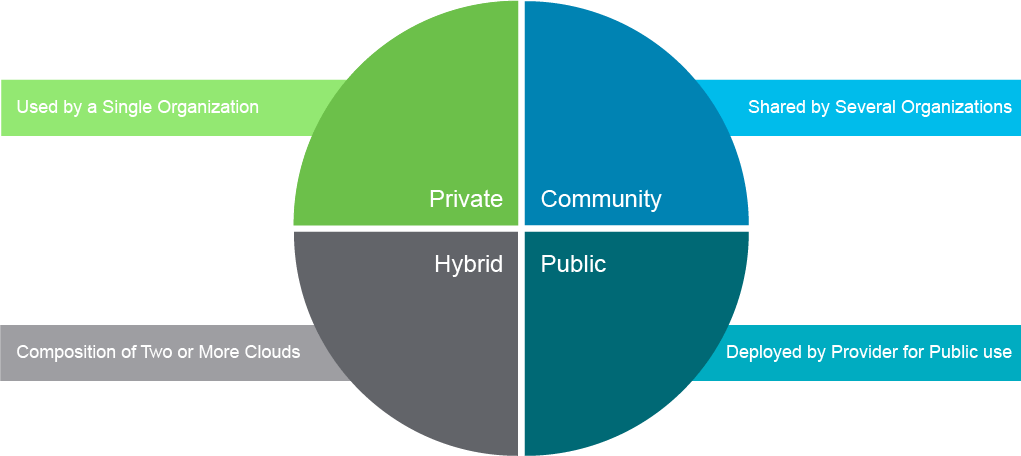
Cloud deployment models describe the cloud ownership and control of data in the cloud. The four cloud deployment models distinguished by NIST are as follows:
雲端部署模型描述雲端中資料的所有權與控制方式。NIST 區分出的四種雲端部署模型如下:
- Public clouds: Public clouds are open to use by the public and managed by a dedicated cloud service provider. The cloud infrastructure exists on the premises of the cloud provider and is external to the customers (businesses and individuals). The cloud provider owns and controls the infrastructure and data. Outsourcing resources to a public cloud provider means that you have little or no control over upgrades, security fixes, updates, feature additions, or how the cloud provider implements technologies.公有雲:公有雲開放供大眾使用,並由專責的雲端服務供應商管理。雲端基礎架構位於雲端供應商的場地,對客戶(企業與個人)而言是外部的。雲端供應商擁有並控制基礎架構與資料。將資源外包給公有雲供應商,代表你對升級、安全性修補、更新、功能新增或供應商如何實作技術幾乎沒有控制權。
- Private cloud: The main characteristic of a private cloud is the lack of public access. Users of private clouds are particular organizations or groups of users. A private cloud infrastructure is owned, managed, and operated by a third party, or the user itself. An enterprise might own a cloud data center and IT departments might manage and operate it, which allows the user to enjoy advantages that a cloud provides, such as resiliency, scalability, easier workload distribution, while maintaining control over corporate data, security and performance.私有雲:私有雲的主要特徵是不對外公開存取。私有雲的使用者是特定組織或使用者群組。私有雲基礎架構由第三方或使用者自身擁有、管理與營運。企業可能自行擁有雲端資料中心,並由 IT 部門管理與營運,讓使用者享有雲端帶來的韌性、可擴充性、更易於分配工作負載等優勢,同時仍能掌控企業資料、安全性與效能。
- Community cloud: The community cloud is an infrastructure intended for users from specific organizations that have common business-specific objectives or work on joint projects and have the same requirements for security, privacy, performance, compliance, and so on. Community clouds are "dedicated," in other words, they are provisioned according to the community requirements. They can be considered halfway between a public and private cloud—they have a multitenant infrastructure, but are not open for public use. A community cloud can be managed internally or by a third party and it may exist on or off premises. An example of a community cloud is Worldwide LHC Computing Grid, a European Organization for Nuclear Research global computing resource to store, distribute, and analyze the data of operations from the Large Hadron Collider (LHC).社群雲:社群雲是一種基礎架構,供有共同業務目標、共同專案,或對安全性、隱私、效能、法規遵循等有相同需求的特定組織使用者使用。社群雲是「專屬的」,也就是依社群需求進行布建。它們可視為介於公有雲與私有雲之間,具有多租戶基礎架構,但並非開放供公眾使用。社群雲可由內部或第三方管理,並可位於地端或非地端。社群雲的一個例子是全球 LHC 運算網格(Worldwide LHC Computing Grid),這是歐洲核子研究組織用來儲存、分發與分析大型強子對撞機(LHC)作業資料的全球運算資源。
- Hybrid cloud: A hybrid cloud is the cloud infrastructure that is a composition of two or more distinct cloud infrastructures, such as private, community, or public cloud infrastructures. This deployment takes advantage of security provided in private clouds and scalability of the public clouds. Some organizations outsource certain IT functions to a public cloud but prefer to keep higher-risk or more tailored functions in a private cloud or even in-house. An example of hybrid deployment would be using public clouds for archiving of older data, while keeping the current data in the private cloud. The user retains control over how resources are distributed. For hybrid solutions to provide data protection, great care must be taken that sensitive data is not exposed to the public.混合雲:混合雲是由兩種以上不同雲端基礎架構(如私有雲、社群雲或公有雲)組合而成的雲端基礎架構。此部署方式結合了私有雲的安全性與公有雲的可擴充性。有些組織會將特定 IT 功能外包給公有雲,但偏好將風險較高或較客製化的功能保留在私有雲甚至內部自行處理。混合部署的一個例子是使用公有雲封存較舊的資料,同時將目前的資料保留在私有雲中。使用者仍能掌控資源的分配方式。若混合方案要提供資料保護,必須非常小心,避免敏感資料暴露於公共環境。
Clouds are large data centers, whose computing resources, in other words storage, processing, memory, and network bandwidth, are shared among many users. Computing resources of a cloud are offered as a service, rather than a product. Clouds can offer anything a computer can offer, from processing capabilities to operating system and applications, therefore cloud services vary considerably. Service models define which services are included in the cloud.
雲端是大型資料中心,其運算資源,也就是儲存、處理能力、記憶體與網路頻寬,由許多使用者共用。雲端的運算資源以服務形式提供,而非產品形式。雲端可以提供電腦所能提供的任何功能,從處理能力到作業系統與應用程式,因此雲端服務的種類差異相當大。服務模型定義了雲端所包含的服務內容。
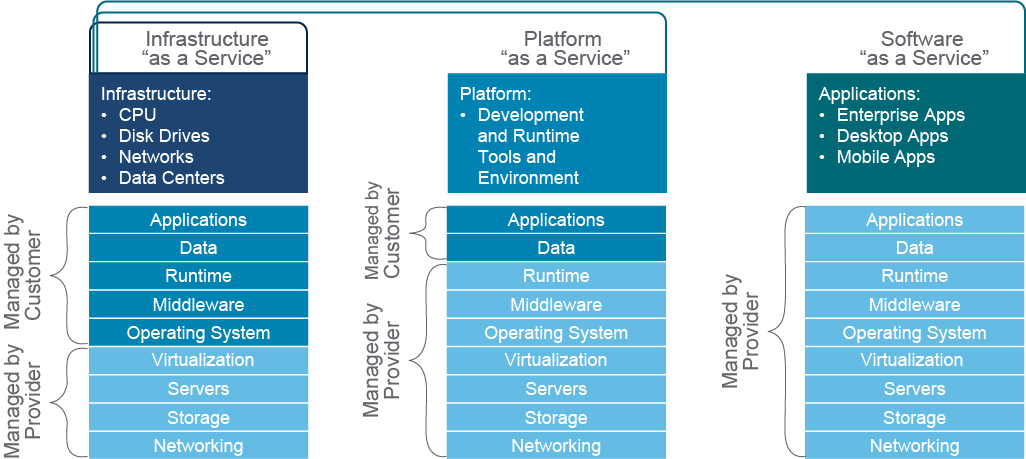
NIST has defined three service models that differ in the extent that the IT infrastructure is provided by the cloud. The following three NIST-defined service models also define the responsibilities for management of the equipment and the software between the service provider and the customer.
NIST 定義了三種服務模型,其差異在於 IT 基礎架構由雲端提供的程度。以下三種 NIST 定義的服務模型,也定義了服務供應商與客戶之間對設備與軟體管理的責任分工。
- Infrastructure as a Service (IaaS)clouds offer pure computing, storage, and network resources. For instance, you can purchase a certain number of virtual machines. Software components in IaaS cloud are added by the customer and include operating systems and applications. You are responsible for specifying the resources for the IaaS cloud, such as memory, disk space, and CPU speed. Any changes to the infrastructure, such as adding or removing resources, are your responsibility and not the provider’s. The IaaS model offers customers the greatest control. Examples of IaaS clouds are Amazon Elastic Computing Cloud (EC2), Microsoft Azure Virtual Machines, Google Compute Engine, Oracle Compute Cloud Service, IBM Cloud Virtual Servers, and others.基礎架構即服務(IaaS)雲端提供純粹的運算、儲存與網路資源。例如,你可以購買一定數量的虛擬機器。IaaS 雲端中的軟體元件由客戶自行新增,包括作業系統與應用程式。你負責指定 IaaS 雲端所需的資源,例如記憶體、磁碟空間與 CPU 速度。任何基礎架構的變更,例如新增或移除資源,都是你的責任,而非供應商的責任。IaaS 模型讓客戶擁有最大的控制權。IaaS 雲端的例子有 Amazon Elastic Computing Cloud(EC2)、Microsoft Azure Virtual Machines、Google Compute Engine、Oracle Compute Cloud Service、IBM Cloud Virtual Servers 等。
- Platform as a Service (PaaS) model offers a software platform with everything required to support the complete life cycle of building and delivering applications. Users can build, debug, and deploy their own applications and host them on the PaaS provider's infrastructure. However, the provider decides which programming languages, libraries, services, and tools to support. When hosting the applications in the PaaS cloud, the scalability of the hardware and software is the responsibility of the provider. Examples of PaaS offerings are Google App Engine, Salesforce, Heroku, Oracle Cloud Platform, and others.平台即服務(PaaS)模型提供一個軟體平台,包含建置與交付應用程式完整生命週期所需的一切。使用者可以建置、除錯並部署自己的應用程式,並將其託管在 PaaS 供應商的基礎架構上。不過,供應商決定支援哪些程式語言、程式庫、服務與工具。將應用程式託管於 PaaS 雲端時,硬體與軟體的可擴充性是供應商的責任。PaaS 服務的例子有 Google App Engine、Salesforce、Heroku、Oracle Cloud Platform 等。
- Software as a Service (SaaS) is also called a hosted software model, and includes ready-to-use applications or software with all the required infrastructure elements required for running them, such as operating system, database, and network. The SaaS provider is responsible for managing the software and performs installation, maintenance, upgrading, and patching. Users access the applications from various client devices through either a thin client (software that does not use many resources on the client but uses the resources of a server, for example web-based email), or through a program interface. The customer does not manage or control the underlying cloud infrastructure. Examples of SaaS cloud services are Cisco Webex, Salesforce, Microsoft 365, Adobe Creative Cloud, and others.軟體即服務(SaaS)也稱為代管軟體模型,包含隨時可用的應用程式或軟體,並具備執行所需的全部基礎架構元素,例如作業系統、資料庫與網路。SaaS 供應商負責管理軟體,並執行安裝、維護、升級與修補。使用者可透過各種用戶端裝置,經由輕量型用戶端(不占用太多用戶端資源、而是使用伺服器資源的軟體,例如網頁式電子郵件)或程式介面來存取應用程式。客戶不需管理或控制底層的雲端基礎架構。SaaS 雲端服務的例子有 Cisco Webex、Salesforce、Microsoft 365、Adobe Creative Cloud 等。
Today, other service models exist. Anything as a service (XaaS) is a concept that emphasizes that the cloud offer can include any computing service. Examples of new service models are serverless clouds, which provide computing resources to execute only a specific function developed by the customer. Serverless clouds are also known as Function as a Service (FaaS). Other emerging models include: Database as a Service (DBaaS), Desktop as a Service (DaaS), Business Process as a Service (BPaaS), Network as a Service (NaaS), and so on. Examples of XaaS services are Cisco DaaS, Microsoft Azure SQL Database, Amazon Relational Database Service, Google Function, and others.
如今也存在其他服務模型。萬物即服務(XaaS)是一種概念,強調雲端提供的服務可以是任何運算服務。新服務模型的例子包括無伺服器雲端,它僅為執行客戶開發的特定函式提供運算資源。無伺服器雲端也稱為函式即服務(FaaS)。其他新興模型還包括:資料庫即服務(DBaaS)、桌面即服務(DaaS)、業務流程即服務(BPaaS)、網路即服務(NaaS)等。XaaS 服務的例子有 Cisco DaaS、Microsoft Azure SQL Database、Amazon Relational Database Service、Google Function 等。
| PaaSPaaS | A model that provides ready-to-use applications, which are regularly updated and patched by the provider提供隨時可用的應用程式,並由供應商定期更新與修補的模型 |
| SaaSSaaS | A model that provides infrastructure and software elements that create an environment for the customer to build their own applications and includes provider responsibility for scaling the provided resources提供基礎架構與軟體元素,讓客戶建置自己的應用程式,且供應商負責調整所提供資源規模的模型 |
| IaaSIaaS | A model in which changes in resources are a responsibility of the customer資源變更由客戶負責的模型 |
| XaaSXaaS | A cloud offer that can include any computing service可包含任何運算服務的雲端服務 |