Introduction
簡介
Imagine that you work at the IT helpdesk at a medium-sized manufacturing company. David, an intern, has recently joined your team. Today, you are tasked with showing David how to set up email accounts for new employees. After the accounts are all set up, David asks you an interesting question. He says, "I know the basics of how an email travels from the sender to the recipient, but could you break down what exactly happens at each step?" You start thinking about all the components working together to accomplish this task.
想像你在一家中型製造公司的 IT 服務台工作。實習生 David 最近加入了你的團隊。今天你的任務是教 David 如何為新進員工建立電子郵件帳號。帳號全部設定完成後,David 問了你一個有趣的問題。他說:「我知道電子郵件從寄件者傳送到收件者的基本流程,但你能不能拆解說明每一步究竟發生了什麼事?」你開始思考完成這項工作時,所有元件是如何協同運作的。
You realize the following:
你體認到以下幾點:
- Different computers and systems must communicate in a standardized way, regardless of their hardware or software.不同的電腦與系統必須以標準化的方式通訊,不受其硬體或軟體限制。
- You need mechanisms for detecting errors during communications to ensure reliable data transfer.需要在通訊過程中偵測錯誤的機制,以確保資料傳輸可靠。
- Each computer on a network needs a unique address for accurate data routing.網路上的每台電腦都需要唯一的位址,才能正確地將資料路由送達。
- Data must stay intact and unchanged during transmission.資料在傳輸過程中必須保持完整且不被更動。
- Data flow between computers needs to be managed efficiently.電腦之間的資料流量需要被有效管理。
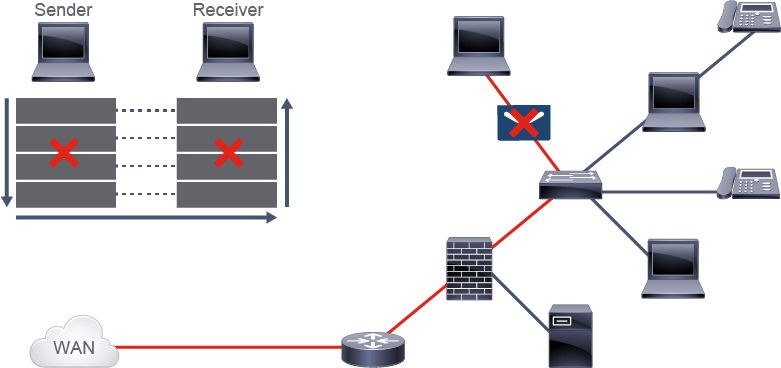
Because there is no communications model in place in this example, devices are unable to effectively communicate with one another.
在這個例子中,由於沒有任何通訊模型,裝置之間無法有效地彼此通訊。
 | How would you solve these problems? 你會如何解決這些問題? |
Network engineers need a structured approach to effectively resolve connectivity issues. The host-to-host communications model provides a standardized framework, aiding in systematic troubleshooting for faster problem resolution and improved network performance.
網路工程師需要一套結構化的方法,才能有效解決連線問題。主機對主機通訊模型提供了標準化的框架,有助於系統性的疑難排解,進而更快解決問題並提升網路效能。
In this course, you will learn the following:
在本課程中,你將學到以下內容:
- The TCP/IP protocol suite layers and their functions.TCP/IP 協定套組的各層及其功能。
- The difference between TCP/IP and OSI models.TCP/IP 模型與 OSI 模型的差異。
- How information is transmitted across networks.資訊如何在網路之間傳輸。
- The encapsulation and de-encapsulation processes.封裝與解封裝的過程。
- Benefits of layered communication models.分層通訊模型的優點。
- How to use the TCP/IP and OSI models to troubleshoot network issues.如何運用 TCP/IP 與 OSI 模型進行網路問題的疑難排解。
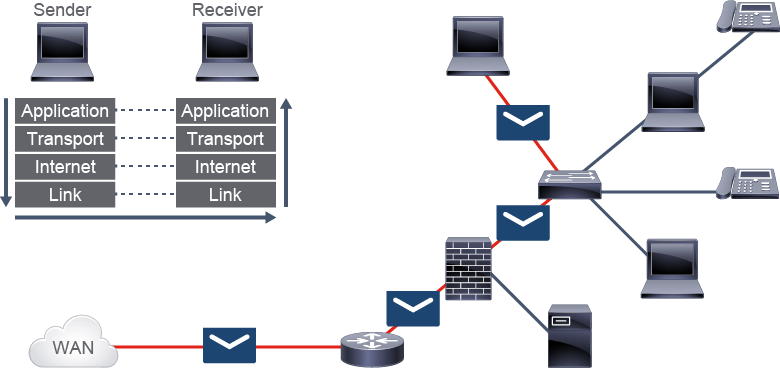
Having a structured communications model in place allows the devices to establish a connection and successfully communicate with one another.
有了結構化的通訊模型,裝置便能建立連線並成功地彼此通訊。