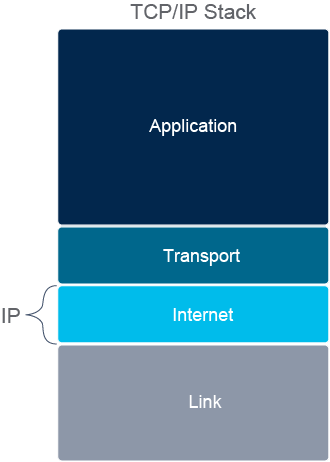
The IP component of TCP determines where packets of data are routed based on their destination addresses. IP has certain characteristics that are related to how it manages this function.
TCP 中的 IP 元件會根據目的地位址決定資料封包的路由方式。IP 具有若干與其管理此功能方式相關的特性。
IP uses packets to carry information through the network. A packet is a self-contained, independent entity that contains data and sufficient information to be routed from the source to the destination without reliance on previous packets.
IP 使用封包在網路中傳遞資訊。封包是一個自成一體、獨立的實體,內含資料及足夠的資訊,可在不依賴先前封包的情況下,從來源被路由到目的地。
IP has these characteristics:
IP 具有下列特性:
- IP operates at Layer 3 or the network layer of the Open Systems Interconnection (OSI) reference model (network layer) and at the Internet layer of the TCP/IP stack.IP 在開放系統互連(OSI)參考模型的第 3 層(網路層),以及 TCP/IP 協定堆疊的網際網路層運作。
- IP is a connectionless protocol, in which a one-way packet is sent to the destination without advance notification to the destination device. The destination device receives the data and does not return any status information to the sending device.IP 是一種無連線協定,會將單向封包送往目的地,事先不會通知目的裝置。目的裝置接收資料後,不會向傳送裝置回傳任何狀態資訊。
- Each packet is treated independently, which means that each packet can travel a different way to the destination.每個封包都是獨立處理的,這表示每個封包可以走不同的路徑抵達目的地。
- IP uses hierarchical addressing, in which the network identification is the equivalent of a street, and the host ID is the equivalent of a house or an office building on that street.IP 使用階層式定址,其中網路識別碼相當於街道,而主機 ID 相當於該街道上的一棟房子或辦公大樓。
- IP provides service on a best-effort basis and does not guarantee packet delivery. A packet can be misdirected, duplicated, or lost on the way to its destination.IP 以盡力而為(best-effort)的方式提供服務,不保證封包送達。封包在前往目的地的途中可能被誤導、重複或遺失。
- IP does not provide any special features that recover corrupted packets. Instead, the end systems of the network provide these services.IP 不提供任何用於復原損毀封包的特殊功能,而是由網路的終端系統提供這類服務。
- IP operates independently of the medium that is carrying the data.IP 的運作與承載資料的傳輸媒介無關。
- There are two types of IP addresses, IPv4 and IPv6, the latter becoming increasingly important in modern networks.IP 位址有兩種類型:IPv4 與 IPv6,後者在現代網路中日益重要。
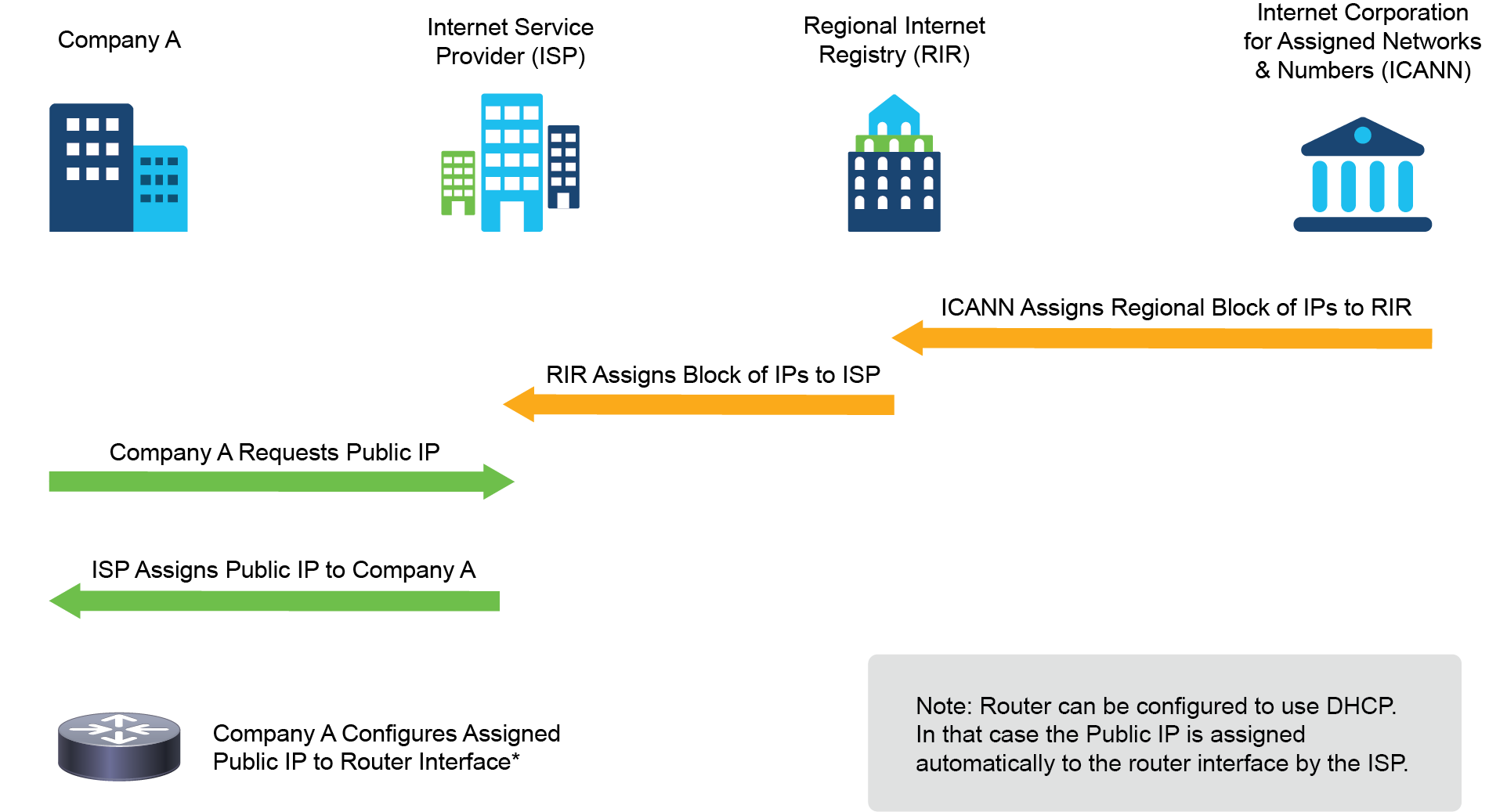
The image below shows the process of Company A obtaining a public IP address. ICANN is responsible for assigning regional blocks of IP addresses to different Regional Internet Registries (RIR). The RIR is then responsible for assigning smaller blocks of their assigned regional block to the Internet Service Providers (ISPs) within their region. Company A sends a request to the ISP to obtain a public IP address and then the ISP assigns a public IP address to the company from their available block of IP addresses.
下圖顯示 A 公司取得公用 IP 位址的過程。ICANN 負責將區域性的 IP 位址區塊分配給不同的區域網際網路註冊管理機構(RIR)。RIR 接著負責將其獲配區域區塊中較小的區塊分配給該區域內的網際網路服務供應商(ISP)。A 公司向 ISP 提出取得公用 IP 位址的請求,接著 ISP 便從其可用的 IP 位址區塊中分配一個公用 IP 位址給該公司。
Example: Delivering a Letter Through a Postal Service
範例:透過郵政服務寄送信件
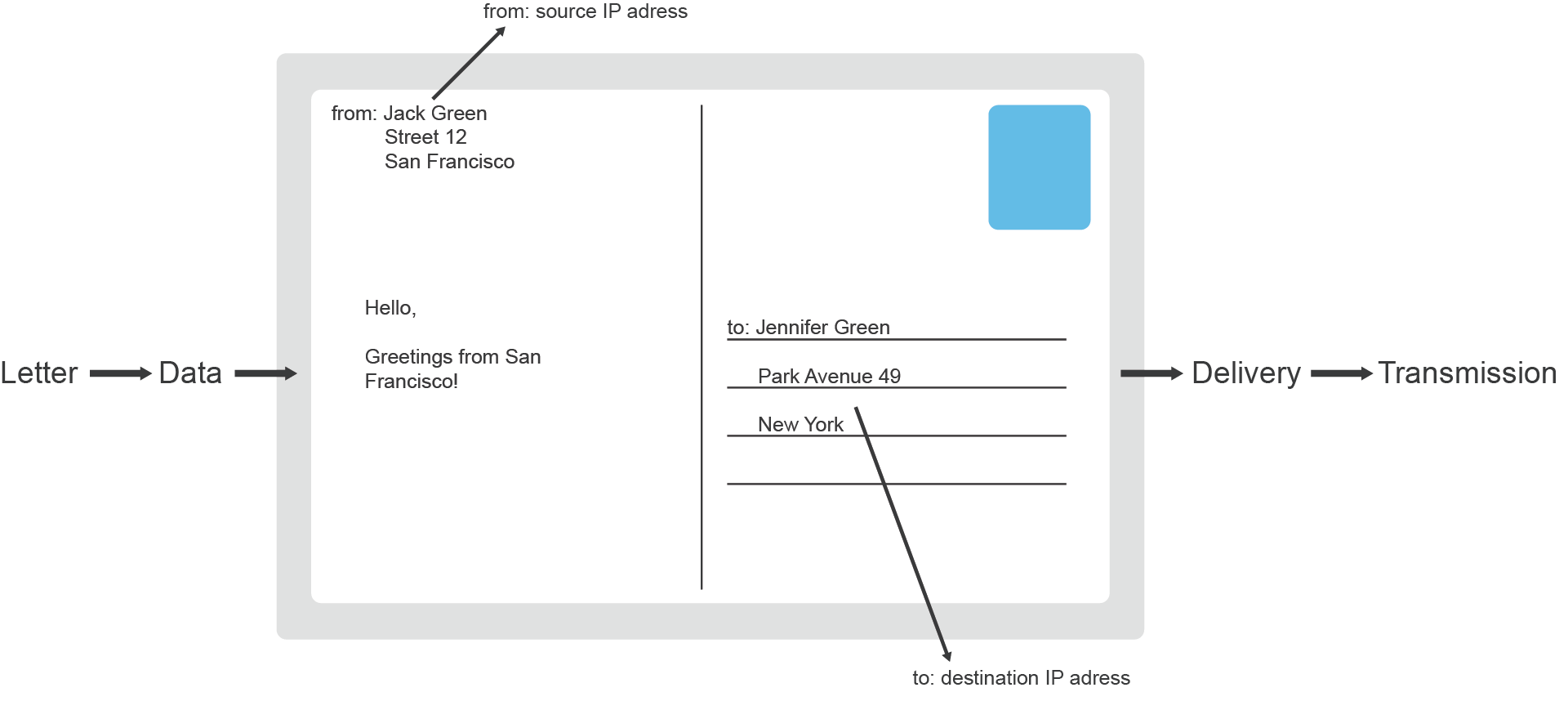
An analogy for IP services would be mail delivery by postal service. For example, you live in San Francisco, and your mother lives in New York. You write three letters to your mother. You seal each letter in a separate envelope, address each letter, and write your return address in the upper left-hand corner of each envelope.
IP 服務的一個類比是郵政服務的郵件遞送。舉例來說,你住在舊金山,你的母親住在紐約。你寫了三封信給母親,將每封信分別封入不同的信封,在每個信封上寫上地址,並在信封左上角寫上你的回郵地址。
You deposit the three letters in the outgoing mail slot at your local post office. The postal service makes its best attempt to deliver all three letters to your mother in New York. However, the postal service will not guarantee that the letters will arrive at their destination. It will not guarantee that all three letters will be processed by the same carrier or take the same route. And it will not guarantee that the letters will arrive in the order in which you mailed them.
你把這三封信投入當地郵局的寄件信箱。郵政服務會盡力嘗試將這三封信都送到你在紐約的母親手中,但郵政服務並不保證信件一定能送達目的地,也不保證三封信會由同一位郵差處理或走相同的路線,更不保證信件會依照你寄出的順序送達。
In this analogy, you can understand the letter as data that an IP packet includes. The letter must have the necessary specifications about where to send it and where to return to. The same is with IP packets—They need to define their source and destination. Your address represents the source IP address of the packet and the address of your mother represents the destination IP address. When the letter is sent to delivery, it represents the analogy of IP packet transmission. If multiple letters are sent, each one of them will be sent independently and the post officer will treat each one of them separately. The same happens with IP packets, where network devices treat each one separately.
在這個類比中,你可以把信件理解為 IP 封包所包含的資料。信件必須具備寄送地址與回郵地址等必要資訊,IP 封包也是一樣——它們需要定義來源與目的地。你的地址代表封包的來源 IP 位址,你母親的地址則代表目的地 IP 位址。信件寄出遞送時,就相當於 IP 封包傳輸的類比。如果同時寄出多封信,每一封都會被獨立寄送,郵局人員也會個別處理每一封信。IP 封包也是如此,網路裝置會分別處理每一個封包。