To connect a switch to a LAN, you must use some sort of media. The most common LAN media is Ethernet. Ethernet is not just a type of cable or protocol. It is a network standard published by the IEEE. So you may hear various Ethernet terms, such as Ethernet protocols, Ethernet cables, Ethernet ports, and Ethernet switches. IEEE 802.3 and Ethernet are often used synonymously, although they have some differences. The term Ethernet is more common, and IEEE 802.3 is usually used when referring to a specific part of the standard, such as a particular frame format. Ethernet is a set of guidelines that enable various network components to work together. These guidelines specify cabling and signaling at the physical and data link layers of the OSI model. For example, Ethernet standards recommend different types of cabling and specify maximum segment lengths for each type.
若要將交換器連接到 LAN,你必須使用某種傳輸媒介。最常見的 LAN 傳輸媒介是乙太網路。乙太網路不只是一種纜線或通訊協定,而是由 IEEE 發佈的一種網路標準。因此你會聽到各種乙太網路相關用語,例如乙太網路通訊協定、乙太網路纜線、乙太網路連接埠與乙太網路交換器。IEEE 802.3 與乙太網路經常被交替使用,儘管兩者之間存在一些差異。「乙太網路」一詞較常見,而 IEEE 802.3 通常用於指稱標準中的特定部分,例如特定的框架格式。乙太網路是一套讓各種網路元件能夠協同運作的準則,這些準則規範了 OSI 模型中實體層與資料鏈結層的纜線配置與訊號傳輸。舉例來說,乙太網路標準建議使用不同類型的纜線,並為每種纜線類型規定最大線段長度。
The names of the standards (shown in the table) specify the transmission speed, the type of signaling, and the type of cabling. For example, the standard name 1000BASE-T denotes the following:
表中所列標準的名稱指明了傳輸速度、訊號類型與纜線類型。舉例來說,標準名稱 1000BASE-T 代表以下含義:
- 1000: Specifies a transmission speed of 1000 Megabits per second (Mbps) or 1 Gigabit per second (Gbps)1000:表示傳輸速度為每秒 1000 百萬位元(Mbps),即每秒 1 十億位元(Gbps)
- BASE: Refers to baseband signaling (which means that only Ethernet signals are carried on the medium)BASE:代表基頻訊號傳輸(意即該傳輸媒介僅承載乙太網路訊號)
- T: Represents twisted-pair cabling.T:代表雙絞線纜線。
Twisted-pair cabling is a type of wiring in which two conductors are twisted together for the purpose of canceling EMI from external sources.
雙絞線是一種將兩條導線互相纏繞在一起的配線方式,目的是抵消外部來源的電磁干擾(EMI)。
Ethernet Media Standards
乙太網路傳輸媒介標準
Requirement 需求 | 100BASE-TX 100BASE-TX | 100BASE-FX 100BASE-FX | 1000BASE-T 1000BASE-T | 1000BASE-SX 1000BASE-SX | 1000BASE-LX 1000BASE-LX |
Media 傳輸媒介 | TIA Category 5 UTP two-pair TIA Category 5 UTP 兩對線 | 62.5 /125-micron multimode fiber 62.5 /125 微米多模光纖 | TIA Category 5, 5e UTP four-pair TIA Category 5、5e UTP 四對線 | 62.5 /50-micron multimode fiber 62.5 /50 微米多模光纖 | 9-micron single-mode fiber 9 微米單模光纖 |
Maximum Segment Length 最大線段長度 | 100 m (328 ft) 100 m (328 ft) | 400 m (1312.3 ft) 400 m (1312.3 ft) | 100 m (328 ft) 100 m (328 ft) | 275 m (62.5 microns) 550 m (50 microns) 275 m (62.5 微米) 550 m (50 微米) | 5–10 km (1.86–6.2 miles) 5–10 km (1.86–6.2 miles) |
Connector 接頭 | ISO 8877 (RJ-45) ISO 8877 (RJ-45) | Duplex MIC ST Duplex MIC ST | ISO 8877 (RJ-45) ISO 8877 (RJ-45) | Optical fiber connector 光纖接頭 | Optical fiber connector 光纖接頭 |
- TIA: Telecommunications Industry AssociationTIA:電信工業協會(Telecommunications Industry Association)
- UTP: Unshielded Twisted PairUTP:非遮蔽雙絞線(Unshielded Twisted Pair)
- ISO: International Organization for StandardizationISO:國際標準化組織(International Organization for Standardization)
- RJ: Registered JackRJ:註冊插孔(Registered Jack)
To physically connect the end devices through the electrical or optical media, there are connectors and jacks of different types.
為了透過電子或光學傳輸媒介實際連接終端裝置,存在著多種不同類型的接頭與插孔。
For optical media connections in an enterprise environment, the usual optical connector types are Lucent Connector (LC), Standard Connector (SC), Multi-fiber Termination Push-on (MTP), and Straight Tip (ST), while Ferrule Connector (FC) is common in service provider equipment.
在企業環境中的光學傳輸媒介連線,常見的光纖接頭類型包括 Lucent Connector(LC)、Standard Connector(SC)、Multi-fiber Termination Push-on(MTP)與 Straight Tip(ST),而 Ferrule Connector(FC)則常見於服務供應商的設備。
An optical transmitter converts an electrical signal to an optical signal. A fiber optic cable carries the optical signal from an optical transmitter to an optical receiver, and the optical receiver reconverts the optical signal to the electrical signal for on-device processing.
光學傳送器會將電子訊號轉換為光學訊號。光纖纜線將光學訊號從光學傳送器傳輸至光學接收器,光學接收器再將光學訊號重新轉換為電子訊號,以供裝置內部處理。
The inner parts of devices operate by using an electrical signal. Transmitters are used to convert an electrical signal into an optical signal, and receivers are used to change an optical signal back to the electrical.
裝置的內部元件是以電子訊號運作。傳送器用來將電子訊號轉換為光學訊號,接收器則用來將光學訊號轉換回電子訊號。
Transmission within the device is electrically different from the transmission over wire even in copper cables.
即使在銅纜中,裝置內部的傳輸在電氣特性上,也與纜線上的傳輸有所不同。
When explained in simplified terms, optical transmission processing includes generating a light impulse. For instance:
簡單來說,光學傳輸處理過程包括產生光脈衝。例如:
- when a device transmits a 1 = switch on the light裝置傳送 1 時=開燈
- when a device transmits a 0 = switch off the light裝置傳送 0 時=關燈
Electrical transmission processing:
電子傳輸處理過程:
- 1 = generate 10 V1=產生 10 V
- 0 = generate -10 V0=產生 -10 V
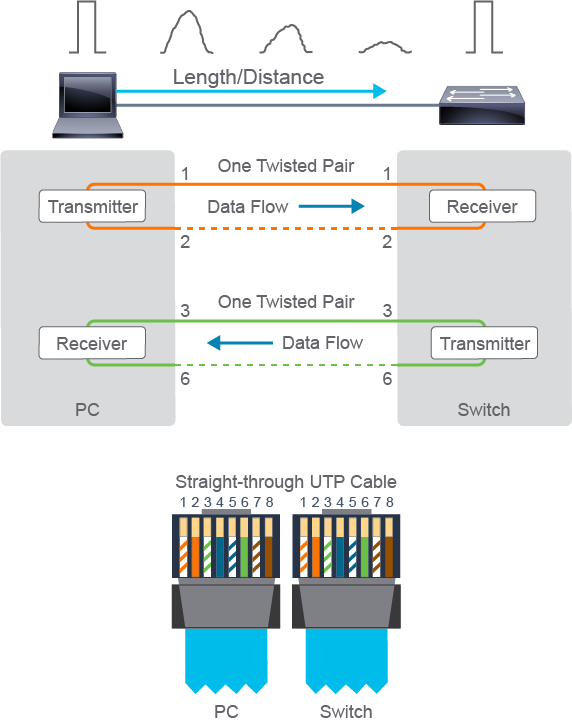
Both electrical and optical signals suffer from similar problems during transmission. Impulse examples (Voltage) between the transmitter and the receiver show the signal degradation due to the attenuation. For signal degradation and timing reasons, segments between the nodes have a restricted size (distance).
電子訊號與光學訊號在傳輸過程中都會遭遇類似的問題。傳送器與接收器之間的脈衝(電壓)範例,顯示了因訊號衰減所造成的訊號劣化。基於訊號劣化與時序方面的考量,節點之間的網段長度(距離)會受到限制。
Another problem that specifically affects the transmission of the electrical signal is the electrical noise, which is an unwanted signal disturbance. Poor connections and patch cables are the main sources of electrical noise. Industrial electrical noise sources are automobiles, airplanes, electric motors, switching gears, high-voltage transmission cables, and fluorescent lamps. All previously mentioned types of electrical noises are produced by the source’s electrical discharge.
另一個特別會影響電子訊號傳輸的問題是電氣雜訊,也就是不受歡迎的訊號干擾。不良的接線與跳接線是電氣雜訊的主要來源。工業界的電氣雜訊來源包括汽車、飛機、電動馬達、開關設備、高壓輸電纜線,以及日光燈。前述所有類型的電氣雜訊,都是由來源的放電所產生。
Natural electrical noise might be from lightning discharges in thunderstorms. Electrical noise that originates from the Sun is called solar noise. Distant stars generate electrical noise called cosmic noise. While these stars are too far away to individually affect terrestrial communications systems, their large number leads to appreciable collective effects. Apart from that, there is a substantial amount of signal disruption from artificial electrical noise.
自然的電氣雜訊可能來自雷雨中的閃電放電。源自太陽的電氣雜訊稱為太陽雜訊。遙遠的恆星會產生稱為宇宙雜訊的電氣雜訊。雖然這些恆星距離過於遙遠,個別上不會影響地球上的通訊系統,但由於數量龐大,累積起來會產生可觀的整體影響。除此之外,人為的電氣雜訊也會造成相當程度的訊號干擾。
Copper Media
銅纜傳輸媒介
Most Ethernet networks use unshielded twisted-pair (UTP) copper cabling for short and medium-length distances because of its low cost compared to fiber-optic or coaxial cable.
大多數乙太網路都在短、中距離使用非遮蔽雙絞線(UTP)銅纜,因為其成本比光纖或同軸電纜低。
Unshielded Twisted-Pair Cable
非遮蔽雙絞線纜線

Characteristic 特性 | Value 數值 |
Speed and throughput 速度與吞吐量 | From 10 Mbps to 40 Gbps 從 10 Mbps 到 40 Gbps |
Average cost per node 每節點平均成本 | Least expensive 最低廉 |
Media and connector size 傳輸媒介與接頭尺寸 | Small 小 |
Maximum cable length 最大纜線長度 | 100 m (30 m for 40 Gbps) 100 m(40 Gbps 時為 30 m) |
Several categories of UTP cable exist:
UTP 纜線有多種類別:
- Category 5: Capable of transmitting data at speeds of up to 100 MbpsCategory 5:可支援高達 100 Mbps 的資料傳輸速度
- Category 5e: Used in networks running at speeds of up to 1000 Mbps (1 Gbps)Category 5e:用於傳輸速度高達 1000 Mbps(1 Gbps)的網路
- Category 6: Comprises four pairs of 24-gauge copper wires, which can transmit data at speeds of up to 10 GbpsCategory 6:由四對 24 號銅線組成,可支援高達 10 Gbps 的資料傳輸速度
- Category 6a: Used in networks running at speeds of up to 10 GbpsCategory 6a:用於傳輸速度高達 10 Gbps 的網路
- Category 7: Used in networks running at speeds of up to 10 GbpsCategory 7:用於傳輸速度高達 10 Gbps 的網路
- Category 8: Used in networks running at speeds of up to 40 GbpsCategory 8:用於傳輸速度高達 40 Gbps 的網路
RJ-45 Connector and Jack
RJ-45 接頭與插孔
UTP cables are used with RJ-45 connectors. The figure shows a UTP cable with an RJ-45 connector and a jack.
UTP 纜線搭配 RJ-45 接頭使用。圖中顯示了搭配 RJ-45 接頭與插孔的 UTP 纜線。
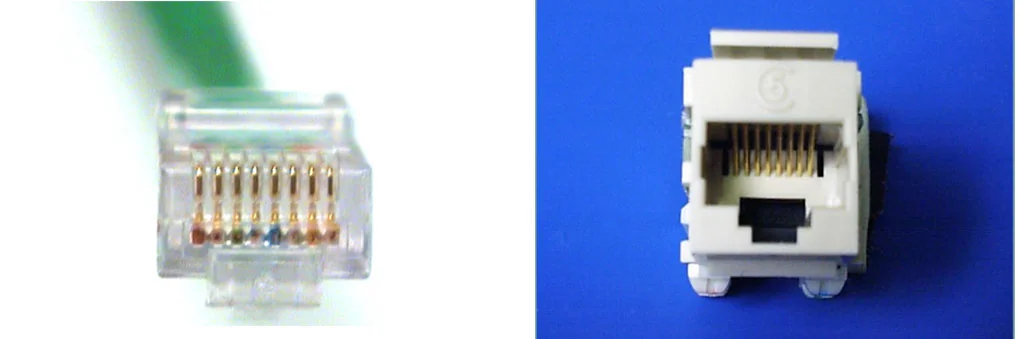
The RJ-45 plug is the male component, which is crimped at the end of the cable. As you look at the plug from the front, as shown in the figure, the pin locations are numbered from 8 on the left to 1 on the right.
RJ-45 插頭是公頭元件,會壓接在纜線末端。如圖所示,從正面觀察插頭時,接腳位置的編號從左側的 8 排到右側的 1。
The jack is the female component in a network device, wall, cubicle partition outlet, or patch panel. As you look at the socket from the front, as shown in the figure, the pin locations are numbered from 1 on the left to 8 on the right.
插孔是網路裝置、牆面、隔間出線口或配線板上的母頭元件。如圖所示,從正面觀察插座時,接腳位置的編號從左側的 1 排到右側的 8。
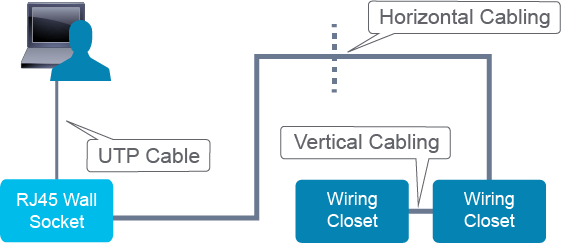
Structured cabling is installed during the building construction phase in modern business environments. The cables are routed from the wiring closet to the sockets in the walls or on office desks. To connect to the local network, you would connect the computer's network adapter, which has a female RJ45 jack, to the wall socket, which also has a female RJ45 jack, by using a UTP cable with a male RJ45 connector on both ends.
在現代商業環境中,結構化佈線是在建築施工階段就完成安裝的。纜線會從配線間佈設到牆面或辦公桌上的出線口。若要連上本地網路,你會使用一條兩端都是公頭 RJ45 接頭的 UTP 纜線,將電腦網路配接卡上的母頭 RJ45 插孔,連接到牆面出線口上同樣是母頭的 RJ45 插孔。
The figure shows a typical office structured cabling installation. Notice that the cable from the wall socket to the wiring closet is called horizontal cabling. Vertical cabling is the term usually reserved for links between wiring closets.
圖中顯示了典型的辦公室結構化佈線安裝方式。請注意,從牆面出線口到配線間的纜線稱為水平佈線;垂直佈線一詞通常則專門用來指配線間之間的連線。
Power over Ethernet
乙太網路供電
Power over Ethernet (PoE) describes systems that pass electric power along with data on Ethernet cabling. This action allows a single Ethernet cable to provide both data connection and electric power to devices such as wireless access points, IP cameras, and VoIP phones by using all four pairs in the Category 5 cable or above.
乙太網路供電(PoE)是指在乙太網路纜線上,同時傳送電力與資料的系統。這項技術讓單一乙太網路纜線能同時為無線基地台、IP 攝影機與 VoIP 電話等裝置,提供資料連線與電力,方法是使用 Category 5 以上纜線中的全部四對線。
Straight-Through or a Crossover UTP Cable?
該選用直通線還是跳線 UTP 纜線?
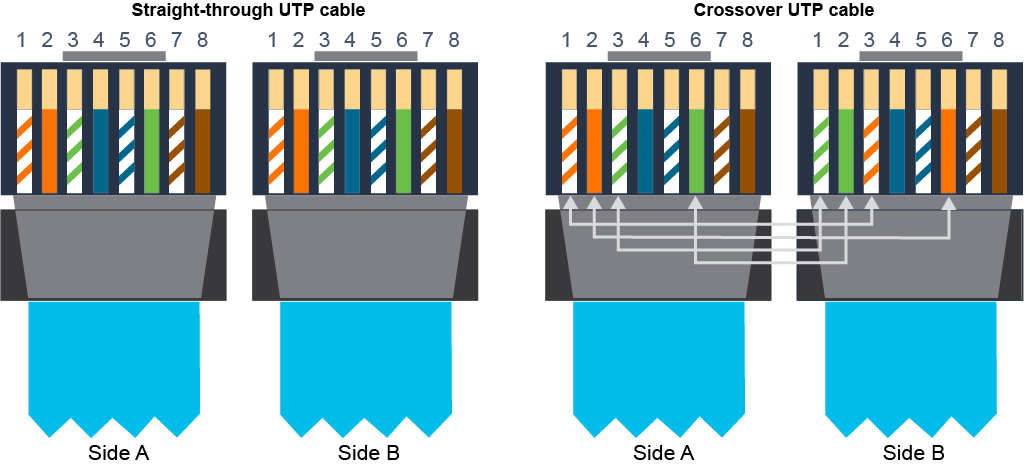
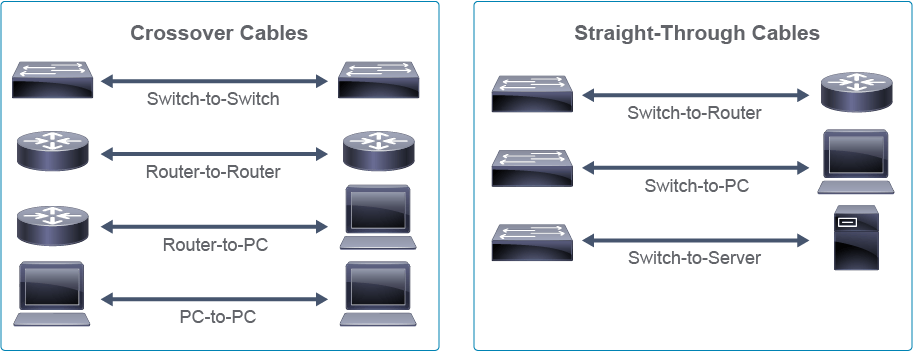
When choosing a UTP cable, you must determine whether you need a straight-through UTP cable or a crossover UTP cable. Straight-through cables are primarily used to connect electrically unlike devices, and crossover cables are used to connect electrically like devices. For example, the receive pin is the same on both devices, so it must be crossed to the transmit pin.
選擇 UTP 纜線時,你必須判斷需要的是直通線還是跳線。直通線主要用於連接電氣特性不同的裝置,跳線則用於連接電氣特性相同的裝置。舉例來說,兩台裝置的接收接腳相同,因此必須將其中一端交叉連接到傳送接腳。
To tell the difference between the two types of cabling, hold the ends of the cable next to each other, with the connector side of each end facing you. As shown in the figure, the cable is a straight-through cable if each of the eight pins corresponds to the same pin on the opposite side. The cable is a crossover cable if some of the wires on one end of the cable are crossed to a different pin on the other side of the cable, as shown in the figure.
若要分辨這兩種纜線類型,可將纜線兩端並排放在一起,並使各端的接頭面朝向自己。如圖所示,若八根接腳中的每一根都對應到另一端相同的接腳,則此纜線為直通線;若纜線一端的部分線芯交叉連接到另一端不同的接腳,如圖所示,則此纜線為跳線。
When automatic medium-dependent interface crossover (auto-MDIX) is enabled on an interface, the interface automatically detects the required cable connection type (straight-through or crossover) and configures the connection appropriately. With auto-MDIX enabled, you can use either type of cable to connect to other devices, and the interface automatically corrects for any incorrect cabling.
當介面上啟用自動媒介相依介面跳線(auto-MDIX)功能時,該介面會自動偵測所需的纜線連接類型(直通線或跳線),並據此設定連線方式。啟用 auto-MDIX 後,你可以使用任一種類型的纜線連接其他裝置,介面會自動校正任何錯誤的佈線方式。
The following figure shows when to use straight-through and crossover cables.
下圖顯示了何時應使用直通線與跳線。
Optical Fiber
光纖
An optical fiber is a flexible, transparent fiber that is made of very pure glass (silica) and is not much larger than human hair. It acts as a waveguide, or light pipe, to transmit light between the two ends of the fiber. Optical fibers are widely used in fiber-optic communication, which permits transmission over longer distances and at higher bandwidths (data rates) than other forms of communication. Fibers are used instead of metal wires because signals travel with less loss and immunity to EMI.
光纖是一種柔軟、透明的纖維,由非常純淨的玻璃(矽石)製成,粗細與人類頭髮相差無幾。它的作用如同波導管,即光管,用於在光纖兩端之間傳輸光線。光纖廣泛應用於光纖通訊,相較於其他通訊形式,光纖通訊可支援更長距離、更高頻寬(資料傳輸速率)的傳輸。之所以使用光纖而非金屬導線,是因為訊號傳輸的損耗較低,且不受電磁干擾影響。
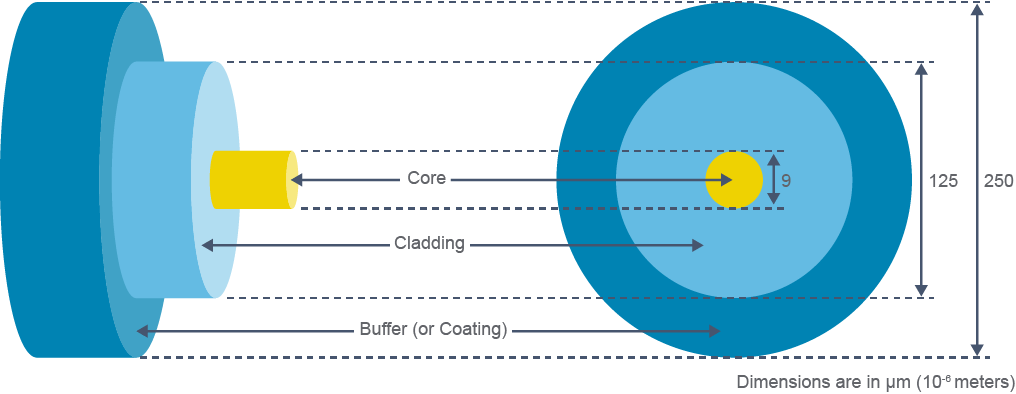
The two fundamental components that allow fiber to confine light are the core and the cladding. Most of the light travels from the beginning to the end inside the core. The cladding around the core provides confinement. The diameters of the core and cladding are shown in the figure, but the core diameter may vary for various fiber types. In this case, the core diameter of 9 micrometers is very small. (The diameter of a human hair is about 50 micrometers.) The outer diameter of the cladding is a standard size of 125 micrometers. Standardizing the size means that component manufacturers can make connectors for all fiber-optic cables.
讓光纖能夠侷限光線的兩個基本元件是核心與披覆層。大部分的光都在核心內部從起點傳輸到終點,核心周圍的披覆層則負責將光線侷限在核心內。圖中顯示了核心與披覆層的直徑,但核心直徑會因光纖類型不同而有所差異。以此為例,9 微米的核心直徑非常小(人類頭髮的直徑約為 50 微米)。披覆層的外徑則是標準尺寸 125 微米。將尺寸標準化,代表元件製造商能夠為所有光纖纜線製作通用的接頭。
The third element in this picture is the buffer (coating), which has nothing to do with the confinement of the light in the fiber. Its purpose is to protect the glass from scratches and moisture. The fiber-optic cable can be easily scratched and broken. If the fiber is scratched, the scratch could propagate and break the fiber. Another important role of the buffer is to keep the fiber dry.
圖中的第三個元件是緩衝層(塗層),它與侷限光纖中的光線無關,其作用是保護玻璃不受刮傷與受潮。光纖纜線很容易被刮傷或折斷,若光纖被刮傷,刮痕可能會擴大並導致光纖斷裂。緩衝層的另一項重要作用,是讓光纖保持乾燥。
Fiber Types
光纖類型
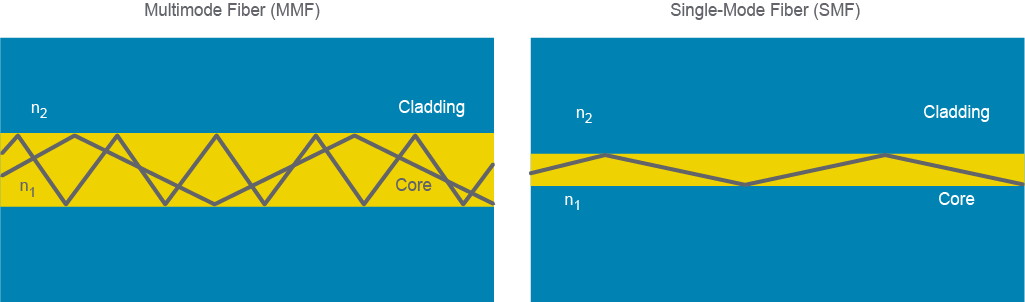
The most significant difference between multimode fiber (MMF) and single-mode fiber (SMF) is in the ability of the fiber to send light over a long distance at high bit rates. In general, MMF is used for shorter distances, while SMF is preferred for long-distance communications. There are many variations of fiber for both MMF and SMF.
多模光纖(MMF)與單模光纖(SMF)之間最主要的差異,在於光纖能否以高位元速率將光線傳送到長距離之外。一般而言,MMF 用於較短距離,而 SMF 則較適合長距離通訊。MMF 與 SMF 各自都有許多不同的變化型。
The most significant physical difference is in the size of the core. The glass in the two fibers is the same, and the index of refraction (a way of measuring the speed of light in a material) between the core and the cladding changes similarly. The diameter of the fiber cladding is also the same. However, the core is a different size, which affects how the light gets through the fiber. MMF supports multiple ways for the light from one source to travel through the fiber" which is why it is called "multimode." Each path can be thought of as a mode.
兩者最主要的實體差異在於核心的尺寸。兩種光纖所使用的玻璃相同,核心與披覆層之間的折射率(用來衡量光在材質中傳播速度的一種方式)變化方式也相似,披覆層的直徑也相同。然而,核心的尺寸不同,這會影響光線通過光纖的方式。MMF 支援來自同一光源的光線以多種路徑通過光纖,這也是「多模」一詞的由來,每一條路徑都可視為一種模態(mode)。
For SMF, the possible ways for light to get through the fiber have been reduced to one—a "single mode." It is not exactly one, but it is a useful approximation.
至於 SMF,光線通過光纖的可能路徑則被縮減為一種,即「單一模態」。雖然嚴格來說並非真正只有一種路徑,但這是一種實用的近似說法。
MMF device uses LED as a light source, which facilitates short-distance transmissions. On the other hand, the SMF device uses a laser to generate the signal, which provides higher transmission rates covering longer distances.
MMF 裝置使用 LED 作為光源,適合短距離傳輸;而 SMF 裝置則使用雷射產生訊號,能提供更長距離、更高的傳輸速率。
The table summarizes MMF and SMF characteristics.
下表彙整了 MMF 與 SMF 的特性。
MMF and SMF Characteristics
MMF 與 SMF 特性
MMF Characteristics MMF 特性 | SMF Characteristics SMF 特性 |
LED transmitter is usually used 通常使用 LED 傳送器 | Laser transmitter is usually used 通常使用雷射傳送器 |
Lower bandwidth and speed 頻寬與速度較低 | Higher bandwidth and speed 頻寬與速度較高 |
Shorter distances 距離較短 | Longer distances 距離較長 |
Less expensive 成本較低 | More expensive 成本較高 |
Fiber Connector Types
光纖接頭類型
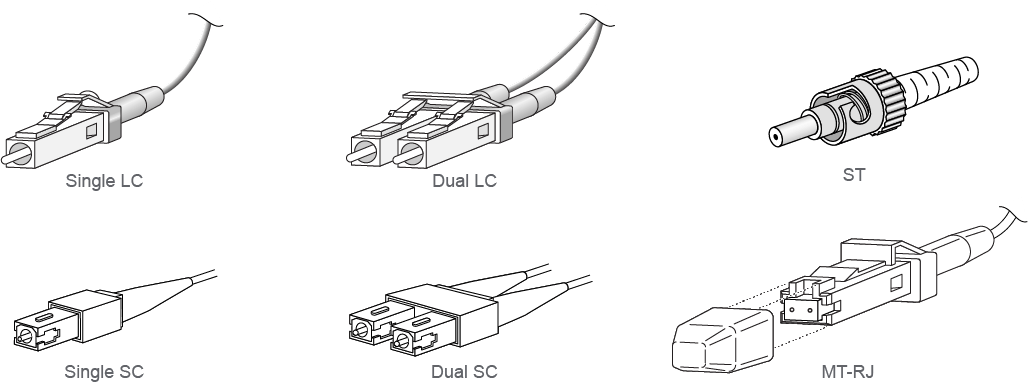
An optical fiber connector terminates the end of an optical fiber. Various optical fiber connectors are available. The main differences among the types of connectors are the dimensions and methods of mechanical coupling. Generally, organizations standardize on one type of connector, depending on the equipment that they commonly use, or they standardize per type of fiber (one for MMF and one for SMF). There are about 70 connector types in use today.
光纖接頭用於終結光纖的末端。市面上有多種光纖接頭可供選擇,各類接頭之間的主要差異在於尺寸與機械耦合方式。一般而言,組織會根據其常用的設備標準化採用某一類接頭,或依光纖類型分別標準化(一種用於 MMF、一種用於 SMF)。目前使用中的接頭類型約有 70 種。
The three types of connectors follow:
接頭有三種類型,如下:
- Threaded螺紋式
- Bayonet刺刀式
- Push-pull推拉式
Connectors are made of the following materials:
接頭由以下材質製成:
- Metal金屬
- Plastic sleeve塑膠套管
Here is a list of the most common types of fiber connectors and their typical uses:
以下列出最常見的光纖接頭類型及其典型用途:
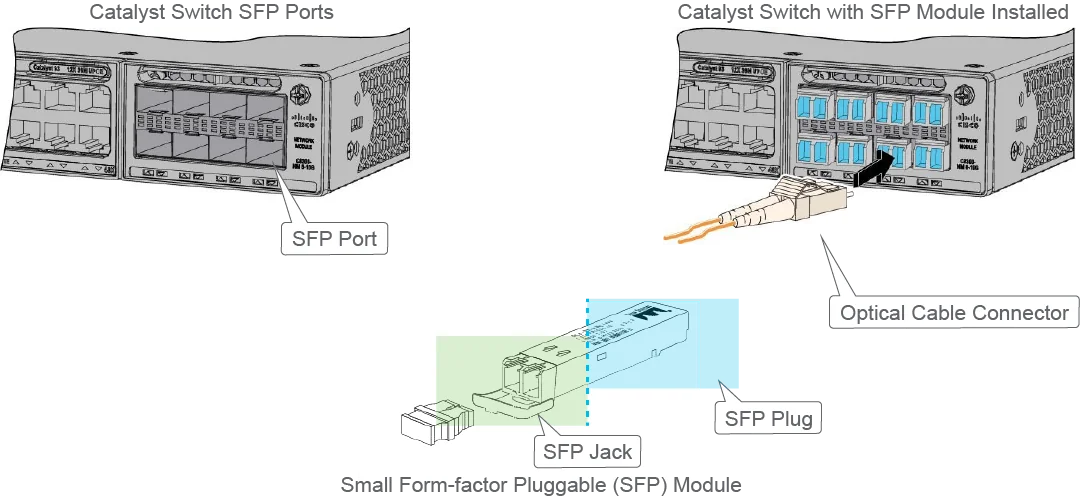
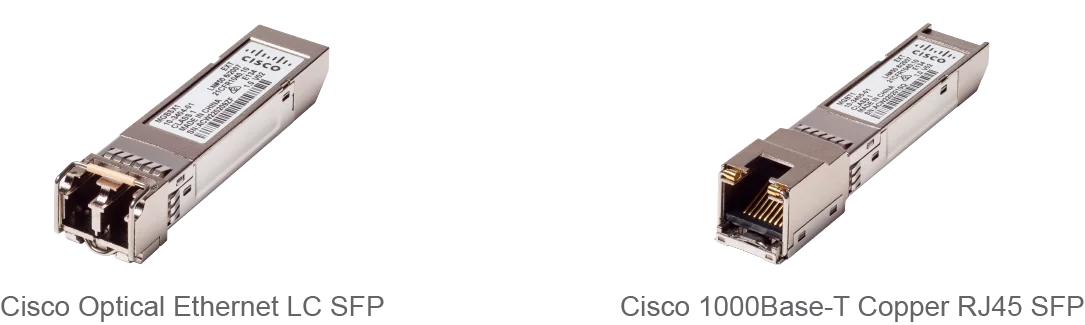
- LC: is for enterprise equipment and is commonly used on Small Form-Factor Pluggable (SFP) modules.LC:用於企業設備,常見於小型可插拔(SFP)模組。
- SC: is for enterprise equipment.SC:用於企業設備。
- ST: is for patch panels (for their durability).ST:用於配線板(因其耐用性)。
- FC: is for patch panels and is used by service providers.FC:用於配線板,由服務供應商使用。
- MT-RJ: the connector is a two-fiber connector (transmit and receive), has a form factor and, is used for enterprise equipment.MT-RJ:此接頭為雙纖接頭(傳送與接收各一),具有特定的外形規格,用於企業設備。
In data communications and telecommunications applications today, small form factor (SFF) connectors (for example, LCs) are replacing the traditional connectors (for example, SCs) mainly to pack more connectors on the faceplate and, as a result, reduce system footprints.
在現今的資料通訊與電信應用中,小型外形規格(SFF)接頭(例如 LC)正逐漸取代傳統接頭(例如 SC),主要原因是為了在面板上容納更多接頭,進而縮減系統體積。
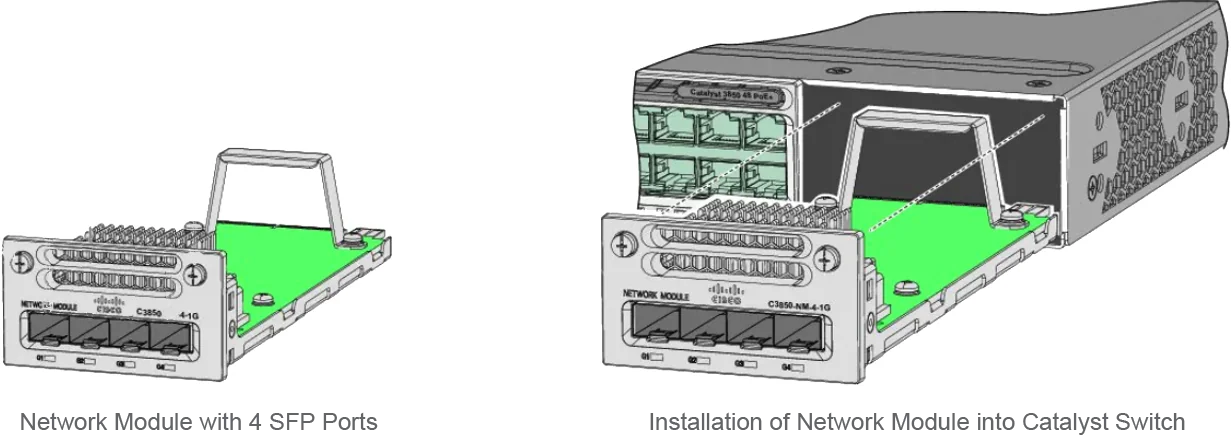
SFP and SFP+ Transceivers
SFP 與 SFP+ 收發模組
Transceiver Type 收發模組類型 | Max Supported Speed 支援的最高速度 | Supported Medium Types 支援的傳輸媒介類型 |
1000BASE SFP 1000BASE SFP | 1 Gbps 1 Gbps | Copper/Fiber Optics 銅纜/光纖 |
10GBASE SFP+ 10GBASE SFP+ | 10 Gbps 10 Gbps | Copper/Fiber Optics 銅纜/光纖 |
25GBASE SFP28 25GBASE SFP28 | 25 Gbps 25 Gbps | Copper/Fiber Optics 銅纜/光纖 |
40GBASE QSFP 40GBASE QSFP | 40 Gbps 40 Gbps | Copper/Fiber Optics 銅纜/光纖 |
100GBASE QSFP 100GBASE QSFP | 100 Gbps 100 Gbps | Copper/Fiber Optics 銅纜/光纖 |
400GBASE QSFP-DD 400GBASE QSFP-DD | 400 Gbps 400 Gbps | Copper/Fiber Optics 銅纜/光纖 |
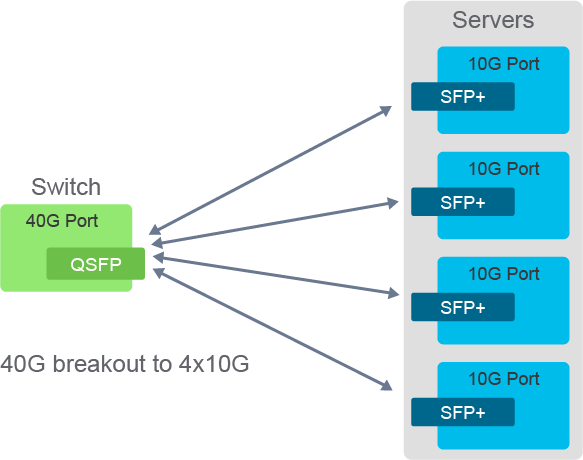
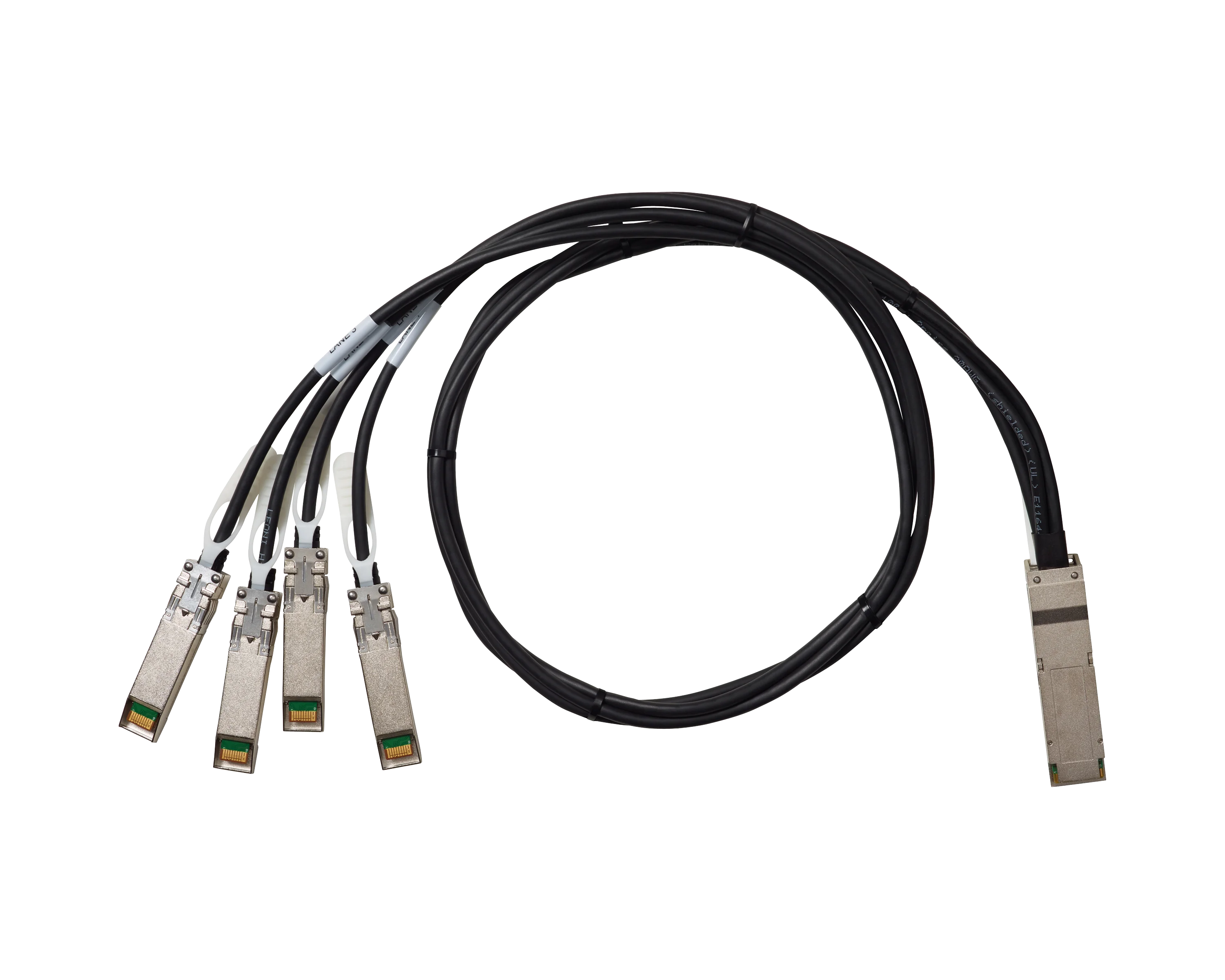
Breakout Cables
分支纜線(Breakout Cable)