Converged networks carry multiple types of traffic, such as voice, video, and data, which were traditionally transported on separate and dedicated networks.
匯聚網路可承載多種類型的流量,例如語音、視訊與資料,這些流量傳統上是分別由獨立且專用的網路來傳輸。
Converged networks have the following important traffic characteristics:
匯聚網路具有下列重要的流量特性:
- Competition between constant, small-packet voice flows and bursty video and data flows固定、小封包的語音流量與陣發性的視訊、資料流量彼此競爭
- Time-sensitive voice and video flows對時間敏感的語音與視訊流量
- Critical traffic that must get priority必須優先處理的關鍵流量
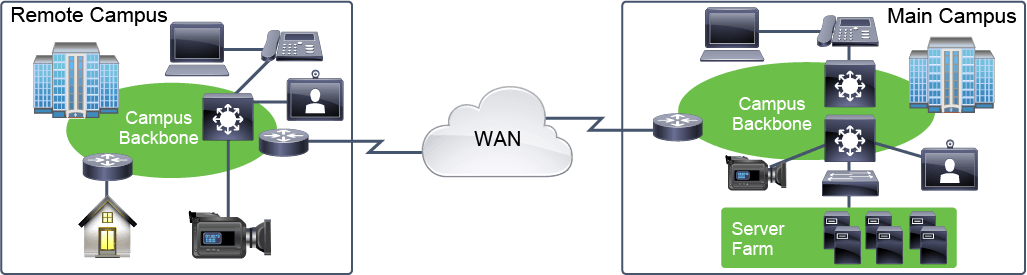
The figure illustrates a converged network in which voice, video, and data traffic use the same network facilities instead of a dedicated network for each traffic type. Although there are several advantages to converged networks, merging these different traffic streams with dramatically differing requirements can lead to a number of quality problems.
下圖說明了一個匯聚網路,其中語音、視訊與資料流量共用相同的網路設施,而非各自使用專用網路。雖然匯聚網路有許多優點,但將這些需求差異極大的不同流量合併,可能導致許多品質問題。
Data traffic is typically not real-time traffic. Data applications may be bursty in that they create unpredictable traffic patterns, and thus have widely varying packet arrival times. Many types of application data exist within an organization. For example, some are relatively noninteractive and therefore not delay-sensitive (such as email). Other applications involve users entering data and waiting for responses (such as database applications) and are therefore very delay-sensitive. You can also classify data according to its importance to the overall corporate business objectives. For example, a company that provides interactive, live e-learning sessions to its customers would consider that traffic to be mission-critical. On the other hand, a manufacturing company might consider that same traffic important, but not critical to its operations.
資料流量通常不是即時流量。資料應用程式可能具有陣發性,會產生不可預測的流量型態,因此封包抵達時間差異很大。組織內存在多種類型的應用程式資料。舉例來說,有些資料相對非互動式,因此對延遲不敏感(例如電子郵件);另一些應用程式則需要使用者輸入資料並等待回應(例如資料庫應用程式),因此對延遲非常敏感。你也可以依資料對整體企業營運目標的重要性來分類。例如,一家為客戶提供互動式現場線上學習課程的公司,會將該流量視為任務關鍵;而製造業公司可能認為同樣的流量重要,但並非其營運不可或缺。
Voice traffic is real-time traffic and comprises constant and predictable bandwidth and packet arrival times.
語音流量屬於即時流量,具有固定且可預測的頻寬與封包抵達時間。
Video traffic comprises several traffic subtypes, including passive streaming video and real-time interactive video. Video traffic can be in real time, but not always. Video has varied bandwidth requirements, and it comprises different types of packets with different delay and tolerance for loss within the same session.
視訊流量包含多種子類型,包括被動串流視訊與即時互動式視訊。視訊流量可能是即時的,但並非總是如此。視訊的頻寬需求各異,同一工作階段中也會包含延遲容忍度與遺失容忍度不同的多種封包類型。
Interactive video, or video conferencing, has the same delay, jitter, and packet loss requirements as voice traffic. The difference is the bandwidth requirements—voice packets are small while video-conferencing packet sizes can vary, as can the data rate. A general guideline for overhead is to provide 20-percent more bandwidth than the data currently requires. Streaming video has different requirements than interactive video. An example of the use of streaming video is when an employee views an online video during an e-learning session. As such, this video stream is not nearly as sensitive to delay or loss as interactive video is. Requirements for streaming video include a loss of no more than 5 percent and a delay of no more than 4 to 5 seconds. Depending on how important this traffic is to the organization, it can be given precedence over other traffic.
互動式視訊(即視訊會議)與語音流量有相同的延遲、抖動與封包遺失需求。差異在於頻寬需求——語音封包很小,而視訊會議封包大小及資料速率則可能有很大變化。一般的建議是額外提供比目前資料所需多 20% 的頻寬,作為額外負擔(overhead)。串流視訊的需求與互動式視訊不同。例如,員工在線上學習課程中觀看線上影片就屬於串流視訊。因此,這種視訊串流對延遲或遺失的敏感度遠不如互動式視訊。串流視訊的需求通常為遺失率不超過 5%、延遲不超過 4 至 5 秒。依此流量對組織的重要程度,也可以給予高於其他流量的優先權。
Voice and some video traffic are not tolerant of delay, jitter, or packet loss, and excessive amounts of any of these will result in a poor experience for the end users. Data flows are typically more tolerant of delay, jitter, and packet loss but are very bursty in nature and will typically use as much bandwidth as possible.
語音與部分視訊流量無法容忍延遲、抖動或封包遺失,若這些情況過度發生,將導致終端使用者體驗不佳。資料流量通常對延遲、抖動與封包遺失的容忍度較高,但本質上具有陣發性,且通常會盡可能使用可用頻寬。
The different traffic flows on a converged network will be in competition for network resources. Unless some mechanism mediates the overall traffic flow, voice and video quality will be severely compromised at times of network congestion. The critical, time-sensitive flows must be given priority in order to preserve the quality of this traffic.
匯聚網路上的不同流量會彼此競爭網路資源。除非有某種機制調節整體流量,否則在網路壅塞時,語音與視訊品質將會嚴重受損。必須優先處理這些關鍵且對時間敏感的流量,才能維持其品質。
Quality Issues in Converged Networks
匯聚網路中的品質問題
Four major problems affect quality on converged networks:
有四個主要問題會影響匯聚網路的品質:
- Bandwidth capacity:Large graphic files, multimedia uses, and increasing use of voice and video can cause bandwidth capacity problems over data networks. Multiple traffic flows compete for a limited amount of bandwidth and may require more bandwidth than is available.頻寬容量:大型圖形檔案、多媒體應用,以及語音與視訊使用量的增加,可能導致資料網路上的頻寬容量問題。多個流量彼此競爭有限的頻寬,所需頻寬可能超過可用頻寬。
- Delay:Delay is the time that it takes for a packet to reach the receiving endpoint after being transmitted by the sender. This period of time is called the end-to-end delay and consists of variable delay components (processing and queueing delay) and fixed delay components (serialization and propagation delay).延遲:延遲是指封包自傳送端發出後,抵達接收端所需的時間。這段時間稱為端對端延遲,由可變延遲元件(處理延遲與佇列延遲)與固定延遲元件(序列化延遲與傳播延遲)組成。
- Jitter:Jitter is the variation in latency or end-to-end delay that is experienced between when a signal is sent and when it is received. It may also be described as a disruption in the normal flow of packets as they traverse the network.抖動:抖動是指訊號從傳送到接收之間,延遲或端對端延遲的變化程度,也可描述為封包在通過網路時,正常流動被打斷的現象。
- Packet loss:Loss of packets is usually caused by congestion, faulty connectivity, or faulty network equipment.封包遺失:封包遺失通常是由壅塞、連線故障或網路設備故障所造成。
Multimedia streams, such as those used in IP telephony or video conferencing, are sensitive to delivery delays. High delay can cause noticeable echo or talker overlap. Voice transmissions can be choppy or unintelligible with high packet loss or jitter. Images may be jerky, or the sound might not be synchronized with the image. Voice and video calls may disconnect or not connect if signaling packets are not delivered.
諸如 IP 電話或視訊會議所使用的多媒體串流,對傳輸延遲十分敏感。高延遲可能導致明顯的回音或說話重疊。若封包遺失或抖動過高,語音傳輸可能斷斷續續或難以辨識;畫面可能不流暢,或聲音與畫面不同步。若信令封包未能正確傳遞,語音與視訊通話可能中斷或無法建立連線。
Some data applications can also be severely affected by poor QoS. Time-sensitive applications, such as virtual desktop or interactive data sessions, may appear unresponsive. Delayed application data could have serious performance implications for users that depend on timely responses, such as in brokerage houses or call centers.
部分資料應用程式也可能因 QoS 不佳而受到嚴重影響。對時間敏感的應用程式,例如虛擬桌面或互動式資料工作階段,可能顯得沒有反應。延遲的應用程式資料,對於依賴即時回應的使用者(例如證券公司或客服中心)可能造成嚴重的效能影響。
Managing Quality Issues in Converged Networks
管理匯聚網路中的品質問題
Different techniques are employed to manage quality issues:
有多種技術可用來管理品質問題:
- Available bandwidth across a network path is limited by the lowest-bandwidth circuit and the number of traffic flows competing for the bandwidth on the path. The best way to manage persistent congestion is to increase the link capacity to accommodate the bandwidth requirements. Circuit upgrades are not always possible due to the cost or the amount of time that is required to perform an upgrade. Alternatives to a link upgrade include using a queuing technique to prioritize critical traffic or enabling a compression technique to reduce the number of bits that are transmitted for packets on the link.跨網路路徑的可用頻寬,受限於頻寬最低的電路以及爭用該路徑頻寬的流量數量。管理持續性壅塞的最佳方式是提升鏈路容量,以滿足頻寬需求。由於成本或升級所需時間,電路升級並非總是可行;替代方案包括使用佇列技術優先處理關鍵流量,或啟用壓縮技術以減少該鏈路上封包所傳輸的位元數。
- Delay can be managed by upgrading the link bandwidth, utilizing a queuing technique to prioritize critical traffic, or enabling a compression technique to reduce the number of bits that are transmitted for packets on the link延遲可以透過升級鏈路頻寬、使用佇列技術優先處理關鍵流量,或啟用壓縮技術以減少該鏈路上封包所傳輸的位元數來加以管理
- When a media endpoint such as an IP phone or a video gateway receives a stream of IP packets, it must compensate for the jitter that is encountered on the IP network. The mechanism that manages this function is a dejitter buffer. The dejitter buffer must buffer these packets and then play them out in a steady stream. This process adds to the total delay of the packet that is being delivered as an audio or video stream but allows for a smooth delivery of the real-time traffic. If the amount of jitter that is experienced by the packet exceeds the dejitter buffer limits, the packet is dropped and the quality of the media stream is affected.當媒體端點(例如 IP 電話或視訊閘道)接收到一連串 IP 封包時,必須補償在 IP 網路上所遇到的抖動。負責處理此功能的機制稱為去抖動緩衝區(dejitter buffer)。去抖動緩衝區必須先緩衝這些封包,再以穩定的速率播放出來。此程序會增加以音訊或視訊串流形式傳送之封包的整體延遲,但能讓即時流量以平順的方式傳遞。若封包所經歷的抖動超過去抖動緩衝區的限制,該封包就會被捨棄,媒體串流的品質也會受到影響。
- Packet loss typically occurs when routers run out of space in a particular interface output queue. The term used for these drops is output drop or tail drop. (Packets are dropped at the tail of the queue.) Packet loss due to tail drop can be managed by increasing the link bandwidth, using a queuing technique that guarantees bandwidth and buffer space for applications that are sensitive to packet loss, or by preventing congestion by shaping or dropping packets before congestion occurs.封包遺失通常發生在路由器某個介面輸出佇列的空間耗盡時,這類捨棄稱為輸出捨棄(output drop)或尾端捨棄(tail drop)(封包是在佇列尾端被捨棄的)。因尾端捨棄造成的封包遺失,可透過增加鏈路頻寬、使用能為對封包遺失敏感的應用程式保證頻寬與緩衝空間的佇列技術,或在壅塞發生前先進行流量整形或捨棄封包來加以管理。