The term network is used in many different aspects. Some examples of networks are social networks, phone networks, television networks, neural networks, and computer networks. A network is a system of connected elements that operate together. A computer network connects PCs, printers, servers, phones, cameras, and other devices. A computer network connects devices that allows them to exchange data with each other, which facilitates information and resource sharing. In a home, computers allow family members to share files (such as photos) and print documents on a network printer, televisions can play movies or other media stored on your computers, and internet-enabled devices can connect to web pages, applications, and services anywhere in the world.
「網路」一詞可用於許多不同的層面。網路的例子包括社群網路、電話網路、電視網路、神經網路以及電腦網路。網路是一組彼此連接、共同運作的元素所構成的系統。電腦網路可連接 PC、印表機、伺服器、電話、攝影機及其他裝置。電腦網路把各種裝置連接起來,讓它們能互相交換資料,進而促進資訊與資源的共享。在家中,電腦讓家庭成員可以共享檔案(例如照片)並透過網路印表機列印文件;電視可以播放儲存在電腦上的電影或其他媒體;可上網的裝置則能連上世界任何地方的網頁、應用程式與服務。
In the business environment, you have many business operations such as marketing, sales, and IT. You need to develop applications that allow information to be collected and processed. Computer systems that collect and process the information need to communicate with each other to share resources. You also need an infrastructure that supports employees, who need to access these resources and interact with each other. A network allows multiple devices such as laptops, mobile devices, servers, and shared storage to exchange information with each other. There are various components connected to each other that are necessary for this communication to take place. This infrastructure allows a business to run, lets customers connect to the business (either through salespeople or through an online store), and allows a business to sell its products or services. To run normally, a business and its applications rely on networking technology.
在企業環境中,有許多業務營運活動,例如行銷、銷售與 IT。你需要開發應用程式,讓資訊得以收集與處理。負責收集與處理資訊的電腦系統必須彼此通訊,才能共享資源。你也需要一套基礎架構來支援員工,因為員工需要存取這些資源並彼此互動。網路讓筆記型電腦、行動裝置、伺服器與共用儲存等多種裝置能互相交換資訊。要讓這種通訊得以進行,需要各種彼此連接的元件。這套基礎架構讓企業得以運作、讓客戶能夠接觸企業(透過業務人員或線上商店),並讓企業能銷售其產品或服務。企業與其應用程式要正常運作,都仰賴網路技術。
A computer network can exist on its own, independent of other computer networks and it can also connect to other networks. The internet is an example of many networks interconnected together. It is global in its span and scope. To operate successfully, interconnected networks follow standardized rules to communicate. These rules are accepted and adhered to by each participating network.
電腦網路可以獨立存在,不依賴其他電腦網路;也可以與其他網路連接。網際網路就是由許多網路互相連接而成的例子,其範圍與規模遍及全球。為了順利運作,互連的網路會遵循標準化的規則來通訊。每一個參與的網路都接受並遵守這些規則。
Years ago, the internet connected only several mainframe computers with computer terminals. The mainframe computers were large, and their computing power was considered enormous (albeit being equivalent to today’s mobile phone). Terminals were simple and inexpensive devices, which were used only to input data and displayed the results. Teletype is an example of such a device. The range of devices that connects to the internet has expanded in last decades. The internet now connects not only laptops, smartphones, and tablets but also game consoles, television sets, home systems, medical monitors, home appliances, thunder detectors, environment sensors, and much more. The earlier concept of centralized computing resources is revived today in the form of computing clouds.
多年以前,網際網路只連接少數幾台大型主機(mainframe)與電腦終端機。大型主機體積龐大,運算能力在當時被視為極為強大(儘管大約只相當於今日的手機)。終端機則是簡單且便宜的裝置,只用來輸入資料並顯示結果,電傳打字機(Teletype)就是這類裝置的例子。近幾十年來,可連上網際網路的裝置範圍大幅擴展。如今網際網路不僅連接筆記型電腦、智慧型手機與平板電腦,也連接遊戲主機、電視、家庭系統、醫療監測器、家電、雷擊偵測器、環境感測器等等。早期集中式運算資源的概念,如今以運算雲端的形式重新復甦。
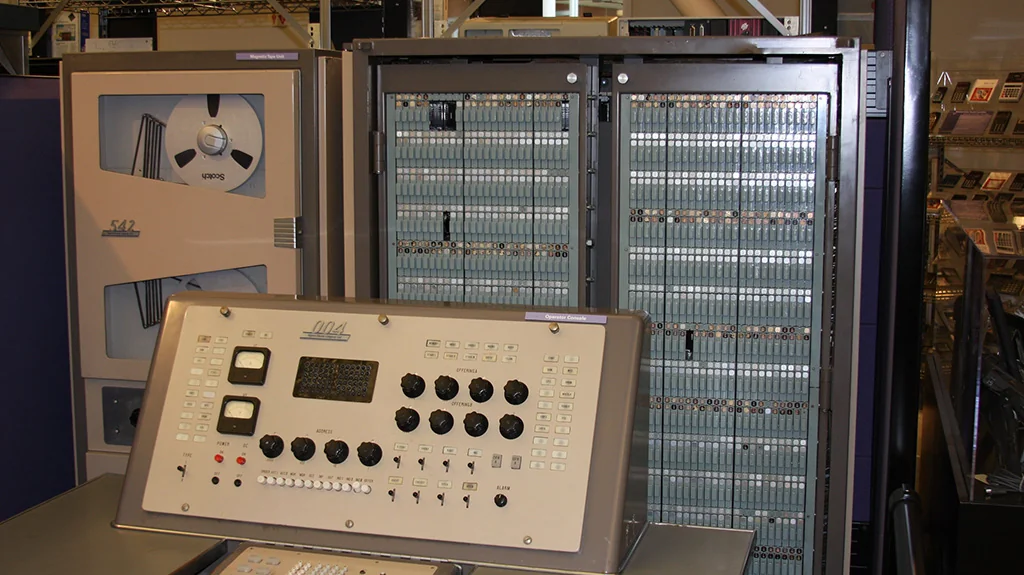
"Mainframe Computer" by Pargon is licensed under CC BY 2.0
「Mainframe Computer」由 Pargon 提供,依 CC BY 2.0 授權
Computer network engineers design, develop, and maintain highly available network infrastructure to support the information technology activities of the business. Network engineers interact with network users and provide support or consultancy services about design and network optimization. Network engineers typically have more knowledge and experience than network technicians, operators, and administrators. A network engineer should constantly update their knowledge of networking to keep up with new trends and practices.
電腦網路工程師負責設計、開發並維護高可用性的網路基礎架構,以支援企業的資訊科技活動。網路工程師會與網路使用者互動,並提供關於設計與網路最佳化的支援或顧問服務。網路工程師通常比網路技術員、操作員與管理員具備更多的知識與經驗。網路工程師應持續更新自己的網路知識,以跟上新的趨勢與做法。
Users who wish to connect their networks to the internet can acquire access through a service provider's access network. Service provider networks can use different technologies from dialup or broadband telephony networks, such as ADSL networks, cable networks, mobile, radio, or fiber-optic networks. A service provider network can cover large geographical areas. Service provider networks also maintain connections between themselves and other service providers to enable global coverage.
想把自己的網路連上網際網路的使用者,可以透過服務供應商(service provider)的接取網路取得連線。服務供應商網路可採用不同的技術,從撥接或寬頻電話網路(例如 ADSL 網路)、有線電視網路、行動網路、無線電網路到光纖網路都有。服務供應商網路可以涵蓋很大的地理區域。服務供應商之間也會維持彼此的連線,以提供全球性的覆蓋範圍。
Computer networks can be classified in several ways, and then combined to find the most appropriate one for the implementation.
電腦網路可以用幾種方式分類,再把這些分類方式組合起來,找出最適合該實作的類型。
The distance distinguishes local and remote networks between the user and the computer networks the user is accessing.
以距離來區分,可依使用者與其所存取的電腦網路之間的距離,分為本地網路與遠端網路。
Examples of networks categorized by their purpose would be data center networks and SAN (Storage Area Network). Focusing on the technology used, you can distinguish between wireless or wired networks.
依用途分類的網路例子,有資料中心網路與 SAN(Storage Area Network,儲存區域網路)。若著眼於所使用的技術,則可區分為無線網路或有線網路。
Looking at the size of the network in terms of the number of devices it has, there are various types of networks. Such as small networks, usually with fewer than ten devices, medium to large networks consisting of tens to hundreds of devices, and very large, global networks, such as the internet, which connects thousands of devices across the world.
若以網路中的裝置數量來看網路規模,也有各種不同類型的網路。例如小型網路通常少於十台裝置;中大型網路由數十到數百台裝置組成;而像網際網路這樣非常大型的全球網路,則連接了世界各地成千上萬的裝置。
One of the most common categorizations looks at the geographical scope of the network. There are LANs (Local-Area Networks) that connect devices located relatively close together in a limited area. Contrasting LANs, there are WANs (Wide-Area Networks), which cover a broad geographic area and are managed by service providers. An example of a LAN network is a university campus network that can span several collocated buildings. An example of a WAN would be a telecommunication provider’s network that interconnects multiple cities and states. This categorization also includes metropolitan-area networks (MANs), which span a physical area larger than LAN but smaller than WAN, for instance, a city.
最常見的分類方式之一,是看網路的地理範圍。區域網路(LAN,Local-Area Network)連接位於有限區域內、彼此相對接近的裝置。與 LAN 相對的是廣域網路(WAN,Wide-Area Network),它涵蓋廣大的地理區域,並由服務供應商管理。LAN 的例子是大學校園網路,可能橫跨數棟相鄰的建築。WAN 的例子則是電信業者的網路,連接多個城市與州。這種分類方式也包含都會網路(MAN,metropolitan-area network),其實體範圍比 LAN 大、比 WAN 小,例如一座城市。
Medium-to-large enterprise networks can span multiple locations. Usually, they have a main office or Enterprise Campus, which holds most of the corporate resources, and remote sites, such as branch offices or home offices of remote workers. A home office usually has a small number of devices and is called a small office, home office (SOHO). SOHO networks mostly use the internet to connect to the main office. The main office network, which is a LAN in terms of its geographical span, may consist of several networks that occupy many floors, or it may cover a campus that contains several buildings. Many corporate environments require the deployment of wireless networks on a large scale, and they use Wireless LAN Controllers (WLC) for centralizing the management of wireless deployments. Enterprise Campuses also typically include a separate data center home to the computational power, storage, and applications necessary to support an enterprise business. Enterprises are also connected to the internet, and a firewall protects internet connectivity. Branch offices have their own LANs with their own resources, such as printers and servers, and may store corporate information, but their operations largely depend on the main office, hence the network connection. They connect to the main office by a WAN or internet using routers as gateways.
中大型企業網路可能橫跨多個地點。它們通常有一個總部或企業園區(Enterprise Campus),存放大部分的企業資源;另外還有遠端據點,例如分公司或遠端工作者的家庭辦公室。家庭辦公室通常只有少量裝置,稱為小型辦公室/家庭辦公室(SOHO)。SOHO 網路大多透過網際網路連接總部。總部網路就地理範圍而言屬於 LAN,可能由分布在許多樓層的數個網路組成,也可能涵蓋一個包含數棟建築的園區。許多企業環境需要大規模部署無線網路,因此會使用無線 LAN 控制器(WLC)來集中管理無線部署。企業園區通常也包含一個獨立的資料中心,容納支撐企業營運所需的運算能力、儲存與應用程式。企業也會連上網際網路,並由防火牆保護網際網路連線。分公司有自己的 LAN 與自己的資源(例如印表機與伺服器),也可能儲存企業資訊,但其營運大多依賴總部,因此需要網路連線。分公司透過 WAN 或網際網路連接總部,並以路由器作為閘道。
Cisco Enterprise Architecture Model
Cisco 企業架構模型
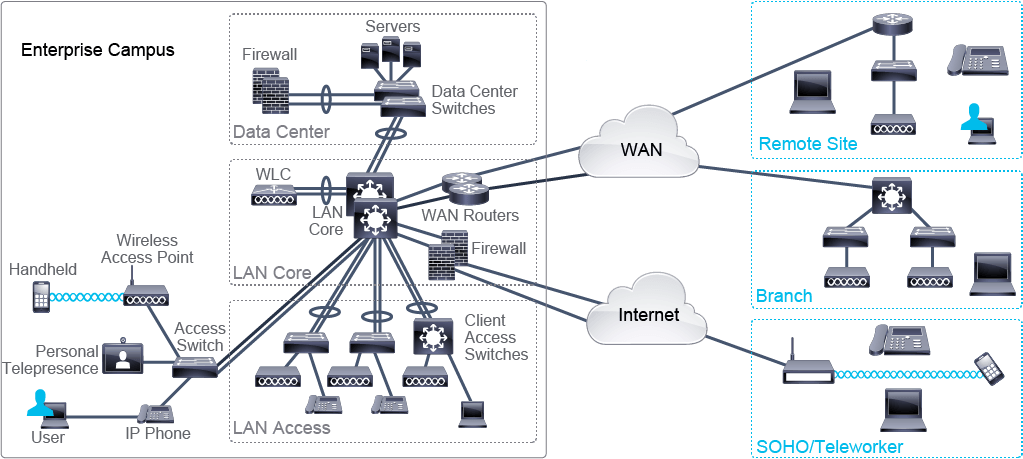
Networks support the activities of many businesses and organizations and are required to be secure, resilient, and to allow growth. The design of a network requires considerable technical knowledge. Network engineers commonly use validated network architecture models to assist in the design and implementation of the network. Examples of validated models are the Cisco three-tier hierarchical network architecture model, the spine-leaf model, and the Cisco Enterprise Architecture model. These models provide hierarchical structure to enterprise networks, which is used to design the network architecture in the form of layers. For example, LAN Access and LAN Core, with each layer providing different functionalities.
網路支撐著許多企業與組織的活動,因此必須安全、具韌性,並能容許成長。網路設計需要相當多的技術知識。網路工程師通常會使用經過驗證的網路架構模型,來協助網路的設計與實作。經過驗證的模型例子有 Cisco 三層式階層網路架構模型、spine-leaf 模型,以及 Cisco 企業架構模型。這些模型為企業網路提供階層式結構,用來以分層的方式設計網路架構,例如 LAN 存取層(Access)與 LAN 核心層(Core),每一層提供不同的功能。
Protocols are a detailed set of rules that govern successful network communication. The rules define various situations, methods, and behaviors that every communicating device should follow. The examples of specifications that protocols include are the voltage to use for an electrical signal, which messages are allowed in communication, what are the building blocks of the messages, what is to be done if a message is lost, and what should be done if the message contains an error.
通訊協定是一套詳細的規則,用來規範網路通訊如何順利進行。這些規則定義了每個通訊裝置應遵循的各種情境、方法與行為。通訊協定所包含的規範例子有:電氣訊號應使用的電壓、通訊中允許哪些訊息、訊息的組成要素是什麼、訊息遺失時該怎麼做,以及訊息含有錯誤時應如何處理。
The exchange of data within the internet follows the same well-defined protocol rules, designed specifically for internet communication. Protocols define how data is transmitted between devices in networks and how it allows the devices to communicate with each other. The analogy to communication between two devices would be two people talking the same language. Protocols are typically created according to the industry standard by various networking or information technology organizations. The internet is a base for various data exchange services, such as email or file transfers. It is a common global infrastructure, composed of many computer networks connected that follow communication rules standardized for the internet. A set of documents called RFCs defines the protocols and processes of the internet.
網際網路內的資料交換遵循同一套定義明確、專為網際網路通訊設計的協定規則。通訊協定定義了資料如何在網路中的裝置之間傳輸,以及如何讓裝置彼此通訊。兩台裝置之間的通訊,可以比喻為兩個人說著同一種語言。通訊協定通常由各種網路或資訊科技組織依產業標準制定。網際網路是各種資料交換服務(例如電子郵件或檔案傳輸)的基礎。它是一個共同的全球基礎架構,由許多相連的電腦網路組成,這些網路都遵循為網際網路標準化的通訊規則。一組稱為 RFC 的文件定義了網際網路的協定與流程。
Request for Comments (RFC) is a document that is written by the technical and standards-setting bodies for the internet. In the following examples, you will browse through some of the RFCs that you can find at https://www.ietf.org/standards/rfcs/. For this task, you do not require any technical knowledge. The objective of the task is to browse through the RFC, get to know its structure, and search for information within it.
Request for Comments(RFC)是由網際網路的技術與標準制定機構所撰寫的文件。在接下來的範例中,你將瀏覽一些可在 https://www.ietf.org/standards/rfcs/ 找到的 RFC。這項任務不需要任何技術知識。任務的目標是瀏覽 RFC、了解其結構,並在其中搜尋資訊。