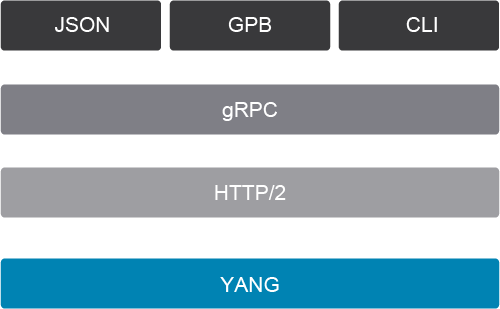
To manipulate and automate on the data models supported on a network device, a network management protocol needs to be used between the application client (such as an SDN controller) and the network devices. Different devices support one or more protocols such as REST, NETCONF, RESTCONF, and gRPC through a corresponding programmable interface agent for these protocols—sometimes a native REST agent is used.
為了操控並自動化網路裝置支援的資料模型,用戶端應用程式(例如 SDN 控制器)與網路裝置之間需要使用網路管理協定。不同裝置透過對應的可程式化介面代理支援一種或多種協定,例如 REST、NETCONF、RESTCONF 及 gRPC,有時也會使用原生 REST 代理。
When a request from a client is received through a NETCONF, RESTCONF, or gRPC protocol, the corresponding programmable interface agent converts the request into an abstract message object that is distributed to the underlying model infrastructure. The appropriate model is selected and the request is passed to it for processing. The model infrastructure executes the request (read or write) on the device data store, returning the results to the originating agent for response transmission back to the requesting client.
當透過 NETCONF、RESTCONF 或 gRPC 協定收到用戶端請求時,對應的可程式化介面代理會將請求轉換為抽象訊息物件,並分派給底層模型基礎架構。系統會選擇適當的模型,將請求傳給該模型處理。模型基礎架構會在裝置的資料儲存區執行請求(讀取或寫入),並將結果回傳給原始代理,再傳送回應給發出請求的用戶端。
Representational State Transfer
表現層狀態轉換(Representational State Transfer)
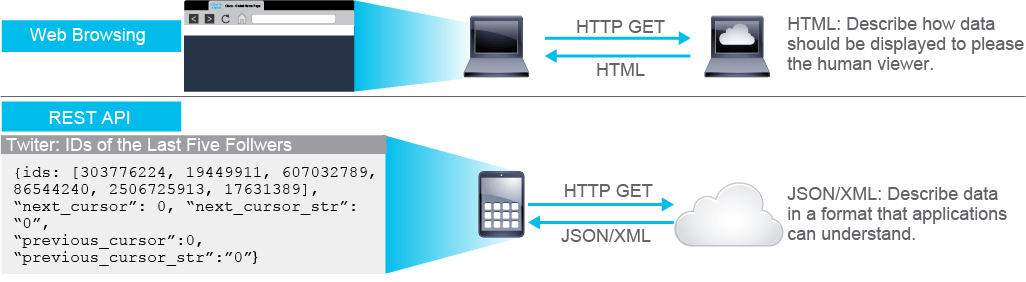
There is often a perception that REST is a complex topic to learn, but in reality, it is analogous to browsing a website with a web browser.
一般人常覺得 REST 是個複雜的主題,但實際上它就類似用網頁瀏覽器瀏覽網站一樣。
REST is an architectural style (rather than a protocol) for designing networked applications.
REST 是一種設計網路應用程式的架構風格(而非協定)。
Network resources can be uniquely identified by two types of Uniform Resource Identifiers (URI):
網路資源可以透過兩種統一資源識別碼(URI)唯一識別:
- Uniform Resource Name (URN): A resource name that has no specific lookup method (protocol) defined, such as example.com.統一資源名稱(URN):沒有定義特定查詢方法(協定)的資源名稱,例如 example.com。
- Uniform Resource Locator (URL): A resource name with a specified lookup method (protocol), such as http://www.cisco.com/index.html. URLs may include the following:統一資源定位符 (URL):具有指定查詢方法(協定)的資源名稱,例如 http://www.cisco.com/index.html。URL 可能包含以下部分:
- Protocol/scheme: HTTP(S), FTP, Telnet, mailto, Network News Transfer Protocol (NNTP), and so on.協定/方案:HTTP(S)、FTP、Telnet、mailto、網路新聞傳輸協定(NNTP)等。
- Hostname: For example, www.cisco.com.主機名稱:例如 www.cisco.com。
- Path and file name: For example, /index.html.路徑與檔名:例如 /index.html。
In REST, a client sends a request for a resource using a URL, and the server responds by providing that resource. This is also known as a stateless client/server model and typically uses HTTP(S) to make calls (referred to as requests) between entities.
在 REST 中,用戶端使用 URL 傳送資源請求,伺服器則提供該資源作為回應。這也稱為無狀態的用戶端/伺服器模型,通常使用 HTTP(S) 在實體之間進行呼叫(稱為請求)。
Usually, you have to identify yourself to the REST resource by some form of authentication to ensure secure access to the network resource.
通常你必須透過某種形式的驗證向 REST 資源表明身分,以確保網路資源的存取安全。
These are the authentication mechanisms that you will come across the most when using REST:
以下是使用 REST 時最常遇到的驗證機制:
- Basic Authentication:This type of authentication is a built-in feature of the HTTP framework. Credentials are sent as user ID (username) and password pairs with each request. This method is considered unsafe since credentials are passed as plaintext in the request. You can enhance security by sending such requests over HTTP(S) which encrypts the request, protecting both the credentials and the sent data in case they get intercepted in transit. This method is also less flexible since the permissions and level of access is defined by the user. This means that granular access control requires setting up new users with custom permissions, which makes access administration very complex.基本驗證(Basic Authentication):此驗證方式是 HTTP 框架內建的功能。認證資訊會以使用者 ID(使用者名稱)與密碼配對的方式隨每個請求傳送。由於認證資訊是以明文方式傳送於請求中,此方法被視為不安全。你可以透過 HTTP(S) 傳送此類請求以加密請求內容,藉此提升安全性,保護認證資訊與所傳送的資料在傳輸過程中遭攔截的風險。此方法也較不靈活,因為權限與存取等級是由使用者定義的。這表示要做到細緻的存取控制,就必須建立具有自訂權限的新使用者,使存取管理變得非常複雜。
- Application Programming Interface (API) Key: This type of authentication uses tokens, which are cryptographic strings of characters encoding your identity. You normally create such a token by logging in to an administration portal using your user credentials and define the level of permissions during the token creation process. Once the token is created, the server where you created the token, associates this specific token with the set permissions. This method requires the server to lookup the information from the API key and associate the access level for every request, which can put a lot of stress on the server when there are a lot of requests to process. With API keys you can set granular permissions for a single user, for instance, one API key has only read permissions for the user who created the key, while another API key grants write permissions for that user, which greatly simplifies the administration process. The API keys are normally set once and used for a long time for a given user and level of access.應用程式設計介面(API)金鑰:此驗證方式使用權杖(token),也就是編碼你身分的加密字元字串。你通常會使用使用者認證登入管理入口網站來建立此類權杖,並在建立權杖的過程中定義權限等級。權杖建立後,建立該權杖的伺服器會將此特定權杖與設定的權限產生關聯。此方法需要伺服器在每次請求時查詢 API 金鑰的資訊並關聯存取等級,當要處理的請求數量很多時,可能會對伺服器造成很大的負擔。使用 API 金鑰時,你可以針對單一使用者設定細緻的權限,例如某個 API 金鑰只給建立該金鑰的使用者讀取權限,而另一個 API 金鑰則授予該使用者寫入權限,大幅簡化了管理流程。API 金鑰通常會針對特定使用者與存取等級設定一次,並長期使用。
- Bearer Token:This method is also token based and is considered an upgrade of API key-based authentication. Normally, this is used in a dynamic environment where you would like to have a token with custom permissions for a given series of requests on the fly. First, you send a request with basic or API key authentication to a server, it replies with a so-called bearer token that is automatically passed to other requests. The advantages of a bearer token over an API key is that the bearer token can be created on the fly and permissions are embedded in the bearer token itself. This means that a server does not have to associate the token with permissions upon every request. This type of authentication is also safer, since bearer tokens usually come with a predefined expiration date, making them invalid after a certain time. In addition, the bearer token is transferable, which means a user can pass this token to an application that accesses the endpoint resource with the permissions granted to the user.持有者權杖(Bearer Token):此方法同樣以權杖為基礎,可視為 API 金鑰驗證的升級版。通常用於動態環境中,你希望針對一系列請求即時產生具自訂權限的權杖。首先,你使用基本驗證或 API 金鑰驗證向伺服器傳送請求,伺服器會回覆一個所謂的持有者權杖,該權杖會自動傳遞給其他請求使用。持有者權杖相較於 API 金鑰的優點是,持有者權杖可以即時建立,而且權限已內嵌於權杖本身,這表示伺服器不必在每次請求時將權杖與權限做關聯。此驗證方式也較安全,因為持有者權杖通常帶有預先定義的到期日,超過一定時間後即失效。此外,持有者權杖是可轉移的,這表示使用者可以將此權杖傳遞給某個應用程式,讓該應用程式以使用者被授予的權限存取端點資源。
- No Authentication:Sometimes you will encounter cases where no authentication is required. This is very rare and normally used with publicly available resources where authentication and authorization are not an issue.無驗證:有時你會遇到不需要任何驗證的情況。這種情況非常少見,通常用於驗證與授權都不是問題的公開資源。
REST supports create, read, update, and delete (CRUD) operations by using specific HTTP verbs. Create, retrieve, update, and delete refers to the four major functions that are implemented in database applications (including network devices). CRUD operations are how you can work with network APIs to create objects (for example, create loopback interfaces), retrieve objects (particular sections of config or operational data), update objects (perform a given change), or delete an object (remove a route, an IP address, and so on).
REST 透過特定的 HTTP 動詞支援建立、讀取、更新與刪除(CRUD)操作。建立、擷取、更新與刪除是資料庫應用程式(包含網路裝置)所實作的四項主要功能。CRUD 操作是你用來操作網路 API 的方式,可用來建立物件(例如建立回送介面)、擷取物件(設定或運作資料的特定部分)、更新物件(執行特定變更),或刪除物件(移除路由、IP 位址等)。
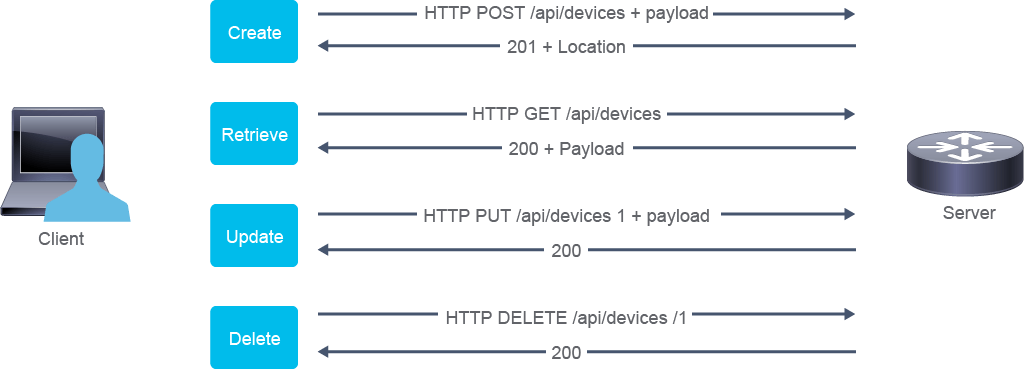
CRUD operations are used with the URL and payload. It is how the server (network device) knows what action to perform. With the REST API, your application passes a request for a certain type of data by specifying the URL path that models the data. Both the request and response are JSON or XML-formatted data. The following image shows an example of an URI address composition. The protocol used is HTTP.
CRUD 操作會搭配 URL 與承載資料使用,這是伺服器(網路裝置)用來判斷該執行何種動作的依據。使用 REST API 時,應用程式會透過指定描述資料模型的 URL 路徑來傳送特定類型資料的請求。請求與回應都是 JSON 或 XML 格式的資料。下圖顯示 URI 位址組成的範例,所使用的協定為 HTTP。

The most common HTTP verbs that are used by REST are GET, POST, PUT, PATCH, and DELETE. HTTP verbs are the methods that are used to perform some sort of action on a specific resource. Because HTTP is a standardized and ubiquitous protocol, the semantics are well known.
REST 最常使用的 HTTP 動詞是 GET、POST、PUT、PATCH 及 DELETE。HTTP 動詞是用來對特定資源執行某種動作的方法。由於 HTTP 是標準化且普及的協定,其語意已廣為人知。
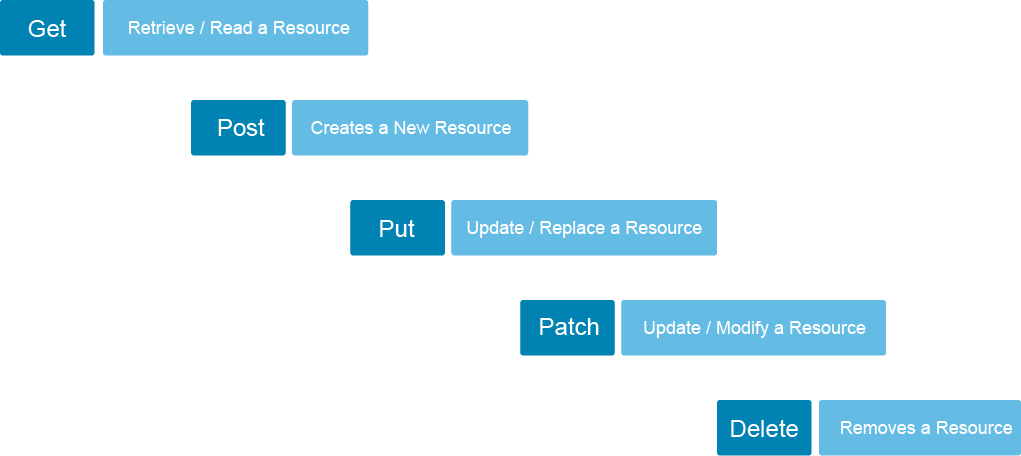
GET is used to read or retrieve information from a resource and returns a representation of the data in JSON or XML. Because the GET method only reads data and does not change it, it is considered a "safe" method, which means there is no risk of data corruption.
GET 用於讀取或擷取資源的資訊,並以 JSON 或 XML 傳回資料的表示形式。由於 GET 方法只讀取資料而不會變更資料,因此被視為「安全」方法,代表不會有資料損毀的風險。
POST, on the other hand, creates new resources, which means it is not considered a "safe" method.
POST 則是用來建立新資源,因此不被視為「安全」方法。
PUT is normally used to update or replace an already existing resource. It is called "PUT-ing" to a resource and involves sending a request with the updated representation of the original resource.
PUT 通常用來更新或取代已存在的資源,稱為對資源進行「PUT」操作,做法是傳送包含原始資源更新後表示形式的請求。
PATCH is similar in some ways to PUT in that PATCH modifies the capabilities of a resource. The difference between PUT and PATCH is that PATCH sends a request containing only the changes to the resource and not a complete updated resource.
PATCH 在某些方面與 PUT 類似,都是修改資源的內容。PUT 與 PATCH 的差異在於,PATCH 傳送的請求只包含對資源的變更部分,而非完整的更新後資源。
DELETE simply deletes a resource that is identified by a URI.
DELETE 單純刪除以 URI 識別的資源。
When an HTTP method is used, there is a specific response code returned. For example, upon successful deletion of a resource using DELETE, the client will receive a 200 message signifying that the request succeeded.
使用 HTTP 方法時,會傳回特定的回應碼。例如,成功使用 DELETE 刪除資源後,用戶端會收到代表請求成功的 200 訊息。
HTTP response codes were developed by the IETF and therefore easy to look up online or on their website, ietf.org. These codes are useful in troubleshooting because they provide specific information regarding the error on the client side or server side. For example, if a client receives a 400 response from a server, you can conclude that there is a syntax problem in the request.
HTTP 回應碼由 IETF 制定,因此很容易在網路上或其官網 ietf.org 查詢。這些回應碼在疑難排解時非常有用,因為它們能提供有關用戶端或伺服器端錯誤的具體資訊。例如,若用戶端收到伺服器回傳的 400 回應,就可以判斷請求中存在語法問題。
In the tables below, you can see some of the most common HTTP response codes.
下表列出一些最常見的 HTTP 回應碼。
Several tools exist that are used to test REST APIs:
有幾種工具可用來測試 REST API:
- cURL:A simple Linux command line tool within a shell script that provides an easy way to transfer data with URL syntax.cURL:一種簡單的 Linux 命令列工具,可在 Shell 指令碼中使用 URL 語法輕鬆傳輸資料。
- Postman: An application that simplifies the development and testing of APIs and is an excellent tool for learning more about RESTful APIs.Postman:一種簡化 API 開發與測試的應用程式,也是深入學習 RESTful API 的絕佳工具。
- Python: Requests make use of embedded Python libraries and a small variety of methods to send HTTP requests to a resource API.Python:Requests 會利用內嵌的 Python 函式庫及少數幾種方法,向資源 API 傳送 HTTP 請求。
Network Configuration Protocol
網路設定協定(Network Configuration Protocol)
NETCONF is an IETF standard transport protocol for communicating with network devices, retrieving operational data and both setting and reading configuration data. Operational data includes interface statistics, memory utilization, errors, and so on. The configuration data refers to how particular interfaces, routing protocols, and other features are enabled and provisioned. NETCONF purely defines how to communicate with the devices.
NETCONF 是 IETF 制定的標準傳輸協定,用於與網路裝置通訊、擷取運作資料,以及設定與讀取設定資料。運作資料包含介面統計資訊、記憶體使用率、錯誤等。設定資料則是指特定介面、路由協定及其他功能如何被啟用與佈建。NETCONF 純粹定義如何與裝置通訊。
NETCONF uses an XML management interface for configuration data and protocol messages. The protocol messages are exchanged on top of a secure transport protocol such as SSH or TLS. NETCONF is session-oriented and stateful—it is worth pointing out as other APIs such as native REST and RESTCONF are stateless.
NETCONF 使用 XML 管理介面來處理設定資料與協定訊息,協定訊息會透過安全傳輸協定(例如 SSH 或 TLS)交換。NETCONF 是以工作階段為導向且具狀態的,值得注意的是,其他 API(例如原生 REST 及 RESTCONF)則是無狀態的。
NETCONF is fairly sophisticated and it uses an RPC paradigm to facilitate communication between the client (for example, an NMS server or an open source script) and the server. NETCONF supports device transaction, which means that when you make an API call configuring multiple objects and one fails, the entire transaction fails,and you do not end up with a partial configuration. NETCONF is fairly sophisticated—it is not simple CRUD processing.
NETCONF 相當複雜,它使用 RPC 範式來促成用戶端(例如 NMS 伺服器或開源指令碼)與伺服器之間的通訊。NETCONF 支援裝置交易,這表示當你透過一次 API 呼叫設定多個物件而其中一個失敗時,整個交易都會失敗,不會出現部分設定的情形。NETCONF 相當複雜,不只是簡單的 CRUD 處理。
NETCONF encodes messages, operations, and content in XML, which is intended to be machine and human-readable.
NETCONF 以 XML 編碼訊息、操作與內容,目的是讓機器與人類都能閱讀。
NETCONF utilizes multiple configuration data stores (including candidate, running, and startup). This is one of the most unique attributes of NETCONF, though a device does not have to implement this feature to "support" the protocol. NETCONF utilizes a candidate configuration, which is simply a configuration with all proposed changes applied in an uncommitted state. It is the equivalent of entering CLI commands and having them not take effect right away. You would then "commit" all the changes as a single transaction. Once committed, you would see them in the running configuration.
NETCONF 使用多個設定資料儲存區(包含候選、執行中及啟動設定)。這是 NETCONF 最獨特的屬性之一,不過裝置不一定要實作此功能才算「支援」該協定。NETCONF 使用候選設定,也就是套用所有建議變更但尚未提交的設定。這就相當於輸入 CLI 指令但不立即生效,等你之後將所有變更以單一交易方式「提交」。一旦提交後,你就會在執行中設定裡看到這些變更。
The example shows different NETCONF data stores:
此範例顯示不同的 NETCONF 資料儲存區:

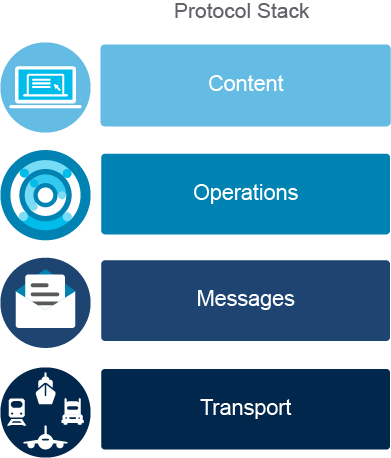
There are four core layers to the NETCONF protocol stack:
NETCONF 協定堆疊有四個核心層:
- Content: Consists of configuration data and notification data. Embedded as XML objects within the operations tag are XML documents, specific data you want to retrieve or configure. It is the content that is an XML representation of YANG models or XML schema definitions.內容:由設定資料與通知資料組成。內嵌於操作標籤中的 XML 物件即是 XML 文件,也就是你想要擷取或設定的特定資料。內容就是 YANG 模型或 XML 結構描述定義的 XML 表示形式。
- Operations: Defines a set of base protocol operations to retrieve and edit config data. Each device and platform supports a given number of operations. Common operations are the following:操作:定義一組用來擷取與編輯設定資料的基礎協定操作。每種裝置與平台支援的操作數量不同。常見的操作如下:Retrieve running configuration and device state information擷取執行中設定與裝置狀態資訊Retrieve all or part of a configuration data store擷取全部或部分設定資料儲存區Loads all or part of a configuration to the specified data store將全部或部分設定載入指定的資料儲存區Delete a configuration data store刪除設定資料儲存區Replace an entire configuration data store with another以另一個設定資料儲存區取代整個設定資料儲存區//Lock or unlock the entire configuration data store system鎖定或解鎖整個設定資料儲存區系統Graceful termination of NETCONF session正常終止 NETCONF 工作階段Forced termination of NETCONF session強制終止 NETCONF 工作階段
- Messages: A mechanism for encoding RPCs and notifications. NETCONF encodes everything in XML, starting with the XML header and message. The first element in the XML document is always the RPC element that is simply telling the server that an RPC is going to be used on the device. These RPC elements map directly back to specific operations on the device.訊息:用於編碼 RPC 與通知的機制。NETCONF 將所有內容都以 XML 編碼,從 XML 標頭與訊息開始。XML 文件中的第一個元素永遠是 RPC 元素,用來單純告知伺服器裝置上將使用 RPC。這些 RPC 元素會直接對應到裝置上的特定操作。
- Transport: How the NETCONF client communicates with the NETCONF server. Secure and reliable transport of messages between client and server.傳輸:NETCONF 用戶端與 NETCONF 伺服器通訊的方式,用於在用戶端與伺服器之間進行安全可靠的訊息傳輸。
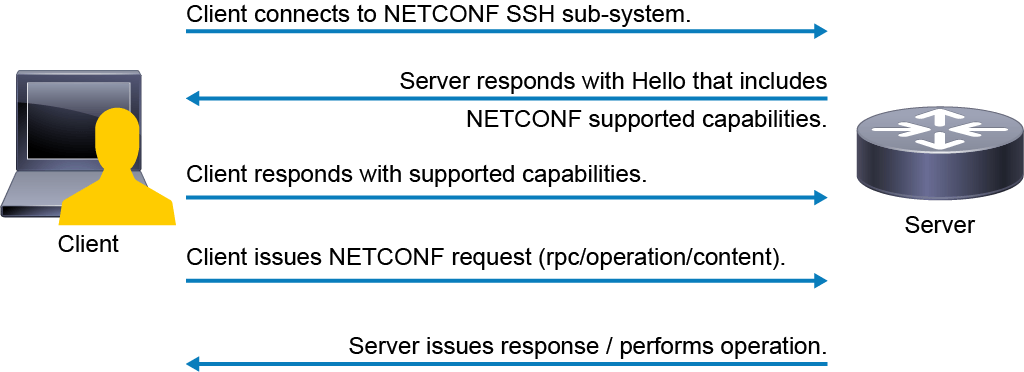
There are a few steps that occur during a NETCONF session; they can be summarized as follows:
NETCONF 工作階段期間會發生幾個步驟,可摘要如下:
- Client first connects to the server NETCONF SSH subsystem.用戶端首先連線到伺服器的 NETCONF SSH 子系統。
- After client connects to the server (network device) and establishes a connection, the server sends a hello and it includes all its supported NETCONF capabilities.用戶端連線到伺服器(網路裝置)並建立連線後,伺服器會傳送 hello 訊息,其中包含其支援的所有 NETCONF 能力。
- When the server sends its hello, the client needs to send a hello with its supported capabilities. The client can respond back with all the capabilities the server supports (assuming the client does, too), or just with the bare minimum to do edits and GETs.當伺服器傳送 hello 訊息後,用戶端也需要傳送包含其支援能力的 hello 訊息。用戶端可以回覆伺服器支援的所有能力(假設用戶端也支援這些能力),或只回覆進行編輯與 GET 所需的最低限度能力。
- Once the client sends its capabilities, it can then send NETCONF requests. When a request is received via NETCONF, the request is converted into an abstract message object. That message object is distributed to the underlying model infrastructure based on the namespace in the request. Using the namespace, the appropriate model is selected and the request is passed to it for processing. The model infrastructure executes the request (read or write) on the device data store.用戶端傳送其能力後,即可傳送 NETCONF 請求。透過 NETCONF 收到請求時,該請求會被轉換為抽象訊息物件,並依據請求中的命名空間分派給底層模型基礎架構。系統會依據命名空間選擇適當的模型,並將請求傳給該模型處理。模型基礎架構會在裝置的資料儲存區執行請求(讀取或寫入)。
- The server processes the client request and responds with the configuration as expected.伺服器處理用戶端的請求,並依預期回傳設定內容作為回應。
Representational State Transfer Configuration Protocol
表現層狀態轉換設定協定(RESTCONF)
RESTCONF characteristics include the following:
RESTCONF 的特性包括:
- Functional subset of NETCONFNETCONF 的功能子集
- Exposes YANG models via a REST API (URL)透過 REST API(URL)公開 YANG 模型
- Uses HTTP or HTTPS as transport使用 HTTP 或 HTTPS 作為傳輸方式
- Uses XML or JSON for encoding使用 XML 或 JSON 進行編碼
- Developed to use HTTP tools and programming libraries設計上可使用 HTTP 工具與程式庫
- Uses common HTTP verbs in REST APIs在 REST API 中使用常見的 HTTP 動詞
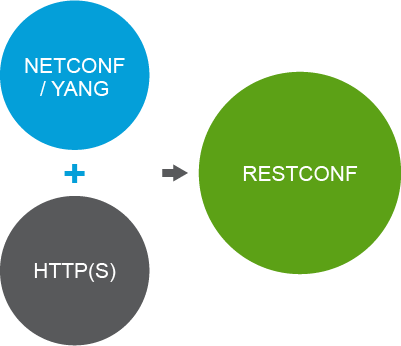
Once you understand REST and NETCONF on their own, RESTCONF becomes much easier to digest. RESTCONF, in simplest terms, adds a REST API to NETCONF. YANG models are used as when you use RESTCONF, and the URLs, HTTP verbs, and Request bodies are automatically generated from the associated YANG model. Unlike NETCONF, RESTCONF supports both XML and JSON.
一旦你分別了解 REST 與 NETCONF,理解 RESTCONF 就會容易得多。簡單來說,RESTCONF 是為 NETCONF 加上一個 REST API。使用 RESTCONF 時同樣使用 YANG 模型,URL、HTTP 動詞及請求主體都是根據相關聯的 YANG 模型自動產生。與 NETCONF 不同,RESTCONF 同時支援 XML 與 JSON。
Remember that RESTCONF is just using REST principles and therefore uses HTTP verbs appropriately. The one key operation to take note of is the use of the PUT operation. The PUT operation has the ability to replace entire sections of configuration that is based on what you send. It is analogous to declarative network configuration. For example, if you PATCH one static route, it will add the route. If you PUT the route, you will end up with just one route configured.
請記住,RESTCONF 只是應用 REST 原則,因此會適當地使用 HTTP 動詞。其中一個需要特別注意的關鍵操作是 PUT 操作的使用。PUT 操作能夠依你傳送的內容取代整個區段的設定,這類似於宣告式的網路設定。例如,如果你對某條靜態路由使用 PATCH,會新增該路由;如果你使用 PUT,最終就只會設定該一條路由。
RESTCONF is not intended to replace NETCONF, but rather to provide an HTTP interface that follows REST principles and is compatible with the NETCONF data store model.
RESTCONF 的目的不是取代 NETCONF,而是提供一個遵循 REST 原則且與 NETCONF 資料儲存區模型相容的 HTTP 介面。
RESTCONF provides a simplified interface that follows REST-like principles running on top of HTTP or HTTPS transport, making RESTCONF an attractive choice for application developers.
RESTCONF 提供簡化的介面,遵循類似 REST 的原則並運作於 HTTP 或 HTTPS 傳輸之上,使 RESTCONF 成為應用程式開發人員青睞的選擇。
Google RPC
Google 遠端程序呼叫(gRPC)
gRPC is an open-source RPC framework that provides simple client development. It is based on Protocol Buffers (Protobuf), which is an open source binary serialization protocol. gRPC provides a flexible, efficient, high-performance automated mechanism for serializing structured data, like XML, but is smaller and simpler to use. This makes it especially useful in model-driven telemetry.
gRPC 是一種開放原始碼的 RPC 框架,可簡化用戶端開發。它基於 Protocol Buffers(Protobuf),這是一種開放原始碼的二進位序列化協定。gRPC 提供靈活、高效且高效能的自動化機制,用於序列化結構化資料(如 XML),但體積更小、使用更簡便,因此在模型驅動遙測方面特別有用。
The user needs to define the structure by defining protocol buffer message types in .proto files. Each protocol buffer message is a small logical record of information, containing a series of name-value pairs. The structure of the data is defined by YANG models. gRPC encodes requests and responses in binary. gRPC is extensible to other content types along with Protobuf. The Protobuf binary data object in gRPC is transported over HTTP/2.
使用者需要在 .proto 檔案中定義 Protocol Buffer 訊息類型來定義結構。每個 Protocol Buffer 訊息都是一筆小型的邏輯資訊記錄,包含一系列名稱與值的配對。資料結構由 YANG 模型定義。gRPC 以二進位方式編碼請求與回應。除了 Protobuf 外,gRPC 也可延伸支援其他內容類型。gRPC 中的 Protobuf 二進位資料物件是透過 HTTP/2 傳輸的。