A physical topology describes the physical arrangement of network devices that allows for data to move from a source to a destination network, while the logical topology represents how data actually flows. When considering WAN topologies, you think about logical topologies. The logical topologies below are the enterprise’s view of its data flows through the service provider’s network. A physical topology might show all the various service provider devices that are switching the data flows inside the cloud.
實體拓樸描述網路裝置的實際擺放方式,使資料能夠從來源移動到目的地網路,而邏輯拓樸則代表資料實際流動的方式。在考量 WAN 拓樸時,考慮的是邏輯拓樸。以下的邏輯拓樸呈現的是企業對其資料流經服務供應商網路的觀點;而實體拓樸則可能顯示雲端內部所有負責交換資料流的各種服務供應商裝置。
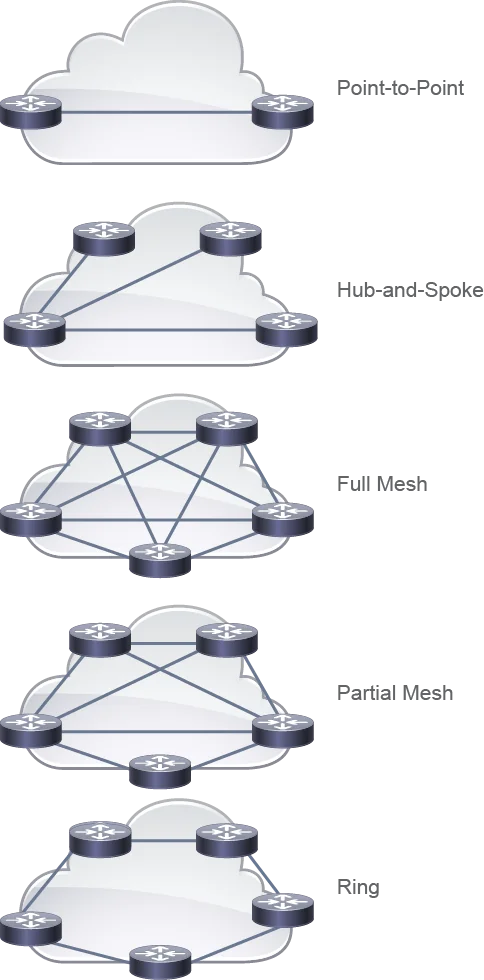
The five basic logical topologies in a WAN design are shown in the figure.
圖中顯示了 WAN 設計中五種基本的邏輯拓樸。
Point-to-point topology: This topology establishes a circuit (a logical connection) between exactly two sites. It is also called a Layer 2 service as it creates a connection, via which it seems that both sites are on the same physical segment. It is considered transparent to the enterprise network as if there was a direct physical link between two endpoints. The link capacity is dedicated to the customer. Typically, a point-to-point topology is offered in the form of leased lines. This solution does not scale well and can be costly.
點對點拓樸:此拓樸在恰好兩個站點之間建立一條電路(邏輯連線),也稱為第 2 層服務,因為它建立了一條連線,使兩個站點看起來就像位於同一個實體區段上。對企業網路而言,這種拓樸是透明的,就好像兩個端點之間有一條直接的實體鏈路一樣。該鏈路容量是專屬於該客戶的。點對點拓樸通常以專線(leased line)的形式提供,此方案的擴充性不佳,且成本可能較高。
Hub-and-spoke topology: This topology features a central router or multilayer switch, acting as the hub, which is connected to all other remote devices, the spokes. All communication among the spoke networks traverses the hub. The advantages of a hub-and-spoke design are that it is a simple network with simplified management, requires few circuits, allows for centralized network services, and consequently minimizes the network operational costs. However, the disadvantages are significant:
軸輻式(Hub-and-spoke)拓樸:此拓樸具有一台中央路由器或多層交換器作為軸心(hub),連接到所有其他遠端裝置,也就是輻條(spoke)。輻條網路之間的所有通訊都必須經過軸心。軸輻式設計的優點是網路簡單、管理簡化、所需電路較少、可提供集中式網路服務,因此能降低網路維運成本。然而,其缺點也相當顯著:
- The central router (hub) represents a single point of failure.中央路由器(軸心)是單一故障點。
- The central router limits the overall performance for access to centralized resources. The central router is a single pipe that manages all traffic that is intended either for the centralized resources or for the other regional routers.中央路由器限制了存取集中式資源的整體效能。中央路由器是單一通道,必須處理所有前往集中式資源或其他區域路由器的流量。
- There may be suboptimal traffic flows, as traffic between spokes must go through the hub.可能出現不理想的流量路徑,因為輻條之間的流量必須經過軸心。
With only one hub node, the topology is also called single-homed. Providing an extra hub node provides for redundancy and the topology is referred to as dual-homed hub-and-spoke.
只有一個軸心節點時,這種拓樸也稱為單軸心(single-homed)。若提供額外的軸心節點以達到備援效果,則稱為雙軸心(dual-homed)軸輻式拓樸。
Meshed topologies are the ones in which there are many redundant interconnections between the nodes. There are two types of meshed topologies, full mesh and partial mesh:
網狀拓樸是節點之間存在許多備援互連的拓樸,有兩種網狀拓樸:全網狀與部分網狀:
- Full mesh topology: In this topology, each remote node on the periphery of a given service provider network has a direct logical connection, also called a circuit, to every other remote node. Any site can communicate directly with any other site. The key rationale for creating a full mesh environment is to provide a high level of redundancy. A disadvantage of a full mesh topology is that it can be complex to configure and maintain the large number of circuits required, and therefore it does not scale well.全網狀(Full mesh)拓樸:在此拓樸中,特定服務供應商網路周邊的每個遠端節點都與其他每個遠端節點有直接的邏輯連線(也稱為電路)。任一站點都可以直接與其他任一站點通訊。建立全網狀環境的主要理由是為了提供高度的備援能力。全網狀拓樸的缺點是需要設定與維護大量電路,較為複雜,因此擴充性不佳。
- Partial mesh topology: In this topology, almost, but not all remote nodes are interconnected. It reduces the number of sites that have direct connections to all other nodes. Partial meshes are highly flexible topologies that can take various very different configurations. Some nodes are organized in a full mesh scheme, but others are only connected to one or two in the network. A partial mesh topology is commonly found in peripheral networks connected to a full meshed backbone. This topology is often used in regionalized enterprise networks. Among all its locations, an enterprise chooses several to act as regional centers. These centers serve a selected area and implement a hub-and-spoke topology within them, where they are the hub. This process creates multiple hub-and-spoke topologies in an enterprise network. Hubs themselves are connected in a full mesh topology. This setup lowers the number of required circuits, provides redundancy, and ensures performance. The cost of a partial mesh topology is higher than hub-and-spoke but less than full mesh.部分網狀拓樸:在此拓樸中,幾乎但並非所有遠端節點都互相連接。它減少了與其他所有節點都有直接連線的站點數量。部分網狀是高度彈性的拓樸,可以呈現多種截然不同的組態。有些節點以全網狀方式組織,但其他節點只連接到網路中的一、兩個節點。部分網狀拓樸常見於連接至全網狀骨幹網路的周邊網路,也常用於區域化的企業網路。企業會在其所有據點中選出幾個作為區域中心,這些中心負責服務選定的區域,並在其中實作軸輻式拓樸,由中心擔任軸心。這個過程會在企業網路中建立多個軸輻式拓樸,而軸心彼此之間則以全網狀拓樸連接。這種設定降低了所需電路的數量,同時提供備援並確保效能。部分網狀拓樸的成本高於軸輻式,但低於全網狀。
- Ring topology: In this topology, all remote nodes are connected to two other remote nodes. Compared with full mesh or partial mesh, the ring topology is often used offering redundancy but using the minimum number of links. Specific technologies exist to guarantee redundancy and fast convergence in this type of topology. A disadvantage of ring topology is that certain traditional technologies, especially for fast convergence, do not work perfectly with ring topologies.環狀拓樸:在此拓樸中,所有遠端節點都連接到另外兩個遠端節點。與全網狀或部分網狀相比,環狀拓樸經常用於在使用最少鏈路數量的情況下提供備援。有特定技術可以在這種拓樸中保證備援及快速收斂。環狀拓樸的缺點是某些傳統技術,特別是用於快速收斂的技術,在環狀拓樸中無法完美運作。
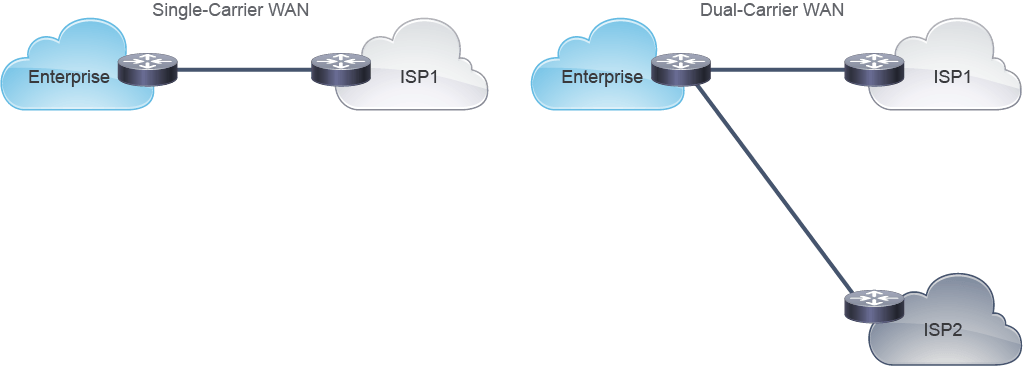
Network downtime can be very expensive in terms of decreased productivity and potential loss of revenue. Take, for example, a company that sells products online. Not being able to access the warehouse records might significantly decrease company’s income. To increase network availability, many organizations deploy a dual-carrier WAN design to increase redundancy and path diversity. Dual-carrier WAN means that the enterprise has connections to two different carriers (service providers).
網路停機在生產力下降及潛在營收損失方面可能代價高昂。舉例來說,一家線上銷售產品的公司,若無法存取倉庫記錄,可能會顯著減少該公司的收入。為了提高網路可用性,許多組織會部署雙電信商 WAN 設計,以提高備援能力與路徑多樣性。雙電信商 WAN 是指企業與兩個不同的電信商(服務供應商)建立連線。
Aspects of the WAN service are determined by a legal agreement between the enterprise and the service provider. These agreements define technical, administrative, and financial aspects of the service. Technical details are commonly included in Service Level Agreements (SLAs) and they describe aspects of the service, such as quality, availability, reliability, and so on.
WAN 服務的各項條件是由企業與服務供應商之間的法律協議所決定,這些協議界定了服務的技術、行政與財務層面。技術細節通常包含在服務等級協議(Service Level Agreement,SLA)中,用於描述服務的品質、可用性、可靠性等方面。
Single-carrier WANs are simpler and easier to support and manage. However, network outages can be detrimental.
單一電信商 WAN 較為簡單,也比較容易支援與管理,但網路中斷可能造成嚴重損害。
Dual-carrier WANs provide better path diversity with better fault isolation between providers. They offer enhanced network redundancy, load balancing, distributed computing or processing, and the ability to implement backup service provider connections. The disadvantage of dual-carrier topologies is that they are more expensive to implement than single-carrier topologies, because they require additional networking hardware. They are also more difficult to implement because they require additional, and more complex, configurations. The cost of downtime to your organization usually exceeds the additional cost of the second provider and the complexity of managing redundancy.
雙電信商 WAN 在不同供應商之間提供更好的路徑多樣性與故障隔離,能提供更佳的網路備援、負載平衡、分散式運算或處理能力,並可實作備援服務供應商連線。雙電信商拓樸的缺點是實作成本較單一電信商拓樸高,因為需要額外的網路硬體,且由於需要額外且更複雜的設定,實作難度也較高。組織因停機所產生的成本,通常會超過第二家供應商的額外成本及管理備援的複雜度。