The OSI model and the TCP/IP stack were developed by different organizations at approximately the same time. The purpose was to organize and communicate the components that guide the transmission of data.
OSI 模型與 TCP/IP 堆疊是由不同組織在大約同一時期發展出來的。其目的是整理並說明引導資料傳輸的各個組成元件。
The speed at which the TCP/IP-based internet was adopted and the rate at which it expanded caused the OSI protocol suite development and acceptance to lag behind. Although few of the protocols that were developed using the OSI specifications are in widespread use today, the seven-layer OSI model has made major contributions to the development of other protocols and products for all types of new networks.
以 TCP/IP 為基礎的網際網路被採用的速度與擴張的幅度,使得 OSI 協定套組的發展與接受度落後。雖然依 OSI 規格開發的協定如今很少被廣泛使用,但七層的 OSI 模型對各類新型網路的其他協定與產品的發展有重大貢獻。
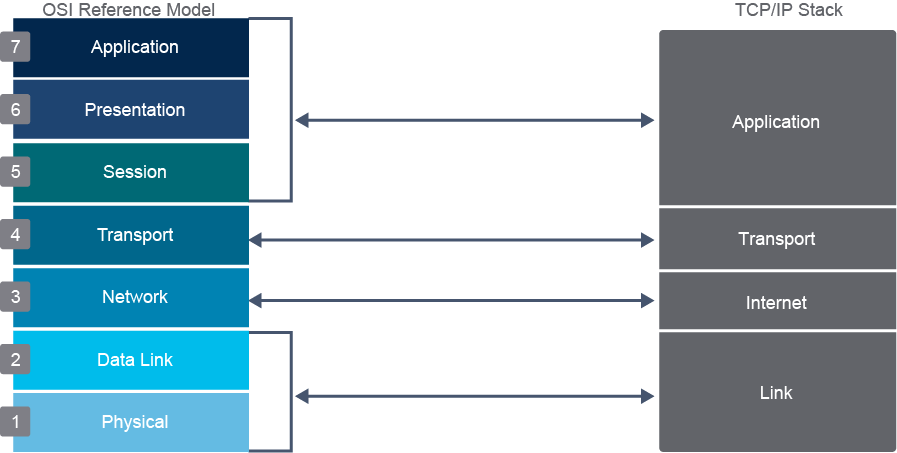
The layers of the TCP/IP stack correspond to the layers of the OSI model:
TCP/IP 堆疊的各層與 OSI 模型的各層對應如下:
- The TCP/IP link layer corresponds to the OSI physical and data link layers and is concerned primarily with interfacing with network hardware and accessing the transmission media. Like layer 2 of the OSI model, the link layer of the TCP/IP model is concerned with hardware addresses.TCP/IP 鏈結層對應 OSI 的實體層與資料鏈結層,主要負責與網路硬體介接以及存取傳輸媒介。和 OSI 模型的第 2 層一樣,TCP/IP 模型的鏈結層也處理硬體位址。
- The TCP/IP internet layer aligns with the network layer of the OSI model and manages the addressing of and routing between network devices.TCP/IP 網際網路層對應 OSI 模型的網路層,負責網路裝置的定址以及裝置之間的路由。
- The TCP/IP transport layer, like the OSI transport layer, provides the means for multiple host applications to access the network layer in a best-effort mode or through a reliable delivery mode.TCP/IP 傳輸層和 OSI 傳輸層一樣,提供讓多個主機應用程式以盡力而為(best-effort)模式或可靠傳遞模式存取網路層的方法。
- The TCP/IP application layer supports applications that communicate with the lower layers of the TCP/IP model and corresponds to the separate application, presentation, and session layers of the OSI model.TCP/IP 應用層支援與 TCP/IP 模型較低層通訊的應用程式,對應 OSI 模型中各自獨立的應用層、表現層與會議層。
Because the functions of each OSI layer are clearly defined, the OSI layers are used when referring to devices and protocols.
由於 OSI 每一層的功能都有清楚的定義,因此在提到裝置與協定時,通常會使用 OSI 的分層。
Take, for example, a "Layer 2 switch," which is a LAN switch. The "Layer 2" in this case refers to the OSI Layer 2, making it easy for people to know what is meant, as they associate the OSI Layer 2 with a clearly defined set of functions.
以「第 2 層交換器(Layer 2 switch)」為例,它就是 LAN 交換器。這裡的「第 2 層」指的是 OSI 第 2 層,因為人們會把 OSI 第 2 層與一組明確定義的功能聯想在一起,所以很容易理解其含意。
Similarly, it is often said that IP is a "network layer protocol" or a "Layer 3 protocol" as the TCP/IP’s internet layer can be matched to the OSI network layer.
同樣地,人們常說 IP 是「網路層協定」或「第 3 層協定」,因為 TCP/IP 的網際網路層可以對應到 OSI 的網路層。
Next, look at the TCP/IP transport layer, which corresponds to the OSI transport layer. The functions defined at both layers are the same. However, different specific protocols are involved. Because of this, it is common to refer to the TCP and UDP as "Layer 4 protocols" again using the OSI layer number.
接著來看 TCP/IP 傳輸層,它對應 OSI 傳輸層。兩者所定義的功能相同,但涉及的具體協定不同。因此,通常會把 TCP 與 UDP 稱為「第 4 層協定」,同樣是沿用 OSI 的層編號。
Another example is the term "Layer 3 switch." A switch was traditionally thought of as a device that works on the link layer level (Layer 2 of the OSI model). A Layer 3 switch is also capable of providing internet layer (Layer 3 of the OSI model) services, which were traditionally provided by routers.
另一個例子是「第 3 層交換器(Layer 3 switch)」這個詞。傳統上,交換器被視為在鏈結層(OSI 模型第 2 層)運作的裝置。第 3 層交換器還能提供網際網路層(OSI 模型第 3 層)的服務,而這些服務傳統上是由路由器提供的。
It is very important to remember that the OSI model terminology and layer numbers are often used rather than the TCP/IP model terminology and layer numbers when referring to devices and protocols.
務必記住,在提到裝置與協定時,經常使用的是 OSI 模型的術語與層編號,而不是 TCP/IP 模型的術語與層編號。