This topic compares traditional versus software-defined networks (SDNs).
本主題比較傳統網路與軟體定義網路(SDN)。
Traditional networks comprise several devices (for example, routers, switches, and WLCs) that are equipped with software and networking functionality:
傳統網路由多種裝置組成(例如路由器、交換器與 WLC),這些裝置都配備了軟體與網路功能:
- The data (or forwarding) plane is responsible for the forwarding of data through a network device.資料(或轉送)平面負責透過網路裝置轉送資料。
- The control plane is responsible for controlling the forwarding tables that the data plane uses.控制平面負責控制資料平面所使用的轉送表。
- The management plane is integrated into the control plane.管理平面整合於控制平面之中。
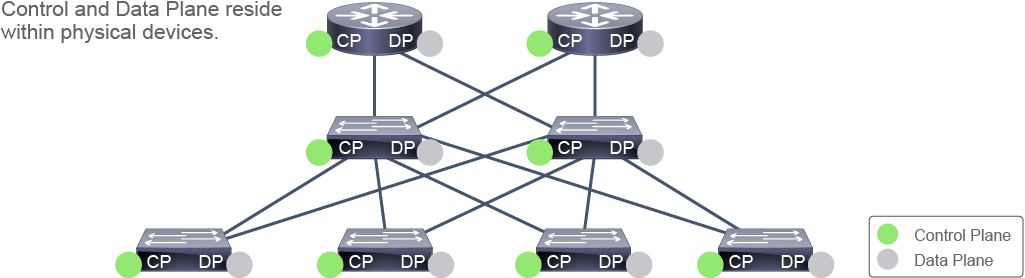
The figure shows a traditional network. Each device has a control and data plane. This means that all devices are equally smart and can make decisions on their own, since the control plane exists. Of course, the data plane is what is responsible for the actual packet forwarding. This network is now referred to as the traditional network, and is still the dominant network type deployed.
下圖顯示一個傳統網路。每台裝置都有各自的控制平面與資料平面。這表示所有裝置的智慧程度相同,且因為控制平面的存在,能夠自行做出決策。當然,實際負責封包轉送的是資料平面。這種網路現稱為傳統網路,目前仍是部署最普遍的網路類型。
- The data plane acts on the forwarding decisions.資料平面依轉送決策執行動作。
- The control and management planes learn/compute forwarding decisions.控制平面與管理平面負責學習/計算轉送決策。
With SDN, the network changes:
採用 SDN 後,網路的變化如下:
- The control (and management) plane becomes centralized.控制(與管理)平面變為集中化。
- Physical devices retain data plane functions only.實體裝置只保留資料平面功能。
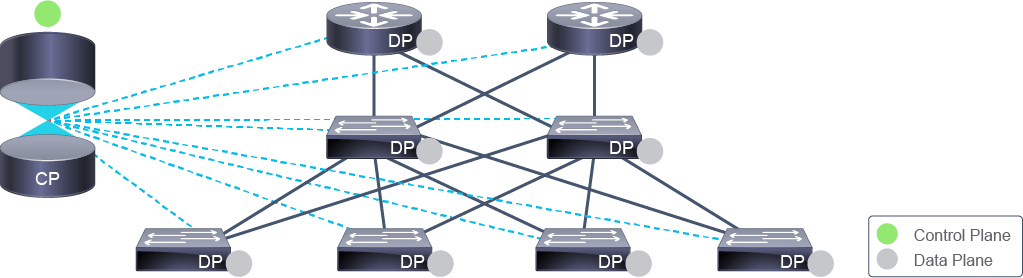
As SDN first emerged, there was the thought that the control and management plane should be removed from each device and that the control and management planes must be centralized into an SDN controller. While a major benefit to this approach is that you can evolve the control and management plane protocols independently of the hardware while now having a central point of control, there were significant scaling problems with this approach.
SDN 剛出現時,曾有一種想法認為應將控制平面與管理平面從每台裝置中移除,並將控制平面與管理平面集中到一台 SDN 控制器中。這種方式的一大好處是,可以獨立於硬體之外持續演進控制平面與管理平面協定,同時擁有一個集中的控制點;然而這種方式也存在明顯的擴充性問題。
The figure shows the network as it could be in a "hybrid SDN".
下圖顯示網路在「混合式 SDN」情況下可能呈現的樣貌。
- A controller is centralized and separated from the physical device, but devices still retain localized control plane intelligence.控制器是集中式的,且與實體裝置分離,但裝置仍保留本機的控制平面智慧。
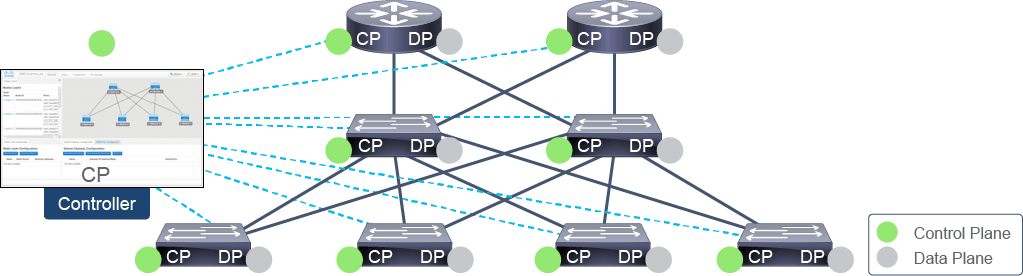
The hybrid SDN option is a combination of the best of both schemas. In a hybrid SDN, the controller becomes an active part of the distributed network control plane, rather than a means to configure the network control plane behavior in devices. This solution also offers a centralized view of the network, giving an SDN controller the ability to act as the brain of the network. In traditional networking, some network protocols, for example routing protocols, scale well, meaning that they provide a certain level of automation. Adding a controller offers a single pane of glass and administration while also offering a single application programming interface (API) to interface to the network, as opposed to establishing SSH connections to a number of network devices to make a change or retrieve data.
混合式 SDN 方案結合了兩種架構的優點。在混合式 SDN 中,控制器成為分散式網路控制平面的積極參與者,而不僅僅是用來設定裝置中網路控制平面行為的手段。這種解決方案也提供了網路的集中視圖,使 SDN 控制器能作為網路的「大腦」。在傳統網路中,某些網路協定(例如路由協定)具有良好的擴充性,也就是說,它們已提供一定程度的自動化。加入控制器後,除了提供單一應用程式設計介面(API)來與網路互動之外,也提供了單一畫面與管理介面,而不必為了進行變更或擷取資料,逐一與多台網路裝置建立 SSH 連線。