The proliferation of bandwidth-intensive applications such as video and interactive messaging created a necessity for links with greater bandwidth. Additional bandwidth is required both at the access to the network, where end devices generate larger amounts of traffic, and at the links that carry traffic aggregated from multiple end devices—for instance, at the uplinks.
影音串流與互動式訊息等需要大量頻寬的應用程式日漸普及,使得需要更大頻寬的連結變得不可或缺。無論是在終端裝置產生大量流量的網路存取端,還是在匯聚多個終端裝置流量的連結(例如上行連結),都需要額外的頻寬。
Another way to increase link bandwidth is by using more than one link between devices. Aggregating multiple physical links increases the available bandwidth between two devices. Aggregating multiple physical links also adds resiliency against link failure, by providing link redundancy.
另一種提升連結頻寬的方式,是在裝置之間使用一條以上的連結。將多條實體連結聚合起來,可以增加兩個裝置之間的可用頻寬。聚合多條實體連結也能藉由提供連結備援,增加對抗連結故障的韌性。
In a LAN environment, you can create logical aggregated Ethernet links. Both Layer 2 and Layer 3 interfaces can be aggregated.
在區域網路(LAN)環境中,你可以建立邏輯聚合乙太網路連結。第 2 層與第 3 層介面皆可進行聚合。
EtherChannel is a technology that enables link aggregation. In the industry, you will often encounter terms such as port channel and Ethernet port channel. When using these terms in an Ethernet LAN environment, EtherChannel, and Ethernet port channel technology mean the same.
EtherChannel 是一種能夠實現鏈路聚合的技術。在業界中,你經常會遇到諸如 port channel 與 Ethernet port channel 之類的術語。在乙太網路 LAN 環境中使用這些術語時,EtherChannel 與 Ethernet port channel 技術指的是同一件事。
EtherChannel enables packets to be sent over several physical interfaces as if over a single interface. EtherChannel logically bonds several physical connections into one logical connection. The process offers redundancy and load balancing while maintaining the combined throughput of physical links.
EtherChannel 讓封包可以透過多個實體介面傳送,就如同透過單一介面一樣。EtherChannel 會將數條實體連線在邏輯上結合成一條邏輯連線。這個過程在維持實體連結合併吞吐量的同時,也提供了備援與負載平衡。
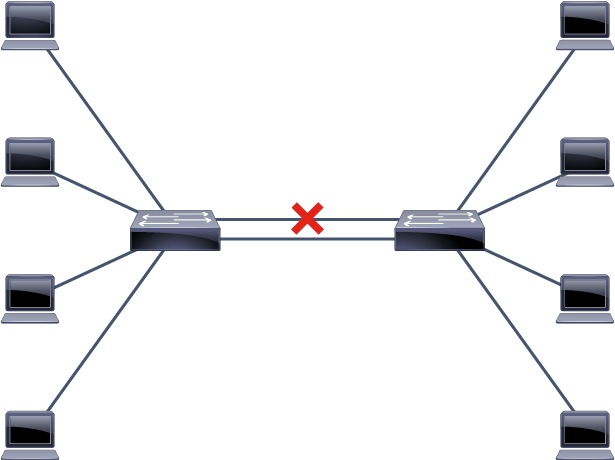
Without EtherChannel technology, most control plane protocols such as Layer 2 STP or Layer 3 routing protocols will treat multiple links as individual links. In the case of STP, multiple links between the same two devices are treated as loops and, to avoid loops, STP makes sure that only one link remains operational. Although the additional links add resiliency, because of the STP, the available bandwidth between the two devices is not increased.
若沒有 EtherChannel 技術,大多數控制平面協定(例如第 2 層的 STP 或第 3 層的路由協定)都會將多條連結視為個別連結。以 STP 為例,同兩個裝置之間的多條連結會被視為迴圈;為了避免迴圈,STP 會確保只有一條連結保持運作狀態。雖然額外的連結增加了韌性,但由於 STP 的緣故,兩個裝置之間的可用頻寬並不會因此增加。
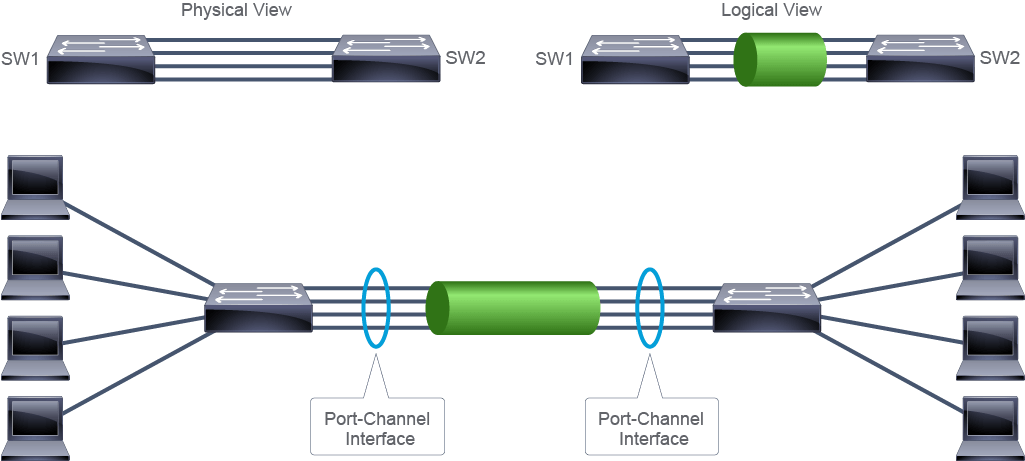
EtherChannel bundles individual links into a channel group to create a single logical interface called a port channel that provides the aggregate bandwidth of several physical links. Each link can be in only one port channel. All the links in a port channel must be compatible. Among other requirements, they must use the same speed and operate in full-duplex mode.
EtherChannel 會將個別連結整合成一個通道群組,建立出一個稱為port channel的單一邏輯介面,提供數條實體連結的總頻寬。每條連結只能屬於一個 port channel。port channel 中的所有連結都必須相容,除了其他要求之外,它們還必須使用相同的速度,並以全雙工模式運作。
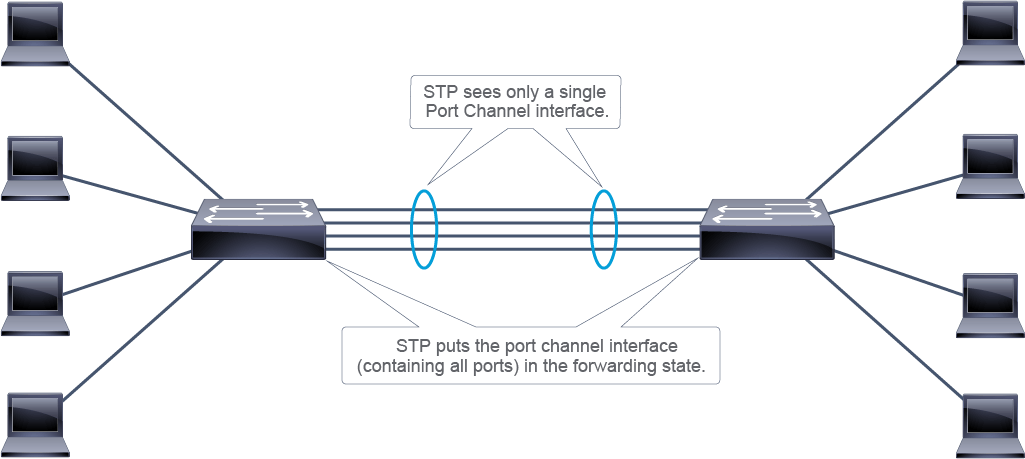
The EtherChannel technology was originally developed by Cisco as a means of increasing speed between switches by grouping several FastEthernet or Gigabit Ethernet ports into one logical link, called an EtherChannel link, as shown in the following figure. Since the multiple physical links are bundled into a single EtherChannel, STP no longer sees them as separate physical links. Instead it sees a single EtherChannel link. As a result, STP does not consider a single link to be a loop and puts the port channel interface (containing all ports) in the forwarding state. Therefore, the combined bandwidth of bundled physical links is available to the logical link.
如下圖所示,EtherChannel 技術最初是由 Cisco 開發的,目的是將數個 FastEthernet 或 Gigabit Ethernet 連接埠群組成一條邏輯連結(稱為 EtherChannel 連結),藉此提升交換器之間的速度。由於多條實體連結被整合成單一 EtherChannel,STP 不再將它們視為個別的實體連結,而是視為單一 EtherChannel 連結。因此,STP 不會將這一條連結視為迴圈,並將 port channel 介面(包含其中所有連接埠)設為轉送狀態。如此一來,整合的實體連結所提供的合併頻寬,就能供該邏輯連結使用。
Some devices other than switches also support link aggregation. You can create an EtherChannel link between two switches or between an EtherChannel-enabled server and a switch. EtherChannel always creates one-to-one logical links. You cannot send traffic to two different switches through the same EtherChannel logical link. One EtherChannel logical link always connects only two devices.
除了交換器之外,部分裝置也支援鏈路聚合。你可以在兩台交換器之間,或是在支援 EtherChannel 的伺服器與交換器之間,建立 EtherChannel 連結。EtherChannel 一律建立一對一的邏輯連結。你無法透過同一個 EtherChannel 邏輯連結,將流量傳送到兩台不同的交換器。一個 EtherChannel 邏輯連結一律只連接兩個裝置。
For an EtherChannel logical link to form, all ports on both devices must be correctly configured. On both sides, ports that are part of the logical link all belong to a logical port channel interface. You can group from two to eight physical ports (or more on some platforms) into a port channel logical interface but you cannot mix port types within a single EtherChannel. For example, you could group four FastEthernet ports into one logical Ethernet link but you could not group two FastEthernet ports and two GigabitEthernet ports into one logical Ethernet link.
若要形成一個 EtherChannel 邏輯連結,兩端裝置上的所有連接埠都必須正確設定。在兩端,屬於該邏輯連結的連接埠都會歸屬於一個邏輯 port channel 介面。你可以將二到八個實體連接埠(在某些平台上可以更多)群組成一個 port channel 邏輯介面,但在同一個 EtherChannel 中不能混用不同的連接埠類型。舉例來說,你可以將四個 FastEthernet 連接埠群組成一個邏輯乙太網路連結,但不能把兩個 FastEthernet 連接埠和兩個 GigabitEthernet 連接埠群組成同一個邏輯乙太網路連結。
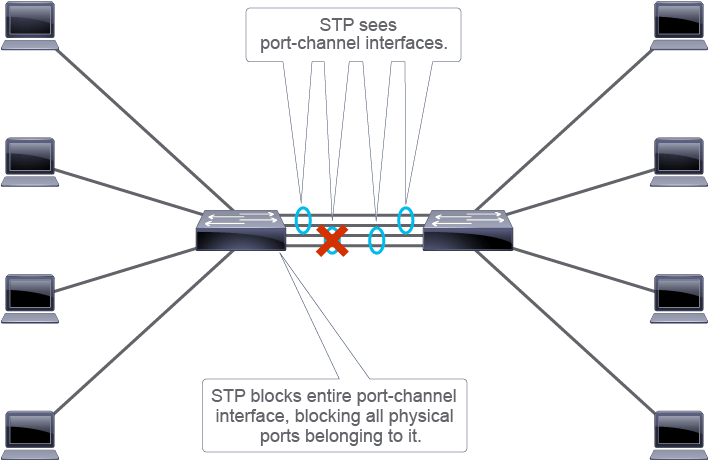
You can also configure multiple EtherChannel links between two devices, as shown in the figure above. However, when several logical EtherChannel links exist between two switches, STP detects loops. To avoid loops, STP will make only one logical link operational. When STP blocks the redundant links, it blocks one entire EtherChannel, thus blocking all the ports belonging to that EtherChannel link.
如上圖所示,你也可以在兩個裝置之間設定多條 EtherChannel 連結。然而,當兩台交換器之間存在多條邏輯 EtherChannel 連結時,STP 會偵測到迴圈。為了避免迴圈,STP 只會讓其中一條邏輯連結保持運作狀態。當 STP 阻斷備援連結時,它會阻斷整個 EtherChannel,也就是阻斷屬於該 EtherChannel 連結的所有連接埠。
The advantages of the EtherChannel link aggregation include:
EtherChannel 鏈路聚合的優點包括:
- EtherChannel creates an aggregation that is seen as one logical link. Where there is only one EtherChannel link, all physical links in the EtherChannel are active because STP sees only one (logical) link. The bandwidth of physical links is combined to provide increased bandwidth over the logical link.EtherChannel 建立的聚合會被視為單一邏輯連結。由於只存在一條 EtherChannel 連結,且 STP 只看到一條(邏輯)連結,因此 EtherChannel 中的所有實體連結都會保持啟用。實體連結的頻寬會合併起來,為該邏輯連結提供更大的頻寬。
- Because EtherChannel relies on the existing switch ports, you do not need to upgrade the ports to faster and more expensive ones to obtain more bandwidth. Most configuration tasks can be performed on the EtherChannel logical interface instead of on each individual port, which ensures configuration consistency throughout the links.由於 EtherChannel 依靠現有的交換器連接埠運作,你不需要為了取得更多頻寬而將連接埠升級成更快、更昂貴的規格。大多數設定工作可以在 EtherChannel 邏輯介面上執行,而不必逐一設定各個連接埠,這能確保各連結之間的設定一致性。
- Load balancing is possible across the physical links that are part of the same EtherChannel.屬於同一個 EtherChannel 的實體連結之間,可以進行負載平衡。
- EtherChannel improves resiliency against link failure, as it provides link redundancy. The loss of a physical link within an EtherChannel does not create a change in the topology and there will not be a spanning-tree recalculation. As long as at least one physical link is active, the EtherChannel is functional, even if its overall throughput decreases.EtherChannel 藉由提供連結備援,提升了對抗連結故障的韌性。EtherChannel 中某條實體連結中斷,不會造成拓樸變化,也不會觸發生成樹重新計算。只要至少有一條實體連結保持啟用,EtherChannel 就能正常運作,即使其整體吞吐量會因此下降。