Several types of devices are specific to WAN environments including modems and certain types of routers and switches. The following are descriptions of WAN devices and terms used in discussing WANs. Some of the devices were used in the past with legacy WAN connectivity options.
有幾種裝置專門用於 WAN 環境,包括數據機以及某些類型的路由器和交換器。以下是討論 WAN 時使用的裝置與術語說明,其中有些裝置過去用於傳統的 WAN 連線選項。
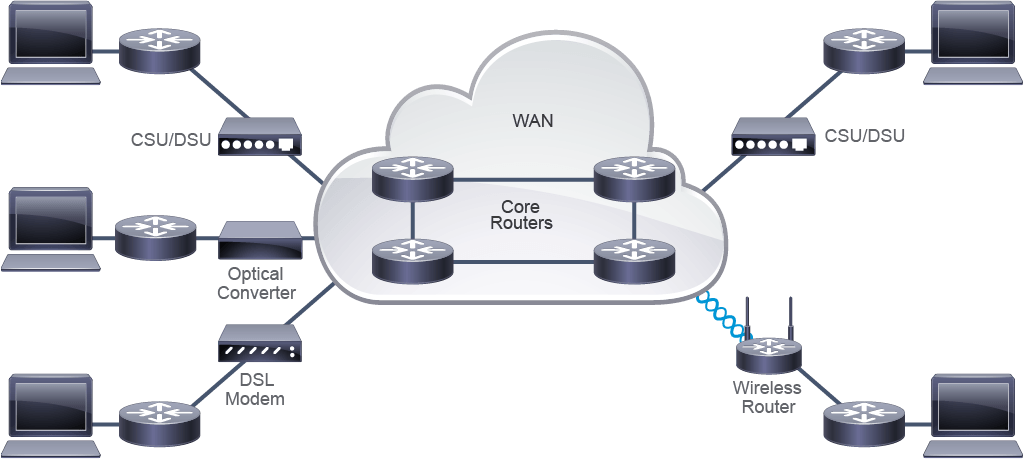
Modems are devices that modulate and demodulate analog carriers to encode and retrieve digital information. A modem interprets digital and analog signals, enabling data to be transmitted over voice-grade telephone lines. At the source, digital signals are converted to a form that is suitable for transmission over analog communication facilities. At the destination, these analog signals are returned to their digital form. Pure analog circuits are not often encountered today. Modems still do modulate multiple carriers and implement coding schemes, which are digital. Nonetheless, the word modem is still in use, by convention, for devices that work on lines that were not primarily intended for data service, such as phone lines of various types and cable TV lines. The terms transceiver or converter or media converter are used for fiber lines. Modems are part of the equipment installed at the customer location, although it is not necessary that they are owned and managed by the customer (for example, the enterprise). In the figure, a DSL modem (which is used in broadband environments based on DSL technology) connects to a router with an Ethernet cable and connects to the service provider network with a telephone cable. A modem can also be implemented as a router module.
數據機(Modem)是調變與解調類比載波,以編碼及還原數位資訊的裝置。數據機解讀數位與類比訊號,讓資料能夠透過語音等級的電話線傳輸。在來源端,數位訊號會被轉換成適合在類比通訊設施上傳輸的形式;在目的端,這些類比訊號會被還原為數位形式。如今很少遇到純類比電路,數據機仍會調變多種載波並實作編碼方案,而這些方案本身是數位的。儘管如此,依照慣例,「數據機」一詞仍用於原本不是為資料服務設計的線路上的裝置,例如各種電話線和有線電視線路。對於光纖線路,則使用「收發器(transceiver)」、「轉換器(converter)」或「媒介轉換器(media converter)」等術語。數據機屬於安裝在客戶端場所的設備之一,但不一定由客戶(例如企業)擁有及管理。在圖中,DSL 數據機(用於以 DSL 技術為基礎的寬頻環境)透過乙太網路線纜連接至路由器,並透過電話線纜連接至服務供應商網路。數據機也可以以路由器模組的形式實作。
Optical fiber converters are used where a fiber-optic link terminates to convert optical signals into electrical signals and vice versa. You can also implement the converter as a router or switch module.
光纖轉換器(Optical fiber converter)用於光纖鏈路終端處,將光訊號轉換為電訊號,反之亦然。也可以將轉換器實作為路由器或交換器模組。
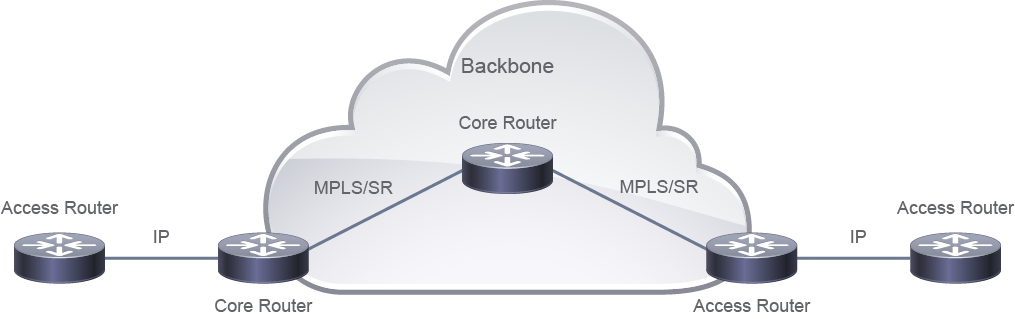
An access router provides internetworking and WAN access interface ports that are used to connect to the service provider network. These interfaces may be serial connections or other WAN interfaces. With some types of WAN interfaces, you need an external device such as a CSU/DSU or modem (analog, cable, or DSL) to connect the router to the local point of presence (POP) of the service provider. Generally, an access router does not support transport service provider technologies, such as MPLS or Segment Routing, they are instead used in the MPLS core. Access routers base the Layer 3 transport on IPv4 or IPv6 protocols, by using any IGP, BGP, or static routing.
存取路由器(access router)提供互連功能及 WAN 存取介面連接埠,用於連接至服務供應商網路。這些介面可能是序列連線或其他 WAN 介面。對某些類型的 WAN 介面而言,需要外部裝置,例如 CSU/DSU 或數據機(類比、有線電視或 DSL),才能將路由器連接至服務供應商的本地服務點(POP)。一般而言,存取路由器不支援傳輸服務供應商技術,例如 MPLS 或區段路由(Segment Routing),這些技術是用在 MPLS 核心中。存取路由器透過任何 IGP、BGP 或靜態路由,以 IPv4 或 IPv6 通訊協定為基礎進行第 3 層傳輸。
A core router or multilayer switch resides within the middle or backbone of the WAN, rather than at its periphery. To fulfill this role, a router or multilayer switch must be able to support multiple telecommunications interfaces of the highest speed in use in the WAN core. It must also be able to forward IP packets at wire speed on all these interfaces. The router or multilayer switch must support the routing protocols that are being used in the core. Core routers use traditional routing and IP transport on interfaces that face access routers. Core routers implement service provider transport, such as MPLS or Segment Routing, on interfaces that face the core network.
核心路由器(core router)或多層交換器位於 WAN 的中間或骨幹,而非邊緣位置。為了扮演這個角色,路由器或多層交換器必須能支援 WAN 核心中所使用的最高速度的多種電信介面,也必須能以線速在這些介面上轉送 IP 封包,並且必須支援核心中所使用的路由通訊協定。核心路由器在面向存取路由器的介面上使用傳統路由與 IP 傳輸;在面向核心網路的介面上,則實作服務供應商的傳輸技術,例如 MPLS 或區段路由。
Wireless routers are used when you are using the wireless medium for WAN connectivity. You can also use an access point instead of a wireless router.
當使用無線傳輸媒介進行 WAN 連線時,會使用無線路由器(wireless router)。也可以改用無線基地台(AP)而非無線路由器。
Router with cellular connectivity features is used when connecting to a WAN via a cellular/mobile broadband access network. Routers with cellular connectivity features include an interface that supports cellular communication standards and protocols. Interfaces for cellular communication can be factory installed, or they can embed a module that provides cellular connectivity. A router can be moved between locations. It can also operate while in motion (in trucks, buses, cars, trains). Enterprise grade routers that support cellular connectivity also include diagnostic and management functions, enable multiple cellular connections to one or more service providers, support Quality of Service (QoS), etc.
具備行動網路連線功能的路由器用於透過行動/蜂巢式寬頻存取網路連接 WAN 時使用。具備行動網路連線功能的路由器包含支援行動通訊標準與協定的介面。行動通訊介面可以是原廠內建的,也可以是嵌入提供行動網路連線功能的模組。這種路由器可以在不同地點間移動,也能在移動中運作(例如卡車、公車、汽車、火車上)。支援行動網路連線的企業級路由器通常也包含診斷與管理功能,能連接一個或多個服務供應商的多個行動網路連線,並支援服務品質(QoS)等功能。
DTE/DCE and CSU/DSU:data terminating equipment (DTE) and data communications equipment (DCE) are terms that were used in the context of WAN connectivity options that are mostly considered legacy today. The two terms name two separate devices. The DTE device is either a source or a destination for digital data. Specifically, these devices include PCs, servers, and routers. In the figure, a router in either office would be considered a DTE. DCE devices convert the data received from the sending DTE into a form acceptable to the WAN service provider. The purpose is to convert a signal from a form used for local transmission to a form used for long-distance transmission. Converted signals travel across the provider’s network to the remote DCE device, which connects the receiving DTE. You could say that a DCE translates data from LAN to WAN "language." To simplify, the data path over a WAN would be DTE > DCE > DCE > DTE.
DTE/DCE 與 CSU/DSU:資料終端設備(DTE)與資料通訊設備(DCE)是用於描述 WAN 連線選項的術語,如今大多已被視為傳統技術。這兩個術語代表兩種不同的裝置。DTE 裝置是數位資料的來源或目的地,具體來說,這類裝置包括 PC、伺服器與路由器。在圖中,兩間辦公室的路由器都會被視為 DTE。DCE 裝置會將發送端 DTE 所送出的資料轉換為服務供應商 WAN 可接受的形式,其目的是將訊號從用於本地傳輸的形式轉換為用於長距離傳輸的形式。轉換後的訊號會通過供應商的網路傳送到遠端的 DCE 裝置,該裝置再連接到接收端的 DTE。可以說,DCE 是將資料從 LAN「語言」翻譯成 WAN「語言」。簡化來說,WAN 上的資料路徑會是 DTE > DCE > DCE > DTE。

DCEs deal with both analog and digital data representations. When dealing only with digitized data, a DCE is a CSU/DSU. In other words, when you connect a digital device to a digital line, you use CSU/DSU. It connects two different types of digital signals. When connecting a digital device to an analog circuit (such as a phone line), the DCE is a modem.
DCE 同時處理類比與數位資料表示形式。當只處理數位化資料時,DCE 就是 CSU/DSU;換句話說,當你將數位裝置連接到數位線路時,會使用 CSU/DSU,它負責連接兩種不同類型的數位訊號。當將數位裝置連接到類比電路(例如電話線)時,DCE 則是數據機。
In the figure, the router, a digital device, connects to a line, which is digital, via the CSU/DSU unit. The CSU/DSU connects to the service provider infrastructure using a telephone or coaxial cable, and it connects to the router with a serial cable. The DSU converts the telephone line frames into frames that can be interpreted on the LAN and vice versa. It also provides a clocking signal on the serial line. If a CSU/DSU is implemented as a module within a router, a serial cable is not necessary.
在圖中,路由器(數位裝置)透過 CSU/DSU 單元連接到數位線路。CSU/DSU 使用電話線或同軸電纜連接至服務供應商的基礎設施,並以序列纜線連接至路由器。DSU 會將電話線路的訊框轉換為可在 LAN 上解讀的訊框,反之亦然,它同時也在序列線路上提供時脈訊號。若 CSU/DSU 是以路由器內建模組的形式實作,則不需要序列纜線。

Nowadays, CSU and DSU are two components within one piece of hardware. The DSU manages the interface with the DTE. In serial communication, where clocking is required, the DSU plays the role of the DCE and provides clocking. The DSU converts DTE serial communications to frames that the CSU can understand and vice versa, it converts the carrier’s signal into frames that can be interpreted on the LAN. The CSU deals with the provider’s part of the network. It connects to the provider’s communication circuit and places the frames from the DSU onto it and from it to the DSU. The CSU ensures connection integrity through error correction and line monitoring.
如今,CSU 與 DSU 是同一件硬體中的兩個元件。DSU 負責管理與 DTE 之間的介面;在需要時脈的序列通訊中,DSU 扮演 DCE 的角色並提供時脈訊號。DSU 會將 DTE 的序列通訊轉換為 CSU 能理解的訊框,反之亦然,同時也會將供應商的訊號轉換為可在 LAN 上解讀的訊框。CSU 則負責處理網路中屬於供應商的部分,它連接至供應商的通訊電路,將來自 DSU 的訊框放上電路,並將電路上的訊框傳回給 DSU。CSU 透過錯誤更正與線路監控來確保連線的完整性。
WAN Interface Cards (WICs) in a router may contain an integrated CSU/DSU.
路由器中的 WAN 介面卡(WIC)可能內建整合式 CSU/DSU。
The demarcation point is a marking which separates a customer’s WAN equipment from the service provider’s equipment. The customer side of the demarcation point accommodates the Customer Premises Equipment (CPE).
分界點(demarcation point)是一個標記,用來區隔客戶的 WAN 設備與服務供應商的設備。分界點的客戶端側容納客戶端設備(Customer Premises Equipment,CPE)。
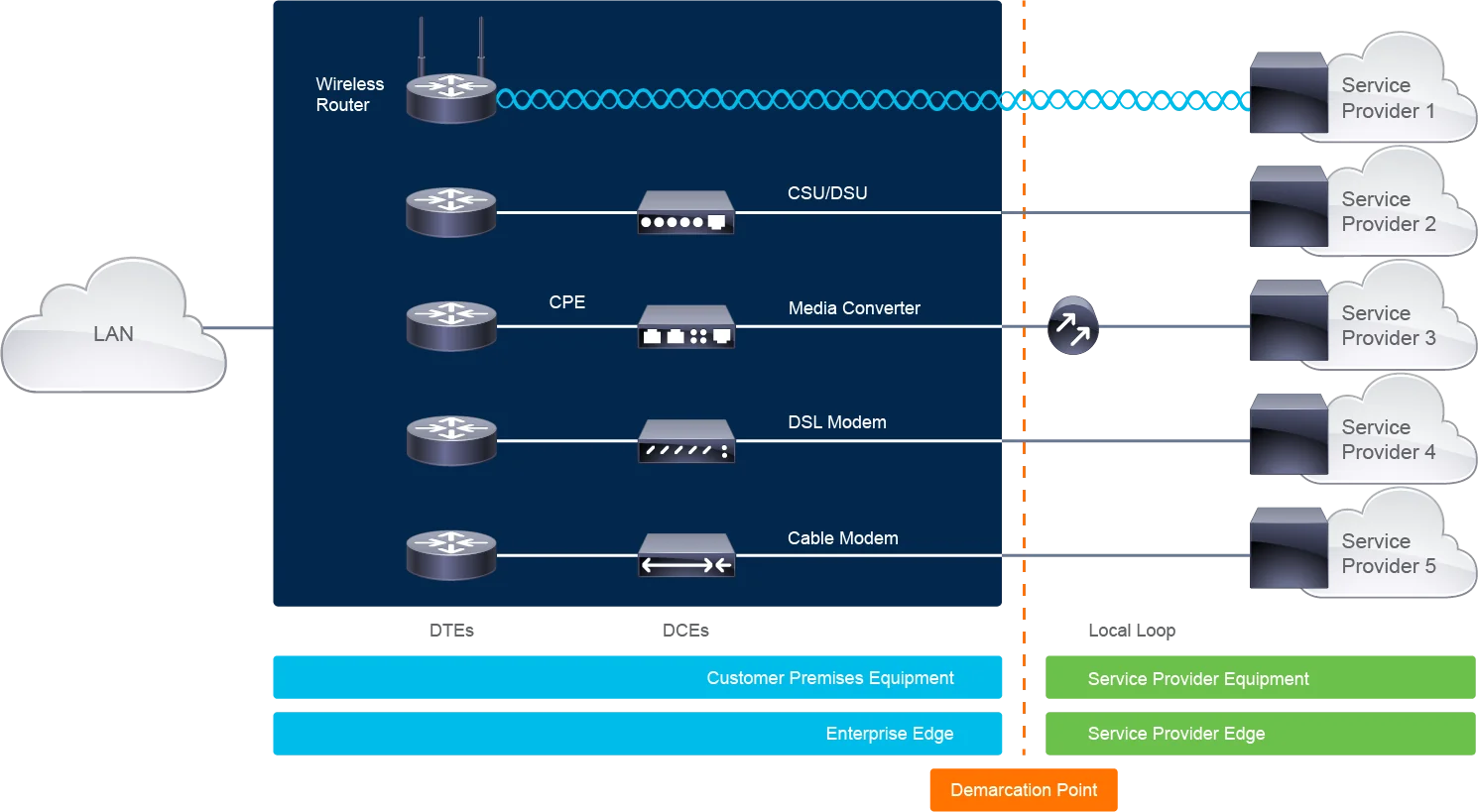
CPEs are typically devices inside the wiring closet located on the subscriber’s premises. CPE either belongs to the subscriber or is leased from the service provider. CPE is connected to the closest point in the service provider’s network (an edge router or an exchange/central office). This link is called the local loop or last mile. This point where the subscriber connects to the service provider's network is called a POP. Examples of CPE devices are modems, routers, optical converters, and so on. A copper or fiber cable connects the CPE to the nearest exchange or central office of the service provider.
CPE 通常是位於訂戶場所配線間內的裝置。CPE 可能屬於訂戶所有,也可能是向服務供應商租用的。CPE 連接到服務供應商網路中最近的節點(一台邊緣路由器或一個交換局/中央機房)。這條連結稱為本地迴路(local loop)或最後一哩(last mile)。訂戶連接至服務供應商網路的這個點稱為POP。CPE 裝置的範例包括數據機、路由器、光纖轉換器等。銅纜或光纖電纜將 CPE 連接到服務供應商最近的交換局或中央機房。
The provider’s side of demarcation point includes links that connect to the service provider equipment—that is, the local loop or last mile.
分界點在供應商端的部分,包括連接至服務供應商設備的連結,也就是本地迴路或最後一哩。
Physically, the demarcation point can be a cabling junction box, located on the customer premises, that connects the CPE wiring to the local loop. It is usually placed for easy access by a technician.
在實體上,分界點可以是位於客戶場所內的一個配線接線盒,用來連接 CPE 配線與本地迴路,通常會設置在技術人員容易存取的位置。
The demarcation point is the place where the responsibility for the connection changes from the user to the service provider. When problems arise, it is necessary to determine whether the user or the service provider is responsible for troubleshooting or repair.
分界點是連線責任由使用者轉移到服務供應商的地方。當發生問題時,需要判定疑難排解或維修的責任屬於使用者還是服務供應商。
| Wireless Router無線路由器 | FF |
| CSU/DSUCSU/DSU | AA |
| DSL ModemDSL 數據機 | DD |
| DTEsDTE | GG |
| DCEsDCE | BB |
| Customer Premises Equipment客戶端設備 | EE |
| Local Loop本地迴路 | CC |