A limitation of a traditional STP is the convergence delay after a topology change and this is why the use of RSTP is recommended. RSTP is an IEEE standard that redefines STP port roles, states, and BPDUs. It greatly improves the recalculation of the spanning tree, and thus the convergence time, when the Layer 2 topology changes, including when links come up and for indirect link failures.
傳統 STP 的一項限制,是拓樸變化後的收斂延遲,這也是建議使用 RSTP 的原因。RSTP 是一項 IEEE 標準,重新定義了 STP 的連接埠角色、狀態與 BPDU。當第 2 層拓樸改變時,包括鏈路啟用與間接鏈路故障的情況,RSTP 大幅改善了生成樹的重新計算,因而縮短了收斂時間。
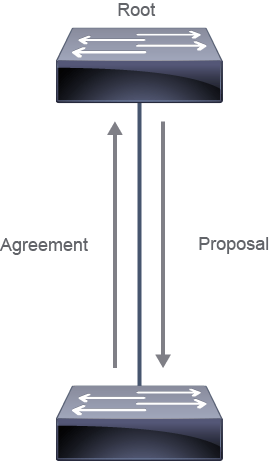
Note the following regarding IEEE 802.1w RSTP:
關於 IEEE 802.1w RSTP,請注意以下幾點:
- 802.1D STP was designed for an era of networks that were more tolerant of 50-second delays in redundancy.802.1D STP 是為了那個能容忍 50 秒備援延遲的網路時代所設計的。
- There are many proprietary mechanisms in place to enhance the performance and convergence of STP; however, not all vendors or all switches have these mechanisms.業界有許多專屬機制可以強化 STP 的效能與收斂速度,但並非所有廠商或所有交換器都具備這些機制。
- The 802.1w RSTP allows the network to converge faster than 802.1D.802.1w RSTP 讓網路的收斂速度比 802.1D 更快。
- Because RSTP is a standards-based protocol, it operates across multiple vendor platforms.由於 RSTP 是以標準為基礎的協定,它可以跨多家廠商的平台運作。
- RSTP is backwards compatible with 802.1D.RSTP 向下相容於 802.1D。
The immediate hindrance of STP is convergence. Depending on the type of failure, it takes anywhere from 30 to 50 seconds to converge after a network change. RSTP helps with convergence issues that plague traditional STP. Cisco proprietary Rapid PVST+ is based on the 802.1w standard in the same way that PVST+ is based on 802.1D. The operation of Rapid PVST+ is simply a separate instance of 802.1w for each VLAN.
STP 最直接的阻礙就是收斂。根據故障類型不同,網路變化後收斂可能需要 30 到 50 秒不等。RSTP 有助於解決困擾傳統 STP 的收斂問題。Cisco 專屬的 Rapid PVST+ 以 802.1w 標準為基礎,就如同 PVST+ 是以 802.1D 為基礎一樣。Rapid PVST+ 的運作方式,就是為每個 VLAN 各自執行一個獨立的 802.1w 實例。
RSTP is proactive and therefore negates the need for the 802.1D delay timers. RSTP supersedes 802.1D while remaining backward compatible. Much of the 802.1D terminology and most parameters remain unchanged. In addition, RSTP is capable of reverting to 802.1D to interoperate with traditional switches on a per-port basis, and negotiate port states on a peer switch basis, using a proposal and agreement process.
RSTP 具有主動性,因此不需要 802.1D 的延遲計時器。RSTP 取代了 802.1D,同時仍維持向下相容。大部分 802.1D 的術語與參數維持不變。此外,RSTP 能以每個連接埠為單位還原為 802.1D,與傳統交換器互通,並透過提案與同意的程序,以每台對等交換器為單位協商連接埠狀態。
Numerous differences exist between RSTP and STP, including that RSTP requires a full-duplex point-to-point connection between adjacent switches.
RSTP 與 STP 之間存在許多差異,包括 RSTP 要求相鄰交換器之間必須是全雙工的點對點連線。
RSTP Port Roles
RSTP 連接埠角色
With RSTP, port roles are slightly different than with STP.
在 RSTP 中,連接埠角色與 STP 略有不同。
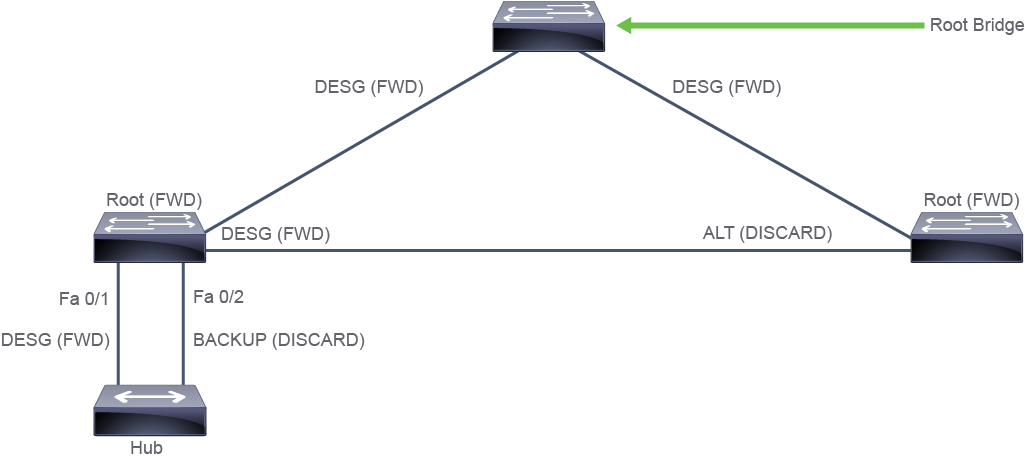
RSTP defines the following port roles.
RSTP 定義了以下連接埠角色。
- Root: The root port is the switch port on every nonroot bridge that is the best path to the root bridge. There can be only one root port on each switch. The root port is considered part of the active topology. It forwards, sends, and receives BPDUs.根埠(Root):根埠是每台非根橋接器上通往根橋接器最佳路徑的交換器連接埠。每台交換器只能有一個根埠。根埠被視為活動拓樸的一部分,負責轉送、傳送與接收 BPDU。
- Designated: In the active topology, a designated port is the switch port that will receive and forward frames toward the root bridge as needed. There can be only one designated port per segment.指定埠(Designated):在活動拓樸中,指定埠是負責視需要接收並向根橋接器方向轉送框架的交換器連接埠。每個網段只能有一個指定埠。
- Alternate: The alternate port is a switch port that offers an alternate path toward the root bridge. It assumes a discarding state in an active topology. The alternate port makes a transition to a designated port if the current designated port fails.替代埠(Alternate):替代埠是提供另一條通往根橋接器路徑的交換器連接埠。在活動拓樸中,它處於捨棄狀態。若目前的指定埠故障,替代埠會轉換為指定埠。
- Backup: The backup port is an additional switch port on the designated switch with a redundant link to the shared segment for which the switch is designated. The backup port is in the discarding state in active topology. The backup port moves to the forwarding state if there is a failure on the designated port for the segment.備援埠(Backup):備援埠是指定交換器上額外的連接埠,為該交換器所負責的共用網段提供備援鏈路。在活動拓樸中,備援埠處於捨棄狀態。若該網段的指定埠發生故障,備援埠會轉為轉送狀態。
- Disabled: A disabled port has no role within the operation of spanning tree.Disabled(停用):停用的連接埠在生成樹的運作中不擔任任何角色。
There is a difference between STP and RSTP port roles. Instead of the STP nondesignated port role, there are now alternate and backup port roles. These additional port roles allow RSTP to define a standby switch port before a failure or topology change.
STP 與 RSTP 的連接埠角色有所不同。RSTP 沒有 STP 的非指定埠角色,取而代之的是替代埠與備援埠角色。這些額外的連接埠角色讓 RSTP 能在故障或拓樸變化發生前,先定義好備用的交換器連接埠。
Comparison of RSTP and STP Port States
RSTP 與 STP 連接埠狀態比較
The RSTP port states correspond to the three basic operations of a switch port: discarding, learning, and forwarding. There is no listening state as there was with STP. The listening and blocking STP states are replaced with the discarding state.
RSTP 連接埠狀態對應交換器連接埠的三種基本運作:捨棄、學習與轉送。RSTP 沒有 STP 的聆聽狀態,聆聽與阻斷狀態被捨棄狀態所取代。
In a stable topology, RSTP ensures that every root port and designated port transit to forwarding, while all alternate ports and backup ports are always in the discarding state.
在穩定的拓樸中,RSTP 確保每個根埠與指定埠都轉換為轉送狀態,而所有替代埠與備援埠則一律處於捨棄狀態。
The characteristics of RSTP port states are as follows:
RSTP 連接埠狀態的特性如下:
Port state 連接埠狀態 | Description 說明 |
Discarding 捨棄 | This state is seen in both a stable active topology and during topology synchronization and changes. The discarding state prevents the forwarding of data frames, thus "breaking" the continuity of a Layer 2 loop. 這個狀態會出現在穩定的活動拓樸中,也會出現在拓樸同步與變化期間。捨棄狀態會阻止資料框架的轉送,藉此「打斷」第 2 層迴圈的連續性。 |
Learning 學習 | This state is seen in both a stable active topology and during topology synchronization and changes. The learning state accepts data frames to populate the MAC table to limit flooding of unknown unicast frames. 這個狀態會出現在穩定的活動拓樸中,也會出現在拓樸同步與變化期間。學習狀態會接受資料框架以填入 MAC 表,藉此限制未知單播框架的泛洪。 |
Forwarding 轉送 | This state is seen only in stable active topologies. The forwarding switch ports determine the topology. Following a topology change, or during synchronization, the forwarding of data frames occurs only after a proposal-and-agreement process. 這個狀態只會出現在穩定的活動拓樸中。轉送狀態的交換器連接埠決定了拓樸。在拓樸變化後或同步期間,只有在完成提案與同意的程序後,才會開始轉送資料框架。 |
A port will accept and process BPDU frames in all port states.
連接埠在所有狀態下都會接受並處理 BPDU 框架。