Challenges with Traditional Network Operations
傳統網路維運面臨的挑戰
Classical programming and scripting have been used for a long time to automate and manage various networking tasks. These traditional methods excel at handling straightforward, rule-based tasks, such as configuring network devices, monitoring performance, and managing network policies. For example, a script can be written to automatically update the firmware on a set of routers or to periodically check the status of network interfaces.
傳統程式設計與腳本撰寫已被用於自動化與管理各種網路任務相當長的時間。這些傳統方法擅長處理直接、以規則為基礎的任務,例如設定網路裝置、監控效能,以及管理網路政策。舉例來說,可以撰寫腳本來自動更新一組路由器的韌體,或定期檢查網路介面的狀態。
Many complex tasks are challenging or even impossible to solve with classical programming. These tasks often involve analyzing vast amounts of data, identifying patterns, predicting future network states, or making real-time decisions in dynamic environments. One such example is the detection of network anomalies and security threats. Although a script can be programmed to recognize known attack patterns, it struggles to identify new, evolving threats or subtle anomalies that do not match predefined rules.
許多複雜任務用傳統程式設計方式難以解決,甚至無法解決。這些任務通常涉及分析大量資料、辨識模式、預測未來的網路狀態,或在動態環境中做出即時決策。其中一個例子是網路異常與安全威脅偵測。雖然可以將腳本設計成能辨識已知的攻擊模式,但它難以辨識新出現、持續演變的威脅,或不符合預先定義規則的細微異常。
To address these challenges, machine learning (ML) and artificial intelligence (AI) techniques are introduced into network operations.
為了應對這些挑戰,機器學習(ML)與人工智慧(AI)技術被引入網路維運中。

ML and AI can analyze large datasets to learn what is considered normal network behavior (baselining), detect anomalies, predict failures, and suggest optimal configurations. For instance, an AI-powered system can continuously monitor network traffic and identify unusual patterns that are indicative of a potential security breach, even if those patterns are new.
ML 與 AI 能分析大量資料集,學習何謂正常的網路行為(基準線建立)、偵測異常、預測故障,並建議最佳設定。舉例來說,具備 AI 能力的系統能持續監控網路流量,並辨識出可能代表潛在安全漏洞的異常模式,即使這些模式是全新的。
AI and ML are intricate fields that require extensive specialized knowledge in computer science and data analytics. Solving complex problems requires dedicated teams of experts who integrate these advanced tools into various products. Leading companies, including Cisco, have embraced this approach.
AI 與 ML 是複雜的領域,需要在電腦科學與資料分析方面有豐富的專業知識。要解決複雜的問題,需要由專家組成的專責團隊,將這些先進工具整合到各種產品中。包括 Cisco 在內的領先企業已採用這種做法。
Difference Between AI and ML
AI 與 ML 的差異
These are the definitions of AI and ML:
以下是 AI 與 ML 的定義:
- AI: An umbrella term that can be explained as the simulation of human-like intelligence by computer systems.AI:一個總稱,可解釋為電腦系統對類人智慧的模擬。
- ML: A subset of AI describes mathematical and statistical methods that enable machines to mimic intelligent human behavior by learning from data without being explicitly programmed.ML:AI 的一個子集,描述的是讓機器能透過從資料中學習而模仿智慧人類行為,而無需明確程式設計的數學與統計方法。
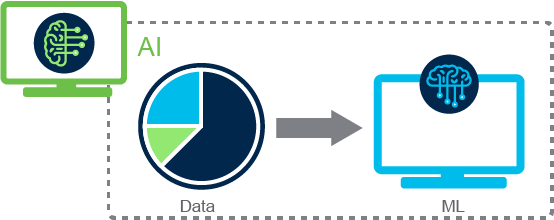
AI is a broad term encompassing various technologies and machines, capable of performing tasks that typically require human-like intelligence, such as problem-solving, reasoning, discovering meaning, and recognizing patterns.
AI 是一個廣義的名詞,涵蓋各種能執行通常需要類人智慧之任務的技術與機器,例如解決問題、推理、發掘意義,以及辨識模式。
ML is a subset of AI that focuses on the development of algorithms and statistical models that enable computers to learn and make decisions based on data. In essence, ML is a technique or method for building AI systems, where the machine improves its performance on a task over time by learning from experience without being explicitly programmed for each specific task.
ML 是 AI 的一個子集,專注於開發演算法與統計模型,讓電腦能根據資料學習並做出決策。基本上,ML 是一種建構 AI 系統的技術或方法,機器透過從經驗中學習,而不需針對每個特定任務進行明確程式設計,隨時間逐步提升在某項任務上的表現。
In network operations, ML is used to create AI systems that can monitor, manage, and optimize network performance. For example, ML algorithms can analyze vast amounts of network traffic data to identify patterns and anomalies. By running these algorithms on data collected from past events, the AI system can learn to predict potential issues, such as network congestion or failures before they occur. The process of using data and ML techniques to teach an AI system how to perform a specific task is called training. After AI is trained, it can autonomously adjust network configurations in real time to prevent or mitigate potential issues, which ensures optimal performance and reduces downtime.
在網路維運中,ML 被用來建立能監控、管理並最佳化網路效能的 AI 系統。舉例來說,ML 演算法能分析大量網路流量資料,以辨識模式與異常。透過在過去事件所收集的資料上執行這些演算法,AI 系統能學會在網路壅塞或故障發生之前預測潛在問題。使用資料與 ML 技術教導 AI 系統執行特定任務的過程稱為訓練。AI 經訓練後,便能即時自主調整網路設定,以預防或緩解潛在問題,確保最佳效能並減少停機時間。
Types of AI—Predictive and Generative
AI 的類型:預測式與生成式
Predictive and Generative AI in a nutshell:
預測式與生成式 AI 概要:
- Predictive AI: Uses advanced algorithms and ML to analyze past data to forecast future events and behaviors.預測式 AI:運用進階演算法與 ML 分析過去資料,以預測未來的事件與行為。
- Generative AI: Creates new data by learning patterns from existing datasets. Generative AI can be multi-modal, which means capable of generating diverse outputs, such as text, images, and audio, from various inputs.生成式 AI:透過學習現有資料集中的模式來建立新資料。生成式 AI 可以是多模態的,意即能夠根據各種輸入產生多元的輸出,例如文字、圖片與音訊。
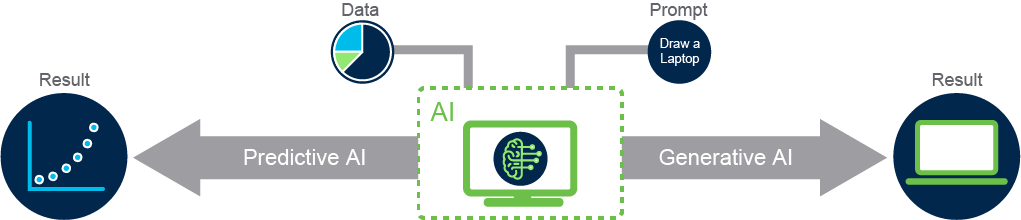
Predictive AI involves the use of advanced algorithms and statistical models to analyze past and current data to forecast future events or behaviors. This type of AI uses ML techniques to identify patterns and trends within the data, which enables it to make informed predictions about what is likely to happen next. In various industries, predictive AI is employed to anticipate customer behavior, optimize inventory management, predict equipment failures, and more.
預測式 AI涉及運用進階演算法與統計模型分析過去與現在的資料,以預測未來的事件或行為。這種類型的 AI 使用 ML 技術辨識資料中的模式與趨勢,使其能對接下來可能發生的事做出有根據的預測。在各個產業中,預測式 AI 被用來預估顧客行為、最佳化庫存管理、預測設備故障等等。
In the context of network operations, predictive AI is used in proactive network maintenance and network performance optimizations. By analyzing past network traffic, performance metrics, and incident reports, predictive AI can see potential issues, such as network congestion, hardware failures, and security breaches. This enables network administrators to take preventive actions, optimize resource allocation, and ensure smoother, more reliable network operations.
在網路維運的情境中,預測式 AI 被用於主動式網路維護與網路效能最佳化。透過分析過去的網路流量、效能指標與事件報告,預測式 AI 能預見潛在問題,例如網路壅塞、硬體故障與安全漏洞。這使得網路管理員能採取預防性措施、最佳化資源配置,並確保網路維運更順暢、更可靠。
Generative AI involves creating new content or data that is based on patterns learned from existing datasets. Using advanced models, such as generative adversarial networks (GANs), variational autoencoders (VAEs), and generative pre-trained transformers (GPT), generative AI can produce output that closely mimics the characteristics of the training data. For now, keep these terms in mind, you will learn about these models later. This technology can generate diverse outputs, which includes text, images, audio, and synthetic data for simulations.
生成式 AI涉及根據從現有資料集中學到的模式,建立新的內容或資料。透過使用生成對抗網路(GAN)、變分自編碼器(VAE),以及生成式預訓練轉換器(GPT)等進階模型,生成式 AI 能產生與訓練資料特性高度相似的輸出。目前先記住這些術語,你稍後會學到這些模型。這項技術能產生多元的輸出,包括文字、圖片、音訊,以及用於模擬的合成資料。
In network operations, generative AI plays a crucial role. It can simulate network scenarios by generating realistic network traffic patterns. These simulations enable testing and evaluating network performance under various conditions without affecting the live network. Also, generative AI can automatically create optimal network configurations and settings based on current demands and predictive insights. Generative AI also helps in developing potential solutions for identified network issues, which provides multiple options for remediation and optimization.
在網路維運中,生成式 AI 扮演著關鍵角色。它能透過產生逼真的網路流量模式來模擬網路情境。這些模擬讓你能在不影響實際運作網路的情況下,測試並評估各種條件下的網路效能。此外,生成式 AI 還能根據目前的需求與預測性洞察,自動建立最佳的網路設定與參數。生成式 AI 也有助於為已辨識出的網路問題開發潛在解決方案,提供多種修復與最佳化選項。
Generative and predictive AI are often used together in network operations. Predictive AI identifies and anticipates potential network problems, while generative AI creates simulations and solutions to address these issues proactively. By combining the strengths of both AI types, network administrators can ensure more resilient, efficient, and dynamic network operations.
生成式 AI 與預測式 AI 在網路維運中經常合併使用。預測式 AI 辨識並預估潛在的網路問題,而生成式 AI 則建立模擬與解決方案,以主動處理這些問題。透過結合這兩種 AI 類型的優勢,網路管理員能確保網路維運更具韌性、效率與動態調整能力。