Introduction
簡介
Imagine you are a network engineer at a large company. Originally, the network had no redundancy, which caused outages after a single link or a switch failure. To fix this, you added extra links to create multiple paths and prevent failures. However, this solution led to new problems: traffic is now taking longer paths, connections to client devices are slow to establish, and the network recently formed a loop after a transceiver became faulty.
想像您是一家大型公司的網路工程師。這個網路原本沒有備援,因此單一鏈路或交換器故障就會造成中斷。為了解決這個問題,您新增了額外的鏈路以建立多條路徑,防止故障發生。然而,這個解法卻帶來了新的問題:流量現在走的路徑變長,用戶端裝置的連線建立速度變慢,而且網路最近因為一個收發器故障而形成了迴圈。
You realize that with Spanning-Tree Protocol (STP) enabled by default:
您意識到,即使預設已啟用生成樹協定(Spanning-Tree Protocol,STP):
- The added redundancy has inadvertently caused traffic to take longer, less efficient paths, which affects the overall performance of the network.新增的備援無意間導致流量走上更長、效率較差的路徑,影響了整體網路效能。
- The client devices are experiencing slow connection times, which could be due to ports not being configured to optimize link establishment.用戶端裝置出現連線速度緩慢的情況,這可能是因為連接埠未設定為最佳化鏈路建立所致。
- The network is still vulnerable to forming loops, especially under specific hardware failures like a faulty transceiver, indicating that loop prevention measures are not adequately in place.網路仍然容易形成迴圈,尤其是在特定硬體故障(例如收發器故障)的情況下,顯示迴圈防止機制並未妥善到位。
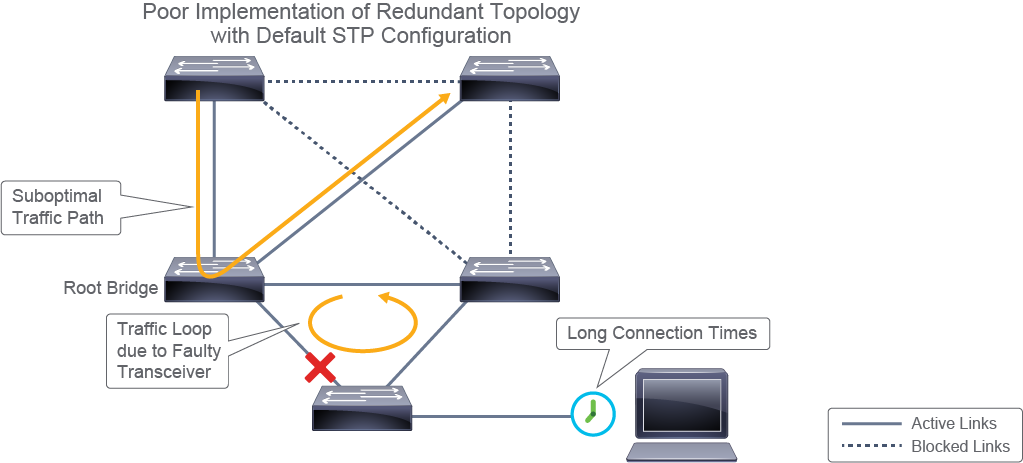
This example illustrates a poorly implemented STP configuration, where a mix of active and blocked links leads to inefficient traffic paths. A network loop has formed due to a faulty transceiver in one of the switches, and suboptimal STP configurations are causing long connection times to the PC, resulting in overall network performance degradation.
這個範例說明了 STP 設定不當的情況:作用中與阻斷中鏈路混雜,導致流量路徑效率不佳。其中一台交換器的收發器故障導致網路形成迴圈,而次佳的 STP 設定又造成連往該 PC 的連線時間過長,使整體網路效能下降。
Have you ever considered what the potential risks and benefits of implementing redundancy in a network are? As a network engineer you must recognize the challenges of implementing redundancy, understand the mechanics of the Spanning Tree Protocol (STP), and effectively apply advanced features to optimize network reliability and performance.
您是否曾經思考過,在網路中導入備援可能帶來哪些風險與效益?身為網路工程師,您必須認清導入備援所面臨的挑戰、理解生成樹協定(STP)的運作機制,並有效運用進階功能來最佳化網路的可靠性與效能。
In this training, you will learn the following:
在本課程中,您將學習以下內容:
- Physical redundancy in a LAN prevents single points of failure.區域網路(LAN)中的實體備援可防止單一故障點。
- Issues in redundant topologies can create traffic bottlenecks and inefficiencies.備援拓樸中的問題可能造成流量瓶頸與效率不彰。
- Spanning Tree Protocol operates to ensure a loop-free network.生成樹協定的運作可確保網路無迴圈。
- Types of Spanning Tree Protocols like STP, Rapid Spanning Tree Protocol (RSTP), and Multiple Spanning Tree Protocol (MSTP) affect network design.STP、快速生成樹協定(RSTP)與多重生成樹協定(MSTP)等不同類型的生成樹協定會影響網路設計。
- PortFast, Bridge Protocol Data Unit (BPDU) guard, and BPDU filter optimize port activation and security.PortFast、橋接協定資料單元(BPDU)防護與 BPDU 過濾可最佳化連接埠啟用與安全性。
- RSTP speeds up network recovery and performance.RSTP 可加快網路復原速度並提升效能。
- STP loop guard and root guard prevent improper data loops and root bridge issues.STP 迴圈防護(loop guard)與根防護(root guard)可防止不當的資料迴圈與根橋接器問題。
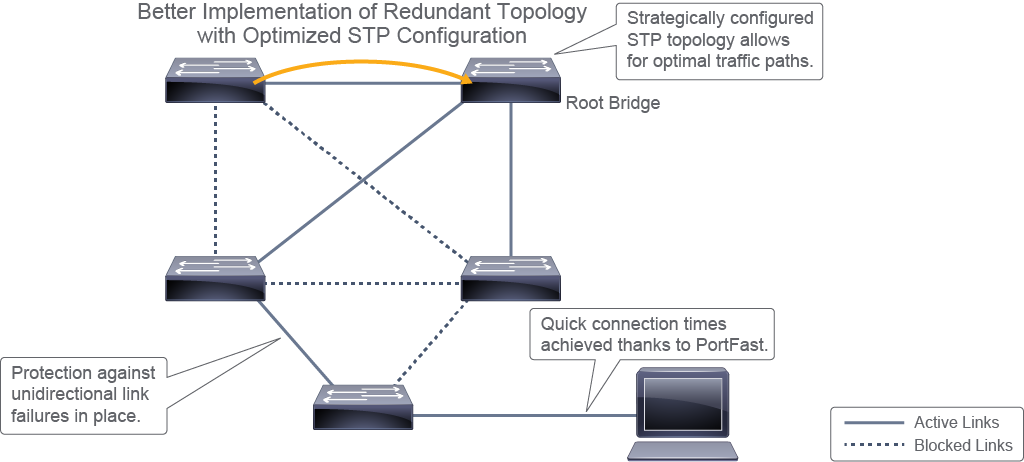
With a thorough understanding of STP and the strategic use of features like PortFast, Root Guard, and Loop Guard, the network can achieve optimal traffic forwarding, faster connection times for hosts, and enhanced stability while effectively preventing potential loops.
只要深入理解 STP,並策略性地運用 PortFast、根防護與迴圈防護等功能,網路就能達到最佳的流量轉送、更快的主機連線時間,並在有效防止潛在迴圈的同時提升穩定性。