With the evolution of networks came two very important concepts. These are the underlay and overlay networks. The underlay network refers to the network as it is physically connected. Routing and traffic forwarding is dependent on the physical topology and routing protocols used between the devices.
隨著網路的演進,出現了兩個非常重要的概念:底層網路(underlay)與覆蓋層網路(overlay)。底層網路指的是網路實際的實體連接方式。路由與流量轉送皆取決於實體拓樸,以及裝置之間所使用的路由協定。
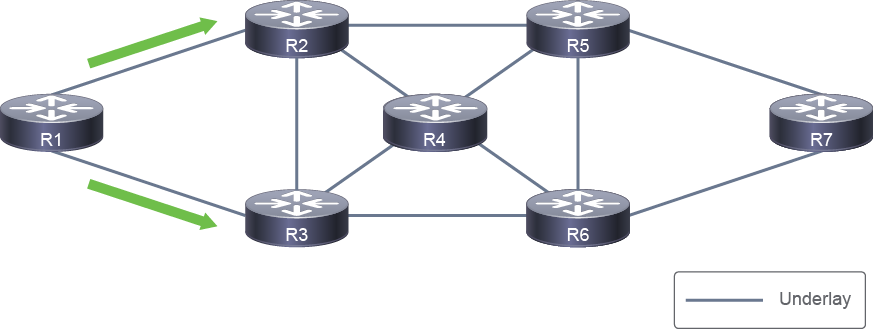
The figure depicts an underlay network topology. In this underlay network, R1 can send packets to R7 by using the routing information in its routing table. In this example, it can forward the packets to either R2 or R3 as the next hop. Each router utilizes the routing information in its routing table to forward the packets to the destination (R7).
此圖描繪了一個底層網路拓樸。在這個底層網路中,R1 可利用其路由表中的路由資訊將封包傳送給 R7。在此範例中,它可將封包轉送至 R2 或 R3 作為下一跳。每台路由器都利用其路由表中的路由資訊,將封包轉送至目的地(R7)。
An overlay network is a virtual network that is built on top of an existing underlay network. An overlay network can be used to hide the specifics of the underlay network, therefore, simplifying the topology. It is important to note that the overlay network depends on having a functioning underlay network. Without a functioning underlay network, traffic cannot be forwarded through an overlay network.
覆蓋層網路是建構在既有底層網路之上的虛擬網路。覆蓋層網路可用來隱藏底層網路的細節,藉此簡化拓樸。值得注意的是,覆蓋層網路必須依賴一個運作正常的底層網路。若底層網路無法正常運作,流量就無法透過覆蓋層網路轉送。
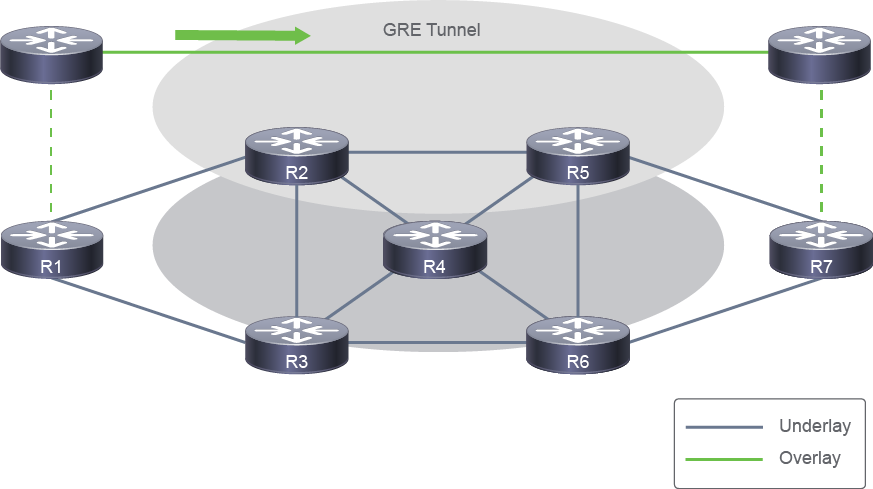
If you configure a Generic Routing Encapsulation (GRE) Tunnel between R1 and R7, this GRE tunnel becomes the virtual network link between both devices. The GRE tunnel between R1 and R7 is the overlay network configured on top of the underlay network. The figure depicts this overlay network. With the GRE tunnel, both R1 and R7 see that they have a direct virtual connection between them. Their routing table information also changes to reflect this. The GRE tunnel becomes a directly connected link that can be used. The GRE tunnel essentially hides the Underlay devices between R1 and R7. However, any packets encapsulated in the GRE tunnel are still sent through the Underlay where the physical connectivity is. Essentially, once traffic is encapsulated in GRE tunnels, it is considered part of the overlay network. Once the traffic is de-encapsulated from the GRE tunnel, it is considered back in the underlay network.
若你在 R1 與 R7 之間設定通用路由封裝(GRE)通道,這個 GRE 通道就會成為兩台裝置之間的虛擬網路鏈路。R1 與 R7 之間的 GRE 通道,就是建構在底層網路之上的覆蓋層網路,如圖所示。有了這個 GRE 通道,R1 與 R7 會看到彼此之間有一條直接的虛擬連線,其路由表資訊也會隨之更新以反映這一點。此 GRE 通道就成為一條可使用的直接連接鏈路。這個 GRE 通道實際上隱藏了 R1 與 R7 之間的底層裝置。然而,任何封裝在 GRE 通道內的封包,仍然會透過底層(實體連接所在之處)傳送。基本上,一旦流量被封裝進 GRE 通道,就會被視為覆蓋層網路的一部分;一旦流量從 GRE 通道解封裝,就會被視為回到底層網路。