On the first LANs, devices with Ethernet connectivity were mostly limited to PCs, file servers, print servers, and legacy devices such as hubs and bridges. Hubs and bridges were replaced by switches and are no longer used.
在最早的 LAN 中,具備乙太網路連線能力的裝置大多僅限於個人電腦、檔案伺服器、列印伺服器,以及集線器、橋接器等舊型裝置。集線器與橋接器已被交換器取代,如今已不再使用。
Today, a typical small office will include routers, switches, access points (APs), servers, IP phones, mobile phones, PCs, and laptops.
如今,典型的小型辦公室會包含路由器、交換器、無線基地台(AP)、伺服器、IP 電話、行動電話、個人電腦與筆記型電腦。
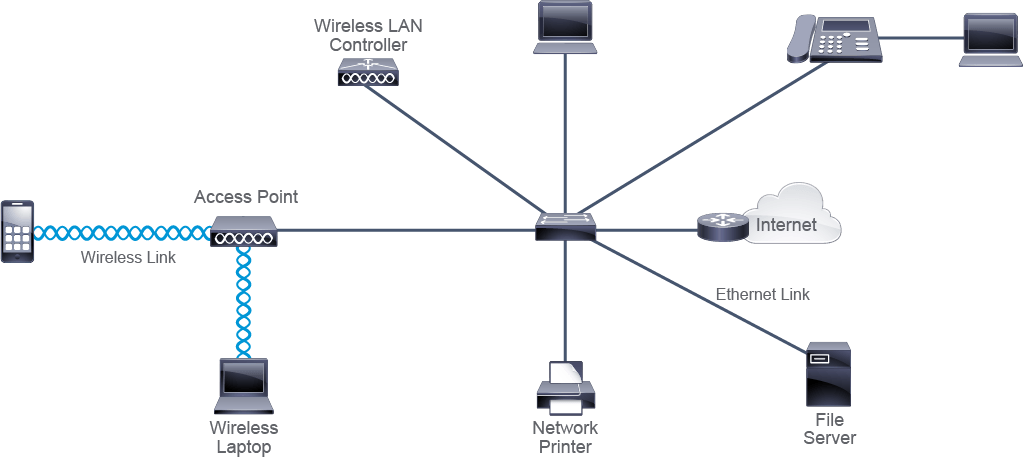
Regardless of its size, a LAN requires these fundamental components for its operation:
不論規模大小,LAN 的運作都需要以下基本元件:
- Hosts: Hosts include any device that can send or receive data on the LAN. Sometimes hosts are also called endpoints. Those two terms are used interchangeably throughout the course.主機:主機是指任何能在 LAN 上傳送或接收資料的裝置。有時主機也稱為端點,本課程中這兩個詞可交替使用。
- Interconnections: Interconnections allow data to travel from one point to another in the network. Interconnections include these components:互連元件:互連元件讓資料能在網路中的兩點之間傳送,包含以下元件:
- Network Interface Cards (NICs): NICs translate the data that is produced by the device into a frame format that can be transmitted over the LAN. NICs connect a device to the LAN over copper cable, fiber-optic cable, or wireless communication.網路介面卡 (NIC):NIC 會將裝置產生的資料轉換成可在 LAN 上傳輸的框架格式。NIC 透過銅纜、光纖纜線或無線通訊,將裝置連接到 LAN。
- Network media: In traditional LANs, data was primarily transmitted over copper and fiber-optic cables. Modern LANs (even small home LANs) generally include a wireless LAN (WLAN).網路傳輸媒介:在傳統 LAN 中,資料主要透過銅纜與光纖纜線傳輸。現代 LAN(即使是小型家用 LAN)通常也包含無線 LAN(WLAN)。
- Network devices: Network devices, like switches and routers, are responsible for data delivery between hosts.網路裝置:交換器、路由器等網路裝置,負責在主機之間傳遞資料。
- Ethernet switches: Ethernet switches form the aggregation point for LANs. Ethernet switches operate at Layer 2 of the Open Systems Interconnection (OSI) model and provide intelligent distribution of frames within the LAN.乙太網路交換器:乙太網路交換器是 LAN 的匯聚點。乙太網路交換器運作於開放系統互連(OSI)模型的第 2 層,並在 LAN 內智慧地分派框架。
- Routers: Routers, sometimes called gateways, provide a means to connect LAN segments and provide connectivity to the internet. Routers operate at Layer 3 of the OSI model.路由器:路由器有時也稱為閘道,提供連接 LAN 區段的方式,並提供對網際網路的連線。路由器運作於 OSI 模型的第 3 層。
- APs: APs provide wireless connectivity to LAN devices. APs operate at Layer 2 of the OSI model.AP:AP 為 LAN 裝置提供無線連線。AP 運作於 OSI 模型的第 2 層。
- Protocols: Protocols are rules that govern how data is transmitted between components of a network. Here are some commonly used LAN protocols:通訊協定:通訊協定是規範網路元件之間資料傳輸方式的規則。以下是一些常見的 LAN 通訊協定:
- Ethernet protocols (IEEE 802.2 and IEEE 802.3)乙太網路協定(IEEE 802.2 與 IEEE 802.3)
- IPIP
- TCPTCP
- UDPUDP
- Address Resolution Protocol (ARP) for IPv4 and Neighbor Discovery Protocol (NDP) for IPv6IPv4 使用的位址解析通訊協定(ARP)與 IPv6 使用的鄰居發現通訊協定(NDP)
- Common Internet File System (CIFS)通用網際網路檔案系統(CIFS)
- DHCPDHCP
Functions of a LAN
LAN 的功能
LANs provide network users with communication and resource-sharing functions:
LAN 為網路使用者提供通訊與資源共用功能:
- Data and applications: When users are connected through a network, they can share files and even software applications. This capability makes data more easily available and promotes more efficient collaboration on work projects.資料與應用程式:使用者透過網路連線後,可以共用檔案,甚至是共用軟體應用程式。這項能力讓資料更容易取得,也能促進工作專案上更有效率的協作。
- Resources: The resources that can be shared include input devices, such as cameras, and output devices, such as printers.資源:可共用的資源包括攝影機等輸入裝置,以及印表機等輸出裝置。
- Communication path to other networks: If a resource is not available locally, the LAN can provide connectivity via a gateway to remote resources, such as the internet.連往其他網路的通訊路徑:若本機沒有所需的資源,LAN 可以透過閘道提供對遠端資源(例如網際網路)的連線。
Which two devices are responsible for forwarding data to endpoint devices based on network information? (Choose two.)下列哪兩種裝置負責根據網路資訊,將資料轉送到端點裝置?(選擇兩項。)