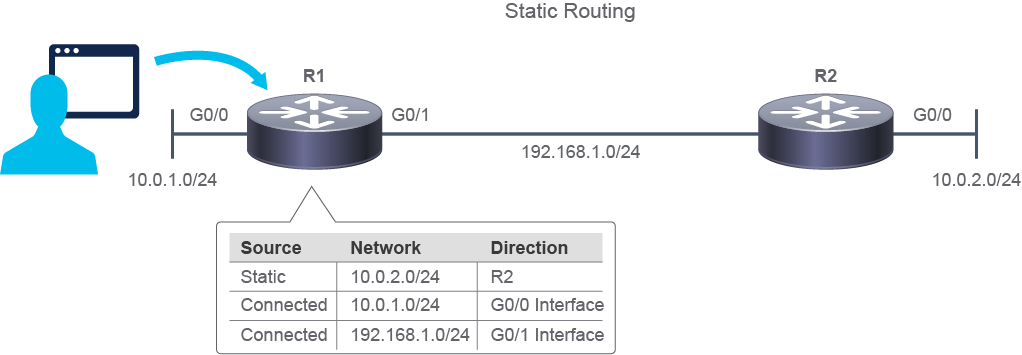
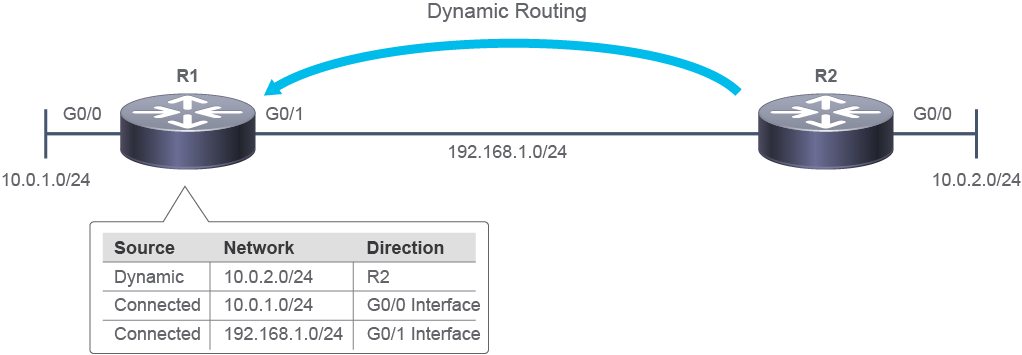
There are two ways that a router can learn where to forward packets to destination networks that are not directly connected:
路由器有兩種方式,可以學到如何將封包轉送到並非直接連接的目的網路:
- Static routing:The router learns routes when an administrator manually configures the static route. The administrator must manually update this static route entry whenever an internetwork topology change requires an update. Static routes are user-defined routes that specify the outgoing interface on the router when packets should be sent to a specific destination. These administrator-defined routes allow a very precise control over the routing behavior of the IP internetwork.靜態路由:當管理員手動設定靜態路由時,路由器就學到該路由。每當網際網路拓樸改變需要更新時,管理員必須手動更新此靜態路由項目。靜態路由是使用者自行定義的路由,用來指定封包在傳送到特定目的地時,路由器要使用的出口介面。這些由管理員定義的路由,可以非常精確地控制 IP 網際網路的路由行為。
- Dynamic routing:The router dynamically learns routes after an administrator configures a routing protocol that determines routes to remote networks. Unlike static routes, after the network administrator enables dynamic routing, the routing process automatically updates the routing table whenever the device receives new topology information. The router learns and maintains routes to the remote destinations by exchanging routing updates with other routers in the internetwork.動態路由:當管理員設定用來判斷通往遠端網路之路由的路由協定後,路由器就會動態學習路由。與靜態路由不同的是,網路管理員啟用動態路由後,只要裝置收到新的拓樸資訊,路由程序就會自動更新路由表。路由器會透過與網際網路中其他路由器交換路由更新,來學習並維護通往遠端目的地的路由。
Which statement about static and dynamic routes is true?關於靜態路由與動態路由,下列哪一項敘述正確?