The growth in data centers and advances in data center technologies have brought on a new approach to network design. The new approach is known as a spine and leaf architecture, or simply spine-leaf. Spine-leaf architecture is a two-tier architecture that resembles Cisco’s original collapsed core design when using the three-tier approach.
資料中心的成長與資料中心技術的進步,帶來了一種新的網路設計方式。這種新方式稱為脊葉架構(spine and leaf architecture),或簡稱脊葉架構(spine-leaf)。脊葉架構是一種兩層式架構,類似 Cisco 採用三層式方法時原本的折疊核心設計。
Communication among the servers in the data center adds a considerable load on networking devices. The data flows of these communications appear horizontal and are said to be of the "east-west" nature. With virtualized servers, applications are increasingly deployed in a distributed way, which leads to increased east-west traffic. Such traffic needs to be handled efficiently, with low and predictable latency.
資料中心內伺服器之間的通訊,為網路裝置帶來相當大的負載。這些通訊的資料流呈水平方向,被稱為具有「東西向」性質。隨著伺服器虛擬化,應用程式日益以分散方式部署,導致東西向流量增加。這類流量需要有效率地處理,並具備低且可預測的延遲。
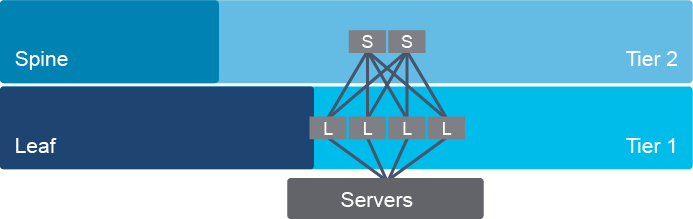
In spine-leaf two-tier architecture, every lower-tier switch (leaf layer) is connected to each of the top-tier switches (spine layer) in a full-mesh topology. The leaf layer consists of access switches that connect to devices such as servers. The spine layer is the backbone of the network and is responsible for interconnecting all leaf switches. Every leaf switch connects to every spine switch. Typically a Layer 3 network is established between leaves and spines, so all the links can be used simultaneously.
在脊葉兩層式架構中,每台較低層的交換器(葉層)都以全網狀拓樸連接到每台最上層交換器(脊層)。葉層由連接伺服器等裝置的存取交換器組成。脊層是網路的骨幹,負責互連所有葉層交換器。每台葉層交換器都會連接到每台脊層交換器。通常在葉層與脊層之間會建立第 3 層網路,讓所有鏈路都能同時使用。
The path between leaf and spine switches is randomly chosen so that the traffic load is evenly distributed among the top-tier switches. If one of the top-tier switches were to fail, it would only slightly degrade performance throughout the data center. If oversubscription of a link occurs (that is, if more traffic is generated than can be aggregated on the active link at one time), the process for expanding the network is straightforward. An extra spine switch can be added, and uplinks can be extended to every leaf switch, resulting in the addition of interlayer bandwidth and reduction of the oversubscription. If device port capacity becomes a concern, a new leaf switch can be added by connecting it to every spine switch.
葉層與脊層交換器之間的路徑是隨機選擇的,讓流量負載能平均分散在最上層的交換器之間。若其中一台最上層交換器故障,只會讓整個資料中心的效能略微下降。若某條鏈路發生超額認購(即某一時間內產生的流量超過該作用中鏈路可彙整的量),擴充網路的方式也相當直接:可新增一台脊層交換器,並將上行鏈路延伸至每台葉層交換器,藉此增加層間頻寬並降低超額認購的情形。若裝置連接埠容量成為疑慮,也可透過將新葉層交換器連接到每台脊層交換器來新增葉層交換器。
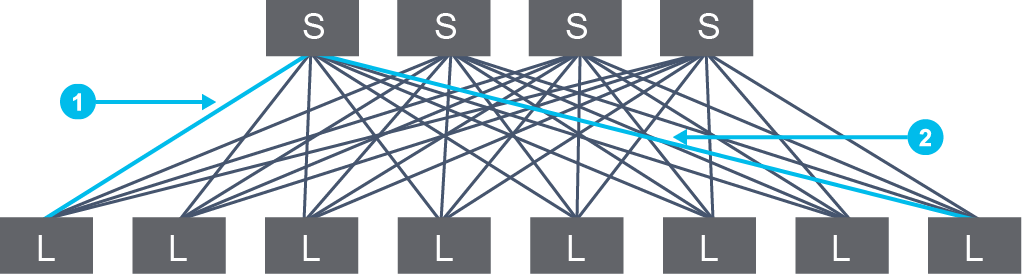
With a spine-leaf architecture, the traffic between two leaves always crosses the same number of devices (unless communicating devices are located on the same leaf.) This approach keeps latency at a predictable level because a payload only has to hop to a spine switch and another leaf switch to reach its destination.
在脊葉架構中,兩台葉層交換器之間的流量,永遠會經過相同數量的裝置(除非通訊裝置位於同一台葉層交換器)。這種方式讓延遲維持在可預測的水準,因為承載資料只需跳到一台脊層交換器與另一台葉層交換器,即可到達目的地。
A spine-leaf approach allows architects to build a network that can expand and collapse (be more elastic) as needed, meaning that components (servers, switches, and ports) can be added dynamically as the load of applications grows. This elastic approach suits data centers that host applications that are distributed across many hosts—with hosts being dynamically added as the solution grows.
脊葉方式讓架構師能建置可依需求擴充與收縮(更具彈性)的網路,也就是說,可依應用程式負載的成長,動態新增元件(伺服器、交換器與連接埠)。這種彈性方式適合用來承載分散於多台主機的應用程式,並隨著解決方案成長而動態新增主機的資料中心。
This approach is beneficial for topologies where end devices are relatively close together and where fast scaling is necessary, such as modern data centers.
這種方式適用於終端裝置彼此相對靠近、且需要快速擴充的拓樸,例如現代資料中心。
A main concern that the spine-leaf model addresses is the addition of new leaf (access) layer switches and the redundant cross-connections that are needed for a scalable data center. It has been estimated that a spine-leaf model allows for 25-percent greater scalability over a three-tier model when used for data center designs.
脊葉模型所解決的主要問題,是新增葉(存取)層交換器,以及可擴充資料中心所需的備援交叉連接。據估計,用於資料中心設計時,脊葉模型比三層式模型可提供高出 25% 的可擴充性。
The spine-leaf design has these additional benefits for a modern data center:
脊葉設計為現代資料中心帶來以下額外優點:
- Increased scale within the spine to create equal-cost multipaths from leaf to spine增加脊層內部的規模,以在葉層與脊層之間建立等成本多路徑
- Support for higher performance switches and higher speed links (10-Gigabits per second [Gbps], 25-Gbps, 40-Gbps, and 100-Gbps)支援效能更高的交換器與更高速的鏈路(每秒 10 GB [Gbps]、25 Gbps、40 Gbps 與 100 Gbps)
- Reduced network congestion by isolating traffic and VLANs on a leaf-by-leaf basis透過在每台葉層交換器上隔離流量與 VLAN,降低網路壅塞
- Optimization and control of east-west traffic flows優化並控制東西向流量