The Cisco Enterprise Architecture model recognizes several functional areas of a network and provides a network module to support these functions. Failures within a module are isolated from the rest of the network. Changes and upgrades can be applied to particular modules and implemented in a controlled manner. Network services, such as security and QoS, are also implemented on a modular basis.
Cisco 企業架構模型識別出網路中的幾個功能區域,並提供支援這些功能的網路模組。某個模組內的故障會與網路其他部分隔離。變更與升級可套用到特定模組,並以受控方式實作。安全性與 QoS 等網路服務,也是以模組化方式實作。
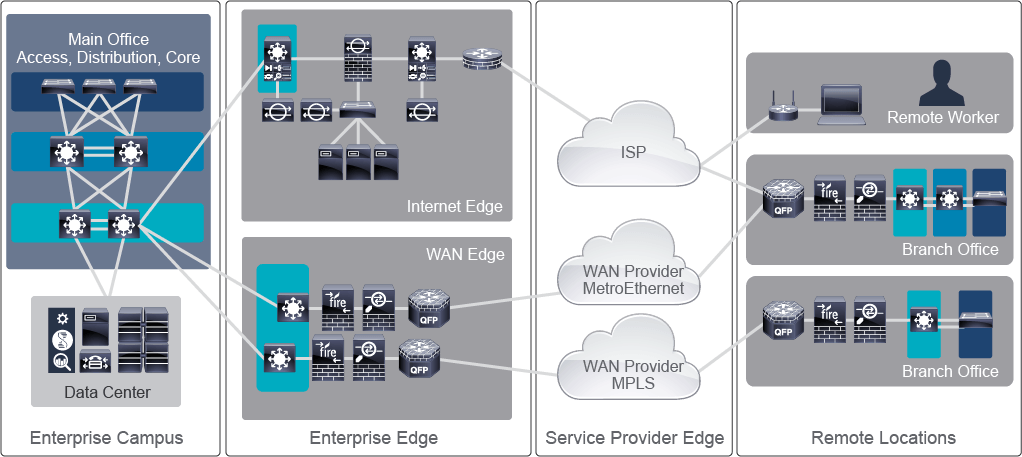
The following modules make up the Cisco Enterprise Architecture:
以下模組組成 Cisco 企業架構:
- Enterprise Campus: A campus network spans a fixed geographic area. It consists of a building or a group of buildings connected into one network, which consists of many network segments. An example of a campus network is a university campus, or an industrial complex. The enterprise campus module follows the three-tier architecture with access, distribution, and core tiers, but it includes network services, normally inside a data center submodule. The data center submodule centralizes server resources that provide services to internal users, such as application, file, email, and Domain Name System (DNS) servers. It typically supports network management services for the enterprise, including monitoring, logging, and troubleshooting. Inside the data center submodule, the architecture is spine-leaf.企業園區(Enterprise Campus):園區網路涵蓋固定的地理區域。它由一棟建築或一組建築連接成一個網路,其中包含許多網路區段。園區網路的例子包括大學校園或工業園區。企業園區模組遵循存取、分佈、核心三層式架構,但也包含網路服務,通常位於資料中心子模組內。資料中心子模組集中管理伺服器資源,為內部使用者提供應用程式、檔案、電子郵件與網域名稱系統(DNS)伺服器等服務。它通常也支援企業的網路管理服務,包括監控、記錄與疑難排解。在資料中心子模組內,其架構為脊葉架構。
- Enterprise Edge: The enterprise edge module provides the connectivity outside the enterprise. This module often functions as an intermediary between the enterprise campus module, to which it connects via its core, and other modules. It can contain submodules that provide internet connectivity to one or more ISPs, termination for remote access and site-to-site VPN, WAN connectivity via purchased WAN services (Multiprotocol Label Switching [MPLS], Metro Ethernet, Synchronous Optical Network [SONET], and so on).企業邊緣(Enterprise Edge):企業邊緣模組提供企業外部的連線能力。此模組通常作為企業園區模組(透過其核心層連接)與其他模組之間的中介。它可包含提供與一或多個 ISP 連線的子模組、遠端存取與站對站 VPN 的終止點,以及透過採購的 WAN 服務(多重協定標籤交換 [MPLS]、Metro Ethernet、同步光纖網路 [SONET] 等)提供的 WAN 連線。
- Service Provider Edge: A module that provides connectivity between the enterprise main site and its remote locations. This module’s functions and features are determined by the service agreements between the enterprise and the providers.服務供應商邊緣(Service Provider Edge):此模組提供企業主要站點與其遠端據點之間的連線。此模組的功能與特性,取決於企業與供應商之間的服務協議。
- Remote Locations: A module that represents geographically distant parts of the enterprise network, such as branch offices, a teleworker’s network, or a remote data center.遠端據點(Remote Locations):此模組代表企業網路中地理上較遠的部分,例如分公司、遠距工作者的網路,或遠端資料中心。
Match the module of the Cisco Enterprise Architecture Model with its corresponding description.請將 Cisco 企業架構模型中的模組,與其對應的描述配對。
| A module that provides connectivity for enterprise LAN internal users and to a specialized service or data center area為企業 LAN 內部使用者提供連線,並連接到專屬服務或資料中心區域的模組 | Enterprise Campus企業園區 |
| A module that is concerned with connectivity to and from outside networks負責與外部網路之間連線的模組 | Enterprise Remote Locations企業遠端據點 |
| A module that represents WAN and ISP functionalities代表 WAN 與 ISP 功能的模組 | Service Provider Edge服務供應商邊緣 |
| A module that encompasses branch offices, teleworkers, and backup data centers涵蓋分公司、遠距工作者與備援資料中心的模組 | Enterprise Edge企業邊緣 |