A WAN is a data communications network that operates beyond the geographic scope of a LAN. To implement a WAN, enterprises use the facilities of service providers or carriers, such as a telephone or cable company. The provider interconnects enterprises own locations, and connects it to locations of other enterprises, to external services, and to remote users. WANs carry various traffic types such as voice, data, and video.
WAN 是一種資料通訊網路,其運作範圍超出 LAN 的地理範圍。企業要建置 WAN,通常會使用服務供應商或電信業者(例如電話公司或有線電視公司)所提供的設施。供應商會將企業各自的據點互連,並將其連接到其他企業的據點、外部服務以及遠端使用者。WAN 可承載語音、資料與視訊等各種類型的流量。
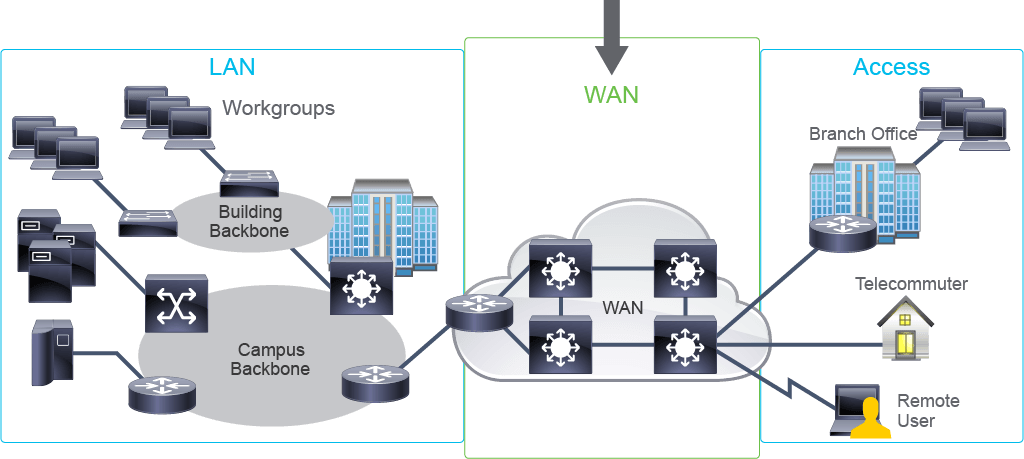
WANs have three major characteristics:
WAN 有三項主要特性:
- WANs generally connect devices that are separated by a broader geographic area than a LAN can serve.WAN 通常連接的裝置,彼此之間的地理距離比 LAN 所能涵蓋的範圍更廣。
- WANs use the services of carriers such as telephone companies, cable companies, satellite systems, and network providers.WAN 使用電話公司、有線電視公司、衛星系統與網路供應商等電信業者所提供的服務。
- WANs use connections of various types to provide access to bandwidth over large geographic areas.WAN 使用各種類型的連線,以在廣大的地理範圍內提供頻寬存取。
WAN operations focus primarily on the physical layer (Open Systems Interconnection [OSI] Layer 1) and the data link layer (OSI Layer 2), and MPLS transport (between Layer 2 and Layer 3). WAN access standards typically describe both physical layer delivery methods and data link layer requirements. The data link layer requirements include physical addressing, flow control, and encapsulation.
WAN 運作主要著重於實體層(開放系統互連〔OSI〕第 1 層)與資料鏈結層(OSI 第 2 層),以及位於第 2 層與第 3 層之間的 MPLS 傳輸。WAN 存取標準通常同時說明實體層的傳輸方式與資料鏈結層的需求。資料鏈結層的需求包括實體定址、流量控制與封裝。
WAN access standards are defined and managed by several recognized authorities; among them are the EIA/TIA, ISO, and IEEE.
WAN 存取標準是由多個公認的機構制定與管理,其中包括 EIA/TIA、ISO 與 IEEE。
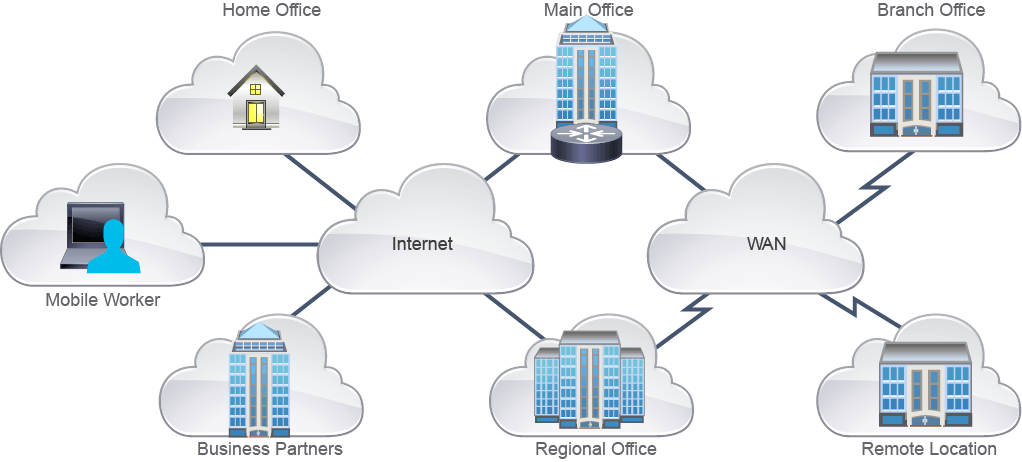
LAN technologies provide high-speed and cost efficiency for the transmission of data in organizations but only in relatively small geographic areas. Businesses require communication with distant sites, provided by a WAN, for several reasons including:
LAN 技術能在相對較小的地理範圍內,為組織的資料傳輸提供高速且具成本效益的解決方案。企業之所以需要 WAN 提供的遠距通訊,原因包括:
- People and processes in the enterprise’s regional and branch offices exchange and share data.企業區域辦公室與分公司的人員與流程需要交換與共享資料。
- Enterprises often share information with other organizations across large distances.企業經常需要與其他組織跨越遙遠的距離共享資訊。
- Employees who travel or work from remote sites frequently need to access information that resides on their corporate networks—that is, they need access to centrally located applications and services.經常出差或在遠端據點工作的員工,需要存取其公司網路上的資訊,也就是說,他們需要存取集中管理的應用程式與服務。
- Applications and services used by employees can be hosted in the cloud.員工使用的應用程式與服務可能是託管在雲端上。
WANs may provide high bandwidth over long distances across complex physical networks, often with performance guarantees. WANs are very different than LANs; maintenance costs increase with longer distances. To guarantee performance, the network should recover from faults very quickly, the signal quality and bit-error rates must be kept under control, and bandwidth should be carefully managed. Therefore, many technologies and standards were developed specifically to meet WAN requirements.
WAN 能在複雜的實體網路上,於長距離之間提供高頻寬,且通常附帶效能保證。WAN 與 LAN 有很大差異:距離越長,維護成本就越高。為了保證效能,網路必須能迅速從故障中恢復,訊號品質與位元錯誤率必須受到控制,頻寬也必須妥善管理。因此,業界特別為滿足 WAN 需求而開發了許多技術與標準。
For many enterprises, it is not feasible to build their own infrastructure to connect computers across a country or around the world, in the same way they would do for a LAN. Therefore, they use the existing WAN technologies and resources to fulfill this need. Nevertheless, the cost of the network and its related services is a significant expense. Increasingly, the internet is being used as an inexpensive alternative to an enterprise WAN for some applications.
對許多企業而言,要像建置 LAN 那樣,自行建置跨國甚至跨全球的基礎架構是不切實際的。因此,企業會使用現有的 WAN 技術與資源來滿足這項需求。然而,網路本身及其相關服務的成本仍是一筆可觀的支出。越來越多情況下,網際網路正被當作企業 WAN 的低成本替代方案,用於部分應用程式。
When a WAN service provider receives data from a client site, it must forward the data to the remote site for final delivery to the recipient. Sometimes, the remote site may be connected to the same service provider as the originating site, but it is not always the case. If providers are not the same, the originating provider must pass the data to the destination provider, through provider interconnections.
當 WAN 服務供應商從客戶據點收到資料時,必須將資料轉送到遠端據點,以完成向收件者的最終傳遞。有時候,遠端據點可能與原始據點使用同一家服務供應商,但情況並非總是如此。如果供應商不同,原始供應商就必須透過供應商之間的互連,將資料傳遞給目的地供應商。
WAN service providers use several different technologies to connect their subscribers. The connection type that is used may not be the same as one service provider employs inside its own network or the one it uses to connect to other service providers.
WAN 服務供應商會使用多種不同技術來連接其用戶。所使用的連線類型,可能與服務供應商在自身網路內部所採用的類型,或是用來連接其他服務供應商的類型並不相同。