Switches have become a fundamental part of most networks. LAN switches have special characteristics that make them effective in alleviating network congestion by increasing effective network bandwidth.
交換器已成為大多數網路中不可或缺的一部分。LAN 交換器具備特殊的特性,能透過提升有效網路頻寬,有效緩解網路壅塞。
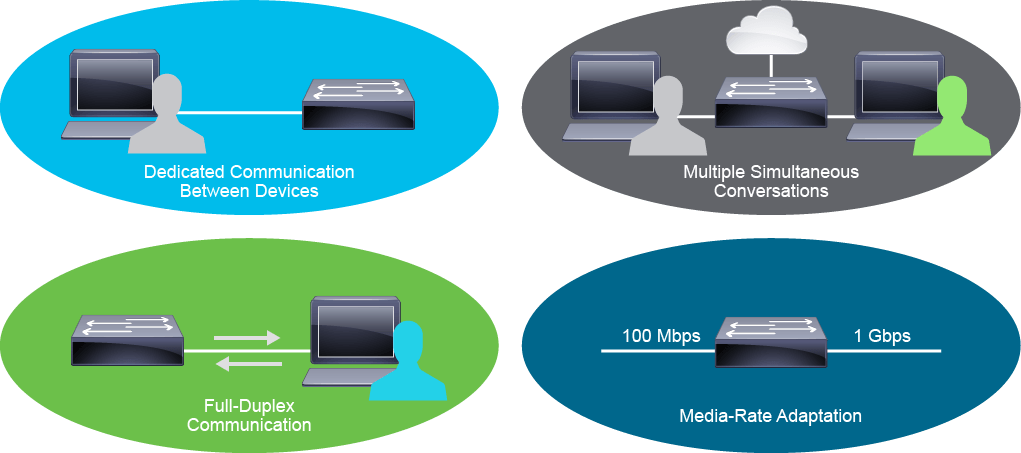
Switches provide the following important functions, resulting in even greater benefits for eliminating network congestion:
交換器提供以下重要功能,能為消除網路壅塞帶來更大的益處:
- Dedicated communication between devices: This increases frame throughput. Switches with one user device per port have microsegmented the network. In this type of configuration, each user receives access to the full bandwidth and does not have to contend with other users for available bandwidth. As a result, collisions do not occur.裝置之間的專屬通訊:這能提升框架吞吐量。每個連接埠僅連接一台使用者裝置的交換器,會將網路進行微區段化。在這種設定下,每位使用者都能取得完整頻寬,不必與其他使用者爭用可用頻寬,因此不會發生碰撞。
- Multiple simultaneous conversations: Multiple simultaneous conversations can occur by forwarding or switching several packets at the same time, increasing network capacity by the number of conversations that are supported. For example, when frames are being forwarded between ports 1 and 2, another conversation can be happening between ports 5 and 6. This multiplication is possible because of input/output (I/O) buffers and fast internal transfer speeds between ports. A switch that can support all possible combinations of frame transfers between all ports simultaneously offers wire-speed and nonblocking performance. Of course, this class of switch is relatively expensive.多組同時進行的通訊:透過同時轉送或交換多個封包,可以同時進行多組通訊,並依所支援的通訊組數增加網路容量。舉例來說,當框架正在連接埠 1 與連接埠 2 之間轉送時,連接埠 5 與連接埠 6 之間也可以同時進行另一組通訊。這種倍增效果之所以可行,是因為輸入╱輸出(I/O)緩衝區以及連接埠之間快速的內部傳輸速率。若一台交換器能同時支援所有連接埠之間所有可能組合的框架傳輸,即可提供線速(wire-speed)且無阻塞的效能。當然,這類交換器價格相對昂貴。
- Full-duplex communication: After a connection is microsegmented, it has only two devices (the switch and the host). It is now possible to configure the ports so they can both receive and send data at the same time, which is called full-duplex communication. For example, point-to-point 100-Mbps connections have 100 Mbps of transmission capacity and 100 Mbps of receiving capacity for an effective 200-Mbps capacity on a single connection. The configuration between half duplex and full duplex is automatically negotiated at the initial establishment of the link connection. Half duplex means that there is a transmission of data in just one direction at a time.全雙工通訊:連線經過微區段化後,只剩下兩個裝置(交換器與主機)。此時就可以將連接埠設定為能同時接收與傳送資料,這稱為全雙工通訊。舉例來說,點對點的 100 Mbps 連線,具有 100 Mbps 的傳送容量與 100 Mbps 的接收容量,在單一連線上有效容量可達 200 Mbps。半雙工與全雙工之間的設定,會在連結建立之初自動協商。半雙工是指同一時間只能朝一個方向傳送資料。
- Media-rate adaptation: A LAN switch with ports supporting various media rates can adapt between different speeds, such as 10, 100, and 1000 Mbps; 1 and 10 Gbps; 1, 10, and 25 Gbps; as well as 40 and 100 Gbps. This adaptability allows bandwidth to be matched as needed. Without this ability, it is not possible to have different media-rate ports that are operating at the same time.媒介速率調整:連接埠支援多種媒介速率的 LAN 交換器,能在不同速率之間調整,例如 10、100、1000 Mbps;1 與 10 Gbps;1、10 與 25 Gbps;以及 40 與 100 Gbps。這種調整能力可依需求配合頻寬。若沒有這項能力,就無法讓不同媒介速率的連接埠同時運作。
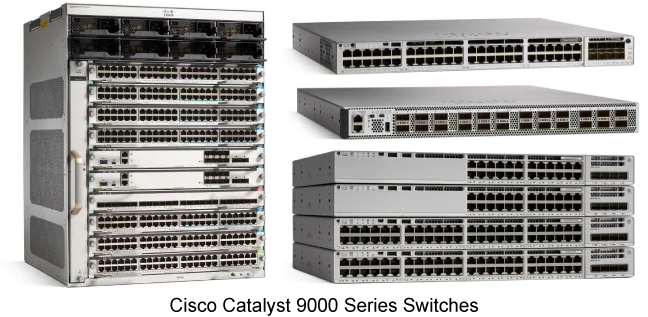
Switches connect LAN segments, determine the segment to send the data, and reduce network traffic. Some important characteristics of switches:
交換器連接 LAN 區段、決定資料要傳送到哪個區段,並降低網路流量。交換器的一些重要特性:
- High port density: Switches have high port densities: 24-, 32-, and 48-port switches operate at speeds of 100 Mbps, 1 Gbps, 10 Gbps, 25 Gbps, 40 Gbps, and 100 Gbps. Large enterprise switches may support hundreds of ports.高連接埠密度:交換器具有高連接埠密度:24、32 與 48 埠交換器,可運作於 100 Mbps、1 Gbps、10 Gbps、25 Gbps、40 Gbps 與 100 Gbps 等速率。大型企業交換器可能支援數百個連接埠。
- Large frame buffers: The ability to store more received frames before having to start dropping them is useful, particularly when there may be congested ports connected to servers or other heavily used parts of the network.大型框架緩衝區:在必須開始丟棄框架之前,能夠儲存更多收到的框架,這項能力相當實用,尤其是在連接到伺服器或網路中其他高使用率部分的連接埠可能發生壅塞時。
- Port speed: Depending on the switch, port speed may be possible to support a range of bandwidths. Ports of 100 Mbps, 1Gbps, and 10 Gbps are expected, but 40- or 100-Gbps ports allow even more flexibility.連接埠速率:依交換器不同,連接埠速率可能可以支援一系列頻寬。100 Mbps、1 Gbps 與 10 Gbps 的連接埠很常見,而 40 或 100 Gbps 連接埠則能提供更高的彈性。
- Fast internal switching: Having fast internal switching allows higher bandwidths: 100 Mbps, 1 Gbps, 10 Gbps, 25 Gbps, 40 Gbps, and 100 Gbps.快速的內部交換:具備快速內部交換能力,可支援更高的頻寬:100 Mbps、1 Gbps、10 Gbps、25 Gbps、40 Gbps 與 100 Gbps。
- Low per-port cost: Switches provide high port density at a lower cost. For this reason, LAN switches can accommodate network designs that feature fewer users per segment. This feature, therefore, increases the average available bandwidth per user.較低的單埠成本:交換器能以較低成本提供高連接埠密度。因此,LAN 交換器能配合每個區段使用者較少的網路設計。這項特性因而提升了每位使用者的平均可用頻寬。
Switches use ASICs, which are fundamental to how an Ethernet switch works. An ASIC is a silicon microchip designed for a specific task (such as switching or routing packets) rather than general-purpose processing such as a CPU. A generic CPU is too slow for forwarding traffic in a switch. While a general-purpose CPU may be fast at running a random application on a laptop or server, manipulating and forwarding network traffic is a different matter. Traffic handling requires constant lookups against large memory tables.
交換器使用特殊應用積體電路(ASIC),這是乙太網路交換器運作方式的核心。ASIC 是一種為特定工作(例如交換或路由封包)而設計的矽晶片,不同於 CPU 那種通用處理器。一般用途的 CPU 對於交換器中的流量轉送來說太慢了。雖然通用 CPU 在筆記型電腦或伺服器上執行隨機應用程式時可能相當快速,但處理與轉送網路流量卻是另一回事。流量處理需要不斷查詢龐大的記憶體表格。