The TCP/IP model represents a protocol suite. It is similar to the ISO OSI model in that it uses layers to organize protocols and explain which functions they perform. TCP/IP protocols are actively used in actual networks today.
TCP/IP 模型代表一個協定套組。它與 ISO OSI 模型相似,都是以分層的方式來組織協定,並說明各協定所執行的功能。TCP/IP 協定在現今的實際網路中被廣泛使用。
The TCP/IP model defines and describes requirements for the implementation of host systems. These include standard protocols that these systems should use. It does not specify how to implement the protocol functions but rather provides guidance for vendors, implementors, and users of what should be provided within the system.
TCP/IP 模型定義並描述主機系統實作的需求,其中包括這些系統應使用的標準協定。它並不規定協定功能該如何實作,而是為廠商、實作者與使用者提供指引,說明系統內應提供哪些內容。
The TCP/IP protocol suite has four layers and includes many protocols, although its name stands for only two: TCP, which stands for the Transmission Control Protocol, and IP, which stands for the Internet Protocol. The reason is that layers represented by these two protocols carry out functions crucial to successful network communication.
TCP/IP 協定套組有四層,並包含許多協定,但它的名稱只代表其中兩個:TCP,即傳輸控制協定(Transmission Control Protocol);以及 IP,即網際網路協定(Internet Protocol)。原因在於這兩個協定所代表的層,執行了網路通訊成功與否的關鍵功能。
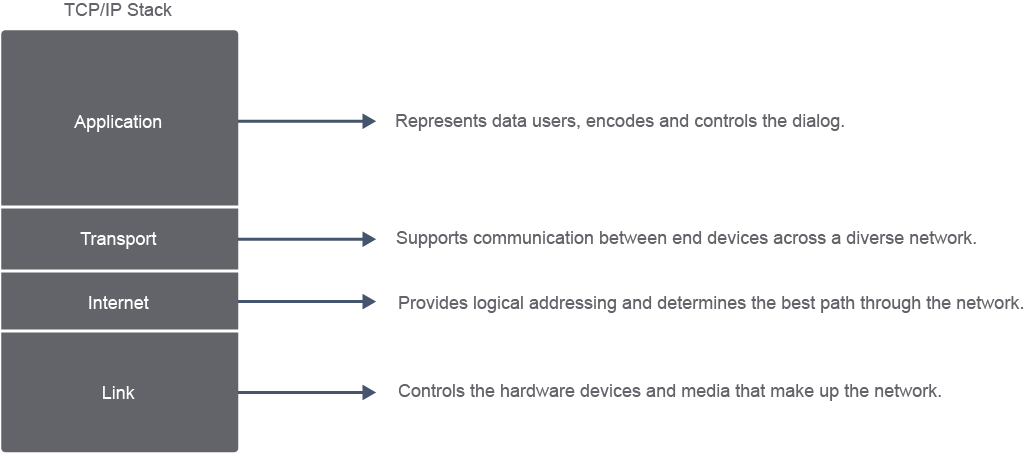
Look at the four layers of the TCP/IP model:
來看看 TCP/IP 模型的四層:
- Link layer: This layer is also known as the media access layer. It defines protocols used to interface the directly connected network. Tasks of the protocols at this layer are closely related to the characteristics of the physical medium and deal primarily with physical network details. The link layer is also referred to as a network interface, network access, or even data link layer. Because there are many different types of physical networks, there are many link layer protocols. An example of the TCP/IP link layer protocol is Ethernet. The link layer introduces physical addresses, sometimes called hardware addresses or MAC addresses, to identify devices sharing a particular physical network segment.鏈結層:這一層也稱為媒介存取層。它定義用來與直接相連網路介接的協定。這一層協定的工作與實體媒介的特性密切相關,主要處理實體網路的細節。鏈結層也被稱為網路介面層、網路存取層,甚至資料鏈結層。由於實體網路的類型繁多,鏈結層協定也有很多種。TCP/IP 鏈結層協定的一個例子是乙太網路(Ethernet)。鏈結層引入實體位址(有時稱為硬體位址或 MAC 位址),用來識別共用同一實體網路區段的裝置。
- Internet layer:This layer routes data from the source to the destination, provides a means to obtain information on reaching other networks and deals with reporting errors. The Internet layer provides logical addressing. Logical addressing helps ensure that a host is uniquely identified. An Internet layer logical address, called an IP address, is used to identify a host. This address is valid globally and aims at uniquely identifying the host. End devices, such as laptops, mobile phones, and servers are configured with a logical address before connecting to the network. IP protocols—namely, IPv4 and the newer version, IPv6"reside in this layer. This layer serves the upper transport layer and passes information to the Link layer.網際網路層:這一層將資料從來源端路由至目的端,提供取得如何到達其他網路之資訊的方法,並負責回報錯誤。網際網路層提供邏輯定址。邏輯定址有助於確保主機能被唯一識別。網際網路層的邏輯位址稱為 IP 位址,用來識別主機。這個位址在全球範圍內有效,目的是唯一識別該主機。筆記型電腦、行動電話與伺服器等終端裝置在連上網路之前,會先設定邏輯位址。IP 協定,也就是 IPv4 與較新的版本 IPv6,位於這一層。這一層為上方的傳輸層提供服務,並將資訊傳遞給鏈結層。
- Transport layer:This layer is the core of the TCP/IP architecture and the Internet layer. It is placed between "data mover" protocols of the link and internet layers and software-oriented protocols of the application layer. There are two main protocols at this layer, TCP and UDP. These protocols serve many application-layer protocols. Transport services "prepare" application data for transfer over the network, follow the transfer process, and ensure that data from different applications is not mixed. To distinguish between the applications, the transport layer identifies each application with its own addressing. This addressing is valid locally, within one host, unlike addressing at the Internet layer, which is valid globally.傳輸層:這一層與網際網路層同為 TCP/IP 架構的核心。它位於鏈結層與網際網路層的「資料搬運」協定,以及應用層的軟體導向協定之間。這一層有兩個主要協定:TCP 與 UDP。這些協定為許多應用層協定提供服務。傳輸服務會「準備」應用程式資料以便透過網路傳輸、追蹤傳輸過程,並確保來自不同應用程式的資料不會混在一起。為了區分各個應用程式,傳輸層以自己的定址方式識別每個應用程式。與網際網路層在全球範圍內有效的定址不同,這種定址只在單一主機內部有效。
- Application layer:The functions of this layer mainly deal with user interaction. It supports user applications by providing protocols and services that let you actually use the network. It also supports network application programming interfaces (APIs) that allow programs to access the network services, regardless of the operating system that they are running on. This layer accommodates protocols such as HTTP, HTTPS, Domain Name System (DNS), FTP, Simple Mail Transfer Protocol (SMTP), Secure Shell (SSH), and many more. These protocols facilitate applications for web browsing, file transfer, names to IP addresses resolution, sending of emails, remote access to devices, and many other functions that network users perform.應用層:這一層的功能主要處理使用者互動。它藉由提供協定與服務來支援使用者應用程式,讓你能夠實際使用網路。它也支援網路應用程式介面(API),讓程式不論在哪種作業系統上執行,都能存取網路服務。這一層容納的協定包括 HTTP、HTTPS、網域名稱系統(DNS)、FTP、簡易郵件傳輸協定(SMTP)、安全殼層(SSH)等。這些協定支援網頁瀏覽、檔案傳輸、名稱到 IP 位址的解析、電子郵件寄送、遠端存取裝置,以及網路使用者執行的許多其他功能。