Introduction
簡介
Picture yourself guiding someone through a maze. You give instructions such as, "Turn left at the first intersection, then right at the second one." This procedure is like static routing in networking, where a network engineer manually sets specific paths for data packets to follow through a network.
想像你正在引導某人走出迷宮,你會給出「在第一個路口左轉,再到第二個路口右轉」這類指示。這個過程就像網路中的靜態路由,網路工程師會手動為資料封包在網路中設定特定的路徑。
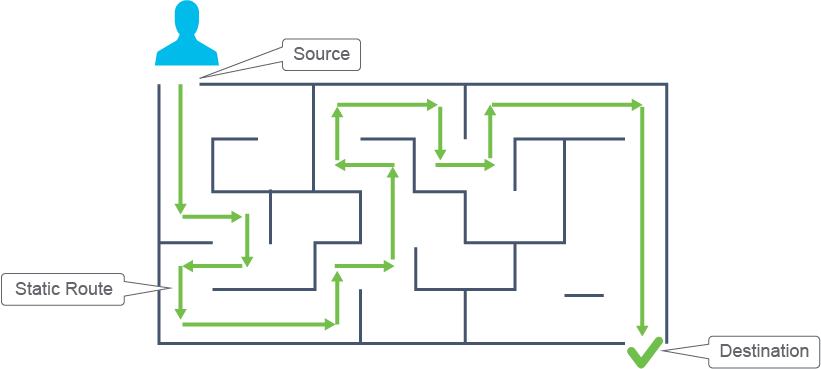
Static routes are similar to giving set directions to a person navigating a maze. The figure shows how a data packet is guided step by step until it reaches its destination.
靜態路由就像是為在迷宮中前進的人提供固定的方向指引。圖中顯示資料封包如何一步步被引導,直到抵達目的地。
However, static routing has the following drawbacks, especially in large or changing networks:
然而,靜態路由在大型或不斷變化的網路中,有以下缺點:
- As the network gets bigger, managing directions becomes more complex.隨著網路規模擴大,管理方向指引會變得更加複雜。
- Each new path needs new directions, making it labor-intensive and hard to maintain.每一條新路徑都需要新的方向指引,既費力又難以維護。
- If the network changes, the original directions become useless, requiring time-consuming manual updates.若網路發生變化,原本的方向指引就會失效,需要耗時的手動更新。
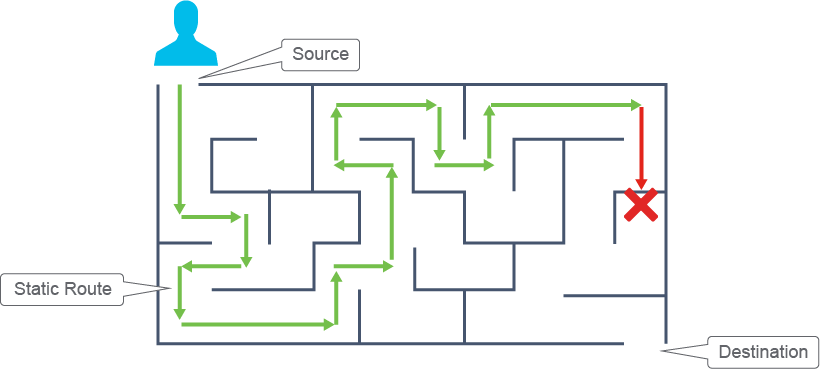
This figure shows how a change in the maze's shape (network topology) affects the efficiency of predefined directions (static routes). Therefore, static routes are great for simple scenarios with consistent route behavior, but are not well suited for dynamic or evolving networks.
此圖顯示迷宮形狀(網路拓樸)的改變如何影響預先設定方向(靜態路由)的效率。因此,靜態路由很適合路由行為一致的簡單情境,但不適合動態或不斷演變的網路。
Still, static routing is useful in the following situations:
儘管如此,靜態路由在下列情況仍然十分實用:
- It's simple and efficient for small, uncomplicated networks with few paths.對於路徑較少、結構簡單的小型網路而言,靜態路由既簡單又有效率。
- Static routes offer more security since they are fixed and not vulnerable to route hijacking or incorrect updates.靜態路由較不容易受到路由劫持或錯誤更新的影響,因此提供了更高的安全性。
- It ensures consistent routing behavior, which is helpful for enforcing specific paths due to policy or performance reasons.它能確保一致的路由行為,有助於因政策或效能考量而強制執行特定路徑。
Are you ready to learn about configuring static routes?
準備好學習如何設定靜態路由了嗎?
After you finish this course, you will be able to:
完成本課程後,你將能夠:
- Grasp the fundamental concepts and operations of static routing.掌握靜態路由的基本概念與運作方式。
- Configure and verify static routes in both IPv4 and IPv6 networks.在 IPv4 與 IPv6 網路中設定並驗證靜態路由。
- Identify appropriate scenarios for using static routing over dynamic routing.辨識適合使用靜態路由而非動態路由的情境。